
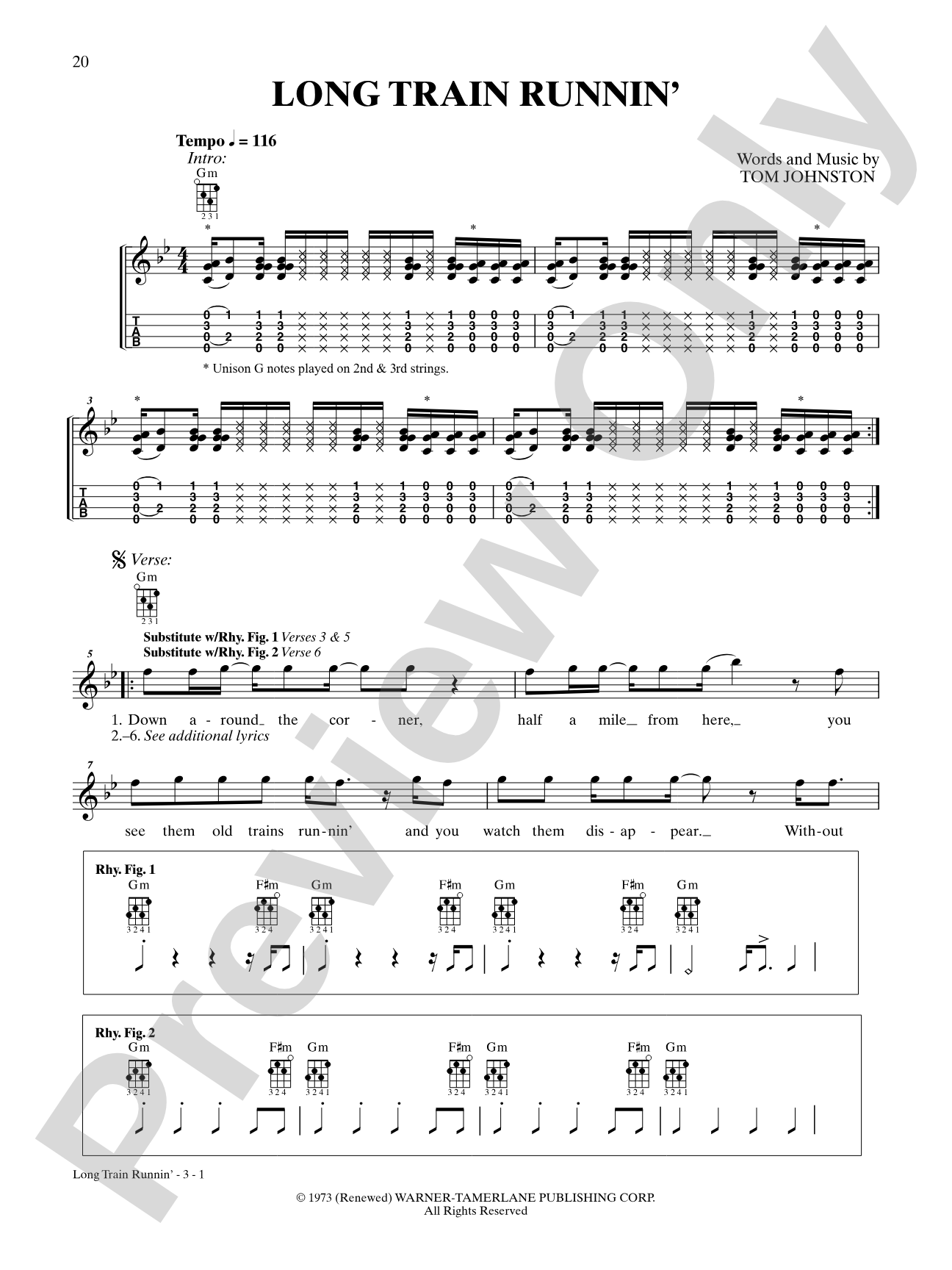

Long Train Runnin': Ukulele TAB
12 Great Songs of the '60s, '70s & '80s
Item: 00-PS-0011865
$4.99
One moment…
Related Items
Paint It, Black: Ukulele TAB |
$4.99
|
View | |
It's All Over Now: Ukulele TAB |
$4.99
|
View | |
The Night They Drove Old Dixie Down: Ukulele TAB |
$4.99
|
View | |
Stairway to Heaven: Ukulele TAB |
$5.99
|
View | |
After Midnight: Ukulele TAB |
$4.99
|
View | |
Maggie May: Ukulele TAB |
$4.99
|
View | |
Sunshine of Your Love: Ukulele TAB |
$4.99
|
View |
Description
Classic Rock Ukulele is designed for your total enjoyment. Each song uses the original guitar parts arranged for the ukulele. The ukulele craze is sweeping the world, so come be a part of it! Titles: After Midnight (Eric Clapton) * Go Your Own Way (Fleetwood Mac) * Hotel California (Eagles) * It's All Over Now (The Rolling Stones) * Jump (Van Halen) * Long Train Runnin' (The Doobie Brothers) * Maggie May (Rod Stewart) * The Night They Drove Old Dixie Down (The Band) * Paint It, Black (The Rolling Stones) * Stairway to Heaven (Led Zeppelin) * Sunshine of Your Love (Cream) * Truckin' (Grateful Dead).


Long Train Runnin': Ukulele TAB isn't in MakeMusic Cloud just yet...but it could be. Let us know you'd like to see it, and you'll help shape what comes next. In the meantime, start a free trial and dive into thousands of interactive titles your students can play along with today.
Request This Title
Tell us you want it.
Start Your Free Trial
Explore everything that's ready to play right now.
Sample Audio
No sample audio found.
Sample Video
No sample videos found.
Additional Details
Series:
Just for Fun
Publisher:
Alfred Music
Page Count:
64
SKU:
00-PS-0011865
More about this title
About the Composer: Tom Johnston
Tom Johnston cofounded The Doobie Brothers in 1970 and served as the band's primary songwriter and guitarist throughout their most prolific years. His knack for crafting radio-friendly rock songs with strong melodic hooks and accessible chord progressions made him central to the band's sound during the 1970s and early 1980s.
Johnston's songwriting emphasizes clarity and memorability, qualities that translate particularly well to ukulele arrangements. His work demonstrates how rock repertoire can migrate across instruments while retaining its essential character and appeal.
Why we love this
This collection pulls genuine rock staples and arranges them thoughtfully for ukulele rather than simply transposing guitar tabs. The song selection spans classic rock touchstones (Led Zeppelin, Eagles, Cream) alongside funk-rock territory (Van Halen's "Jump"), giving students repertoire that sounds and feels like real rock, not watered-down renditions. Ukulele players finally get access to the songs that defined an era.
What to expect
Familiar and energizing. These are songs most musicians and many listeners know by ear, so the ukulele arrangements unlock instant recognition and satisfaction. The collection captures the swagger and drive of 1970s and early 1980s rock, translated into an instrument that sounds bright and intimate even when playing substantial chords and melodic lines.
Who it's for
Ukulele players at the intermediate level who want to move beyond method book exercises and into the rock repertoire that inspired them to pick up the instrument. Teachers looking to build engagement in group ukulele classes or advanced private students seeking repertoire that mirrors what their guitar-playing peers are learning.
How to get the most out of it
- Lean into the original groove. These arrangements preserve the rhythmic character of the source recordings, so lock into the strumming patterns even when you're playing just the melody line.
- Adjust your tone for each song. "After Midnight" calls for a mellow, blues-inflected approach; "Jump" demands brightness and punch. The ukulele's range is smaller than guitar, so tonal color becomes your chief tool for differentiation.
- Use the TAB alongside standard notation to build your sight-reading speed. Cross-referencing the two formats reinforces fretboard knowledge and makes transitions between songs smoother.
- Revisit fingering choices on longer pieces like "Stairway to Heaven." The original guitar voicings may not always map cleanly to ukulele; experimenting with different positions on the neck will reveal more comfortable paths through the passage.
How to use it
Feature individual songs in recitals or student performances throughout the year, building a repertoire across multiple concerts rather than massing them into one program. The variety in style and tempo means you can pair "Hotel California" with ballad literature, use "Jump" as an upbeat closer, or bookend a set with contrasting songs from the same era. This collection also works well for informal performance or jam sessions where students gain confidence in front of an audience without requiring full ensemble coordination.
Skills your students will build
- Reading TAB and standard notation in parallel
- Executing blues-rock and classic rock strumming patterns
- Playing melodic lines that span multiple octaves on a limited range instrument
- Translating guitar-derived voicings and arrangements to ukulele fretboard
- Building confidence with songs that carry strong cultural and sonic recognition