
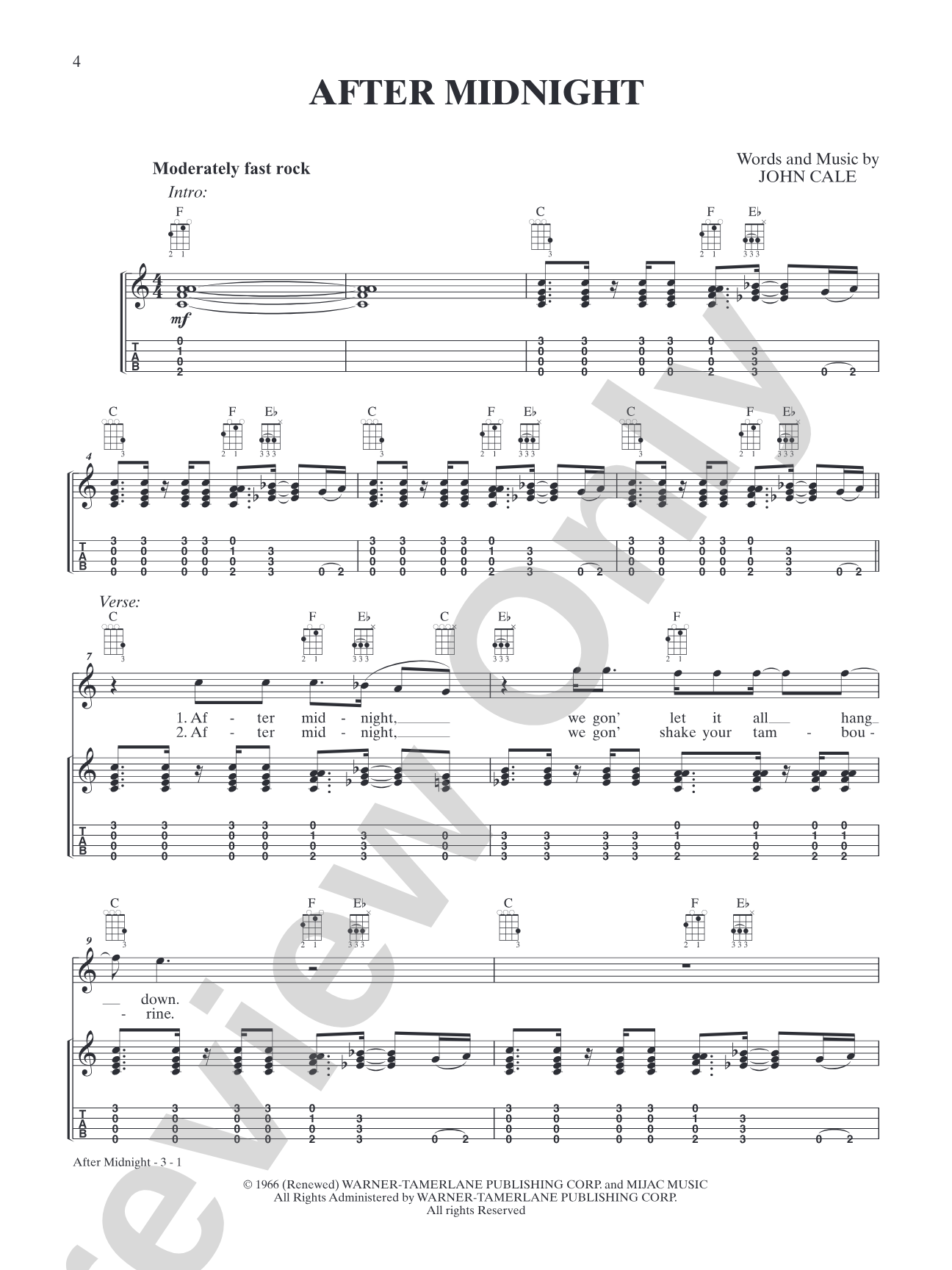

After Midnight: Ukulele TAB
12 Great Songs of the '60s, '70s & '80s
Item: 00-PS-0011914
$4.99
One moment…
Related Items
Paint It, Black: Ukulele TAB |
$4.99
|
View | |
It's All Over Now: Ukulele TAB |
$4.99
|
View | |
Long Train Runnin': Ukulele TAB |
$4.99
|
View | |
The Night They Drove Old Dixie Down: Ukulele TAB |
$4.99
|
View | |
Stairway to Heaven: Ukulele TAB |
$5.99
|
View | |
Maggie May: Ukulele TAB |
$4.99
|
View | |
Sunshine of Your Love: Ukulele TAB |
$4.99
|
View |
Description
Classic Rock Ukulele is designed for your total enjoyment. Each song uses the original guitar parts arranged for the ukulele. The ukulele craze is sweeping the world, so come be a part of it! Titles: After Midnight (Eric Clapton) * Go Your Own Way (Fleetwood Mac) * Hotel California (Eagles) * It's All Over Now (The Rolling Stones) * Jump (Van Halen) * Long Train Runnin' (The Doobie Brothers) * Maggie May (Rod Stewart) * The Night They Drove Old Dixie Down (The Band) * Paint It, Black (The Rolling Stones) * Stairway to Heaven (Led Zeppelin) * Sunshine of Your Love (Cream) * Truckin' (Grateful Dead).


After Midnight: Ukulele TAB isn't in MakeMusic Cloud just yet...but it could be. Let us know you'd like to see it, and you'll help shape what comes next. In the meantime, start a free trial and dive into thousands of interactive titles your students can play along with today.
Request This Title
Tell us you want it.
Start Your Free Trial
Explore everything that's ready to play right now.
Sample Audio
No sample audio found.
Sample Video
No sample videos found.
Additional Details
Series:
Just for Fun
Publisher:
Alfred Music
Page Count:
64
SKU:
00-PS-0011914
More about this title
About the Composer: J. J. Cale
J. J. Cale composed and recorded "After Midnight" in 1966, establishing himself as a distinctive voice in blues-rock songwriting. Though Cale's own recordings remained understated and laid-back, his songs became standards when other artists embraced them: Eric Clapton's version of "After Midnight" became a signature number, and Cale's compositions have been recorded hundreds of times across rock, blues, and country contexts.
Cale's strength lay in writing memorable melodies and groove-based progressions that feel effortless and conversational. His influence on rock songwriting is substantial precisely because his work sounds simple but endures; many of his compositions have become teaching pieces for musicians learning how to balance restraint with emotional impact.
Why we love this
This collection bridges the gap between what ukulele players want to play and what they need to practice. The arrangements adapt guitar-driven rock hits into idiomatic ukulele voicings without losing the character of the originals, so players get authentic arrangements of genuinely engaging material rather than simplified versions that feel like compromises.
What to expect
The collection spans the swagger and groove of classic rock's best-known moments, from the blues-influenced swagger of "After Midnight" and "Sunshine of Your Love" to the soaring melodicism of "Stairway to Heaven" and "Hotel California." Each song carries the weight of its original arrangement while sounding natural under the ukulele's bright, rounded voice.
Who it's for
This book serves ukulele players at intermediate levels who want to expand into recognizable rock repertoire without downgrading their musical ambitions. It's equally valuable for guitarists switching to ukulele who need arrangements that preserve the spirit of songs they already know.
How to get the most out of it
- Study the original recordings to internalize the groove and dynamic shape of each song. Ukulele arrangements work best when the rhythm section sits comfortably rather than rushing to fill space.
- Pay attention to the TAB fingering suggestions, especially on songs like "Stairway to Heaven" where the original guitar part spans registers the ukulele interprets differently than a six-string instrument.
- Lock in the rhythmic feel specific to each era and style. "Jump" requires a tighter, more percussive attack than "Go Your Own Way," which needs a more relaxed pocket.
- Use dynamics to shape melody lines, particularly on the slower pieces. The ukulele's natural brightness can mask subtle expression, so conscious control of attack and sustain makes these classic hooks sing.
How to use it
Build recital programs around thematic connections rather than chronological order: a set of blues-rock pieces, a Fleetwood Mac/Eagles era block, or a showcase of different rhythmic approaches across the rock canon. These titles also work well in informal performance settings and coffee house contexts where the recognizable repertoire creates immediate audience connection.
Skills your students will build
- Transposing guitar voicings to ukulele registers and string configurations
- Reading and executing blues-based progressions and I-IV-V changes across multiple positions
- Maintaining rhythmic pocket and groove in rock contexts with varying tempos and feels
- Interpreting TAB notation in the context of original recordings
- Managing dynamics and tone color to balance melody and rhythm on a single melodic instrument