
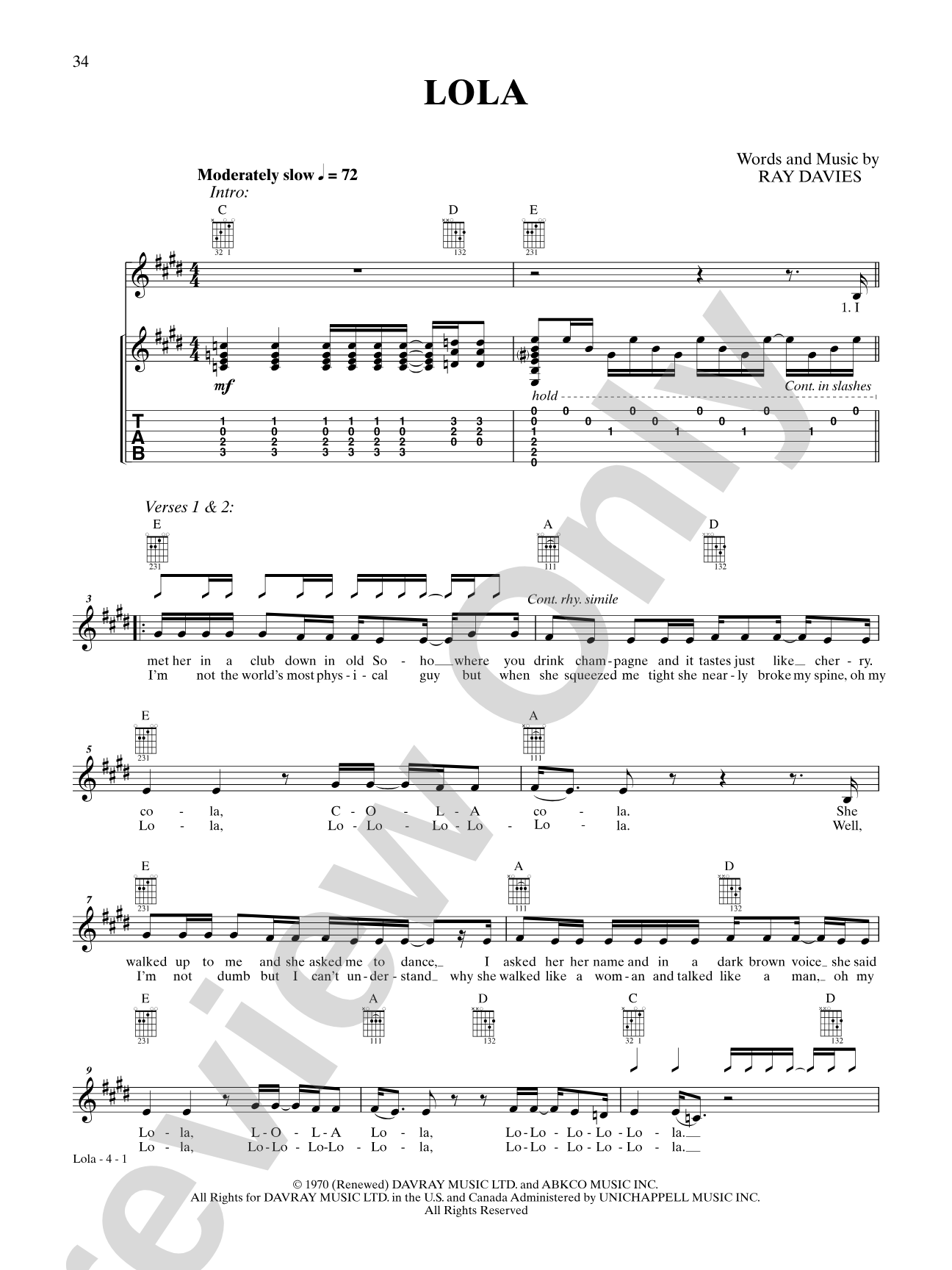

Lola: Easy Guitar
Item: 00-PSG-000847
$4.99
One moment…
Description
Who says the greatest hits have to be for advanced guitarists? Now favorite songs from the '60s and the '70s are at every guitarist's fingertips. Pick up both of these books filled with classic hits and start playing songs from your favorite artists and bands of the '60s and '70s now.
Titles: American Woman (The Guess Who) * Bad Company (Bad Company) * Hotel California (Eagles) * Layla (Derek and the Dominos) * Lola (Kinks) * Lonely Days (The Bee Gees) * Long Train Runnin' (The Doobie Brothers) * Maggie May (Rod Stewart) * Melissa (The Allman Brothers) * Nights in White Satin (The Moody Blues) * Whipping Post (The Allman Brothers) * Wish You were Here (Pink Floyd).


Titles: American Woman (The Guess Who) * Bad Company (Bad Company) * Hotel California (Eagles) * Layla (Derek and the Dominos) * Lola (Kinks) * Lonely Days (The Bee Gees) * Long Train Runnin' (The Doobie Brothers) * Maggie May (Rod Stewart) * Melissa (The Allman Brothers) * Nights in White Satin (The Moody Blues) * Whipping Post (The Allman Brothers) * Wish You were Here (Pink Floyd).
Lola: Easy Guitar isn't in MakeMusic Cloud just yet...but it could be. Let us know you'd like to see it, and you'll help shape what comes next. In the meantime, start a free trial and dive into thousands of interactive titles your students can play along with today.
Request This Title
Tell us you want it.
Start Your Free Trial
Explore everything that's ready to play right now.
Sample Audio
No sample audio found.
Sample Video
No sample videos found.
Additional Details
Series:
Hits for Easy Guitar Series
Publisher:
Alfred Music
Page Count:
56
SKU:
00-PSG-000847
More about this title
About the Artist: The Kinks
The Kinks emerged from London in the mid-1960s as architects of the British Invasion, crafting a sound that blended American blues and rock with distinctly English sensibilities. Their catalog spans decades of innovation, from the fuzzy guitar riffs that defined early rock to the sophisticated pop-rock compositions that influenced generations of songwriters. In the classroom and practice room, their work remains a gateway to understanding how memorable hooks, inventive guitar textures, and storytelling can anchor a song in listeners' minds.
Why we love this
This collection brings genuine classic rock into reach for developing guitarists without sacrificing the songs that made these bands legendary. The selection spans a remarkable range of textures and styles, from the raw energy of "American Woman" to the intricate fingerpicking territory of "Layla," giving students concrete examples of how guitar sits differently in different arrangements. You get immediate wins: recognizable melodies, satisfying rhythms, and the kind of repertoire that keeps students motivated because they actually want to play these songs.
What to expect
These arrangements capture the swagger and authenticity of their era: blues-rooted, guitar-forward, and built on the kind of hooks that stick with you long after you stop playing. Moving through them, you experience the arc from raw rock and roll confidence to more sophisticated harmonic territory, all grounded in the fundamental joy of making a guitar sing.
Who it's for
This book serves guitarists in their first year or two of study who want to play songs they genuinely love rather than just building technical foundations. It's equally valuable for adult learners returning to guitar or students preparing for ensemble or recital contexts where these songs carry real cultural weight.
How to get the most out of it
- Pay close attention to the rhythm notation in these TAB arrangements. The difference between the syncopated pocket in "Lola" and the straight eighth-note feel in "Wish You Were Here" teaches you how guitar grooves are constructed.
- Listen to the original recordings while learning. These arrangements distill essential elements, but hearing how the guitar sits in the full mix clarifies dynamics and tone shaping you won't see on the page.
- Work through the chord transitions slowly before locking into tempo. Several of these songs feature barre chords or unexpected shifts that reward deliberate practice.
- Notice where single-note lines break up the strumming patterns. These melodic passages often carry the song's identity and deserve as much attention as the rhythmic foundation.
How to use it
Program individual songs into student recitals or ensemble concerts, where the audience recognition creates genuine performance momentum. Use the collection as a semester or year-long exploration of classic rock composition, pairing different songs with specific technical focuses (barre chords with "Maggie May," fingerpicking patterns with "Layla"). These titles work equally well as sight-reading or casual performance material in group lessons.
Skills your students will build
- Reading guitar TAB and standard notation together
- Barre chord transitions and finger positioning
- Differentiating strumming patterns (even eighth notes, syncopation, swing feel)
- Single-note melodic lines and chord-melody balance
- Recognizing and executing common rock rhythm grooves