
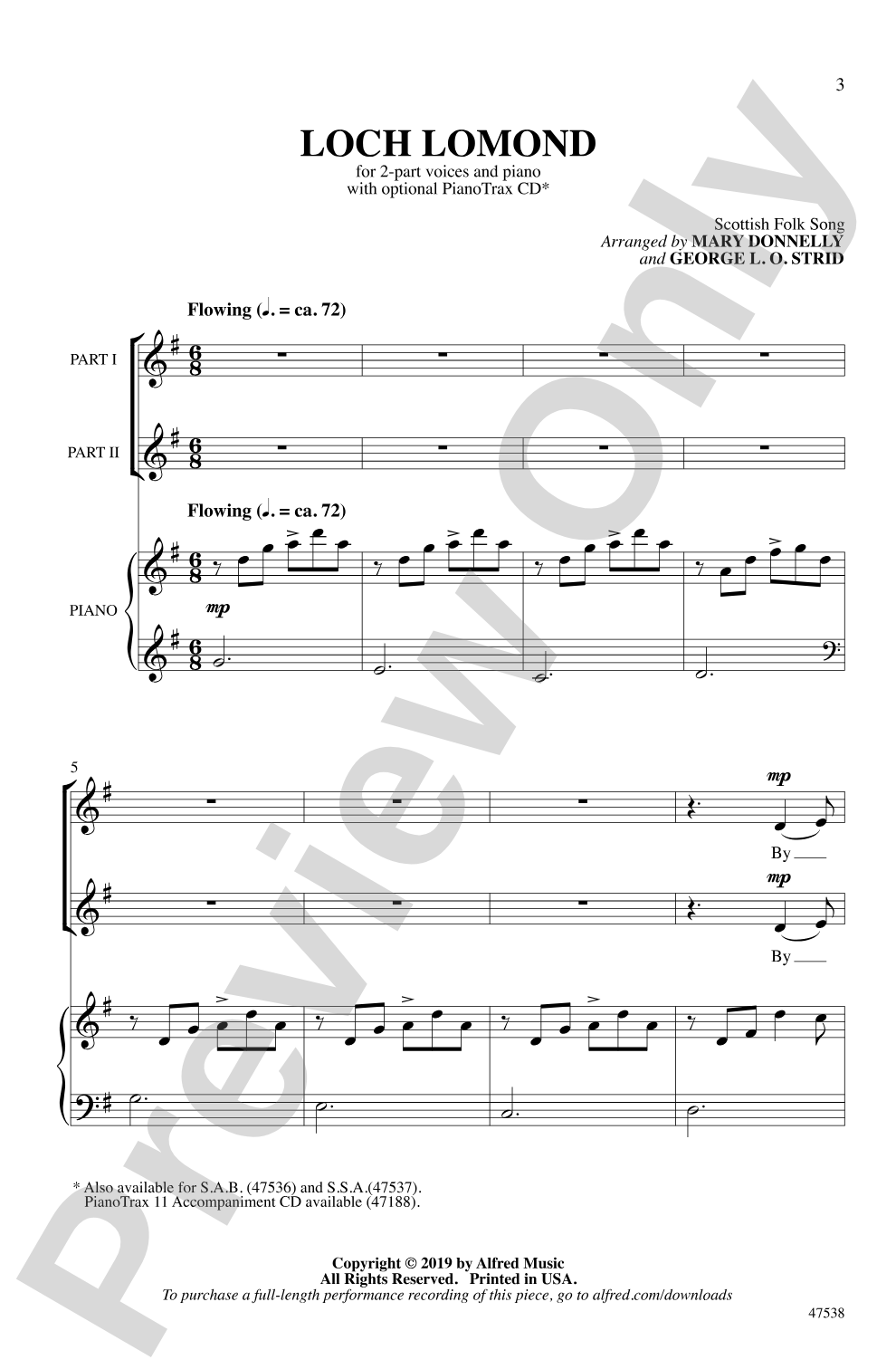

Loch Lomond: 2-Part Choral Octavo
Scottish Folk Song / arr. Mary Donnelly and George L. O. Strid
Item: 00-PO-0005919

$2.05
Minimum order quantity: 20 copies
Pickup currently not available
Description
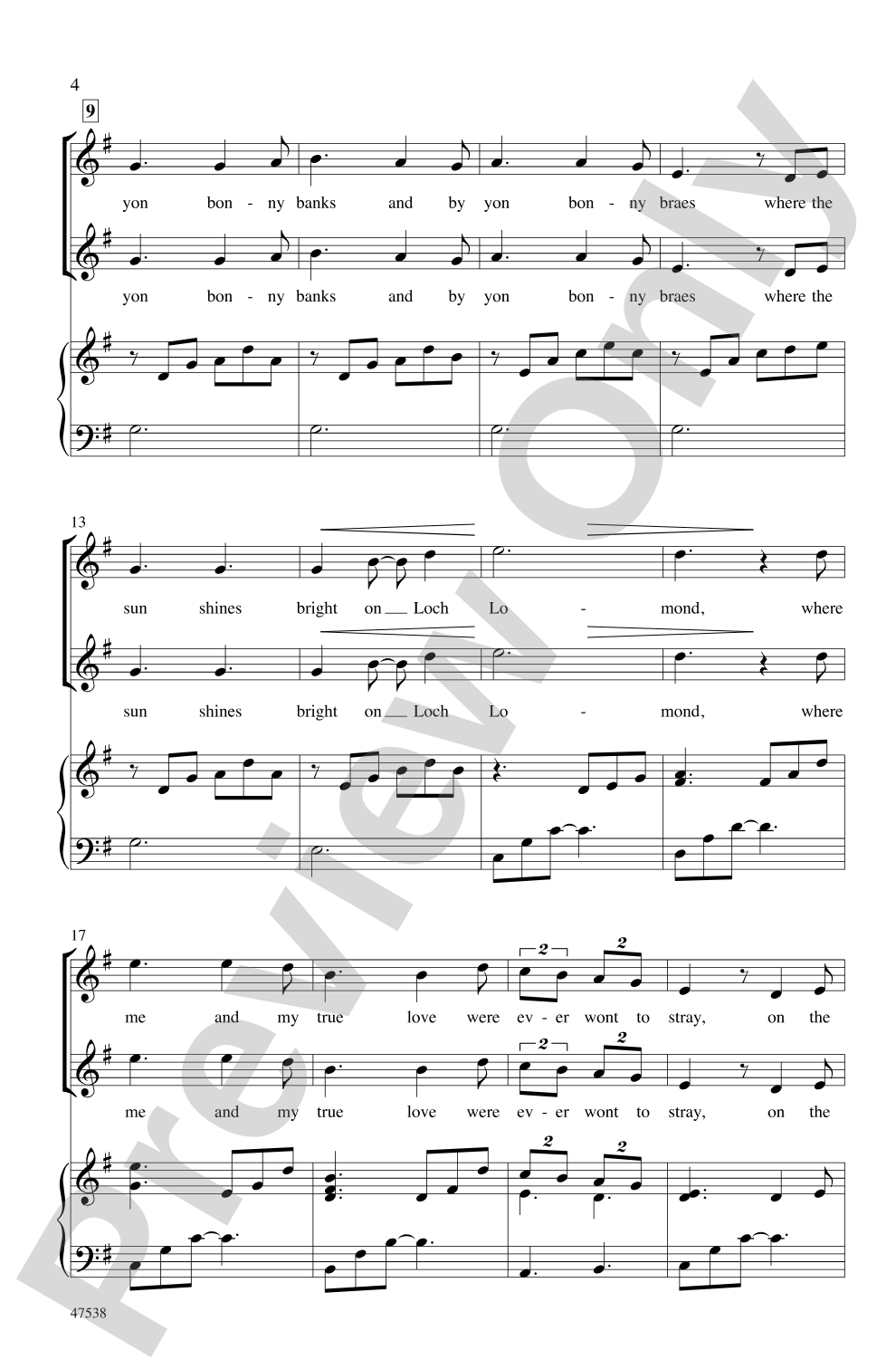
This sweet setting of the famous Scottish folk song generously passes the melody from voice to voice, while gently stretching the traditional rhythms of the piece. Piano players will enjoy the flowing arpeggios of the supportive accompaniment, and singers will savor the long legato lines.


Don't just read it, hear it, play along with it, and watch your students grow with it. In MakeMusic Cloud, Loch Lomond: 2-Part Choral Octavo comes alive with professional accompaniment, adjustable tempo, and built-in practice tools that turn solo practice into real progress.
Open in the Player
Jump straight in and assign it today.
Start Your Free Trial
Open this title and explore the full library in minutes.
Sample Audio
1
Audio File
--:--
0:00
0:00
Sample Video
Additional Details
Series:
Alfred Choral Designs
Publisher:
Alfred Music
Page Count:
12
SKU:
00-PO-0005919
More about this title
About the Arranger: Mary Donnelly

Mary Donnelly grew up in Reno, Nevada, and studied English and French at the University of Nevada before discovering her passion for music education during her undergraduate years. She organized children's choruses while still in college, then earned a Master's Degree in Education from Lesley College in Cambridge, Massachusetts, where she focused on integrating the arts across the curriculum. She spent three decades teaching general music and choir in the Washoe County School District, retiring as a respected voice in elementary and middle school music education.
In 1985, Donnelly began a prolific collaboration with George Strid when their principal asked them to write a musical for Reading Week. That first project, The Million Dollar Mystery, launched a partnership that has produced over two hundred songs and twenty-five musicals. Both active members of ACDA, NEA, and ASCAP, Donnelly and Strid have become known for creating accessible, engaging music that serves real classroom needs.
Why we love this
Donnelly and Strid's approach here respects the melody's Scottish character while making the part writing genuinely singable for young treble voices. The arrangement passes the tune around so that no single part carries the burden of the melody throughout, building confidence in singers who might otherwise struggle with extended passages. The flowing piano accompaniment transforms what could be a simple folk song into something that sounds polished enough for concerts and festivals without requiring advanced musicianship.
What to expect
This setting captures the wistful, reflective quality of the traditional Scottish ballad while letting the melody breathe across both voice parts. Singers experience long, sustained legato lines that allow them to focus on tone production and phrase shaping rather than technical complexity. The arrangement feels intimate and genuinely musical, not simplified.
Who it's for
This octavo works well for mixed-age or mixed-ability treble choirs, including middle school groups and upper elementary programs with stronger singers. The two-part texture and singable ranges make it accessible for singers still building confidence, while the folk song's emotional content appeals to performers and audiences of all ages.
How to get the most out of it
- Shape the phrase arcs carefully; this piece benefits from singers understanding where each melodic fragment begins and ends, even as the tune migrates between parts.
- Balance the accompaniment so the flowing arpeggios support rather than overwhelm the legato vocal lines.
- Explore how the stretched rhythms differ from the traditional version; rehearsing side by side with a recording of the original folk tune helps singers hear the subtle rubato this arrangement invites.
- Use the recorded accompaniment to lock ensemble intonation and rhythmic precision, particularly in passages where both parts move together.
How to use it
Program this alongside other folk song arrangements or world music selections to build a thematic concert block. It also pairs naturally with other Scottish or British isles repertoire in a cultural focus concert, and the modest technical demands make it an ideal choice for festival competition where strong musicianship and clarity matter more than difficulty.
Skills your students will build
- Singing sustained legato lines and long phrases with consistent breath support
- Trading melody between voice parts while maintaining tonal unity
- Listening across parts to balance two-voice homophonic texture
- Responding to rubato and rhythmic flexibility within a folk idiom
- Reading and performing two-part treble choral literature