
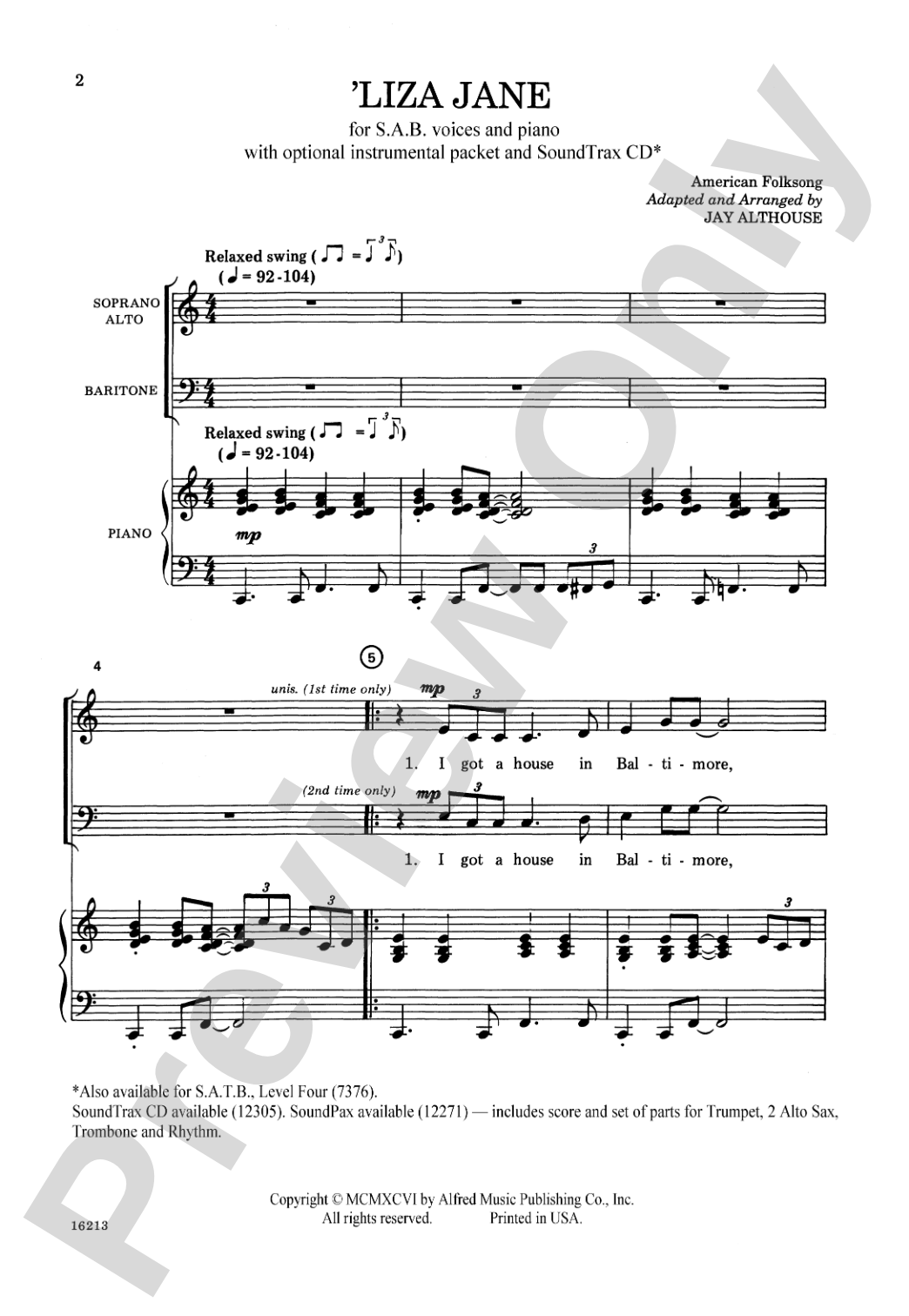
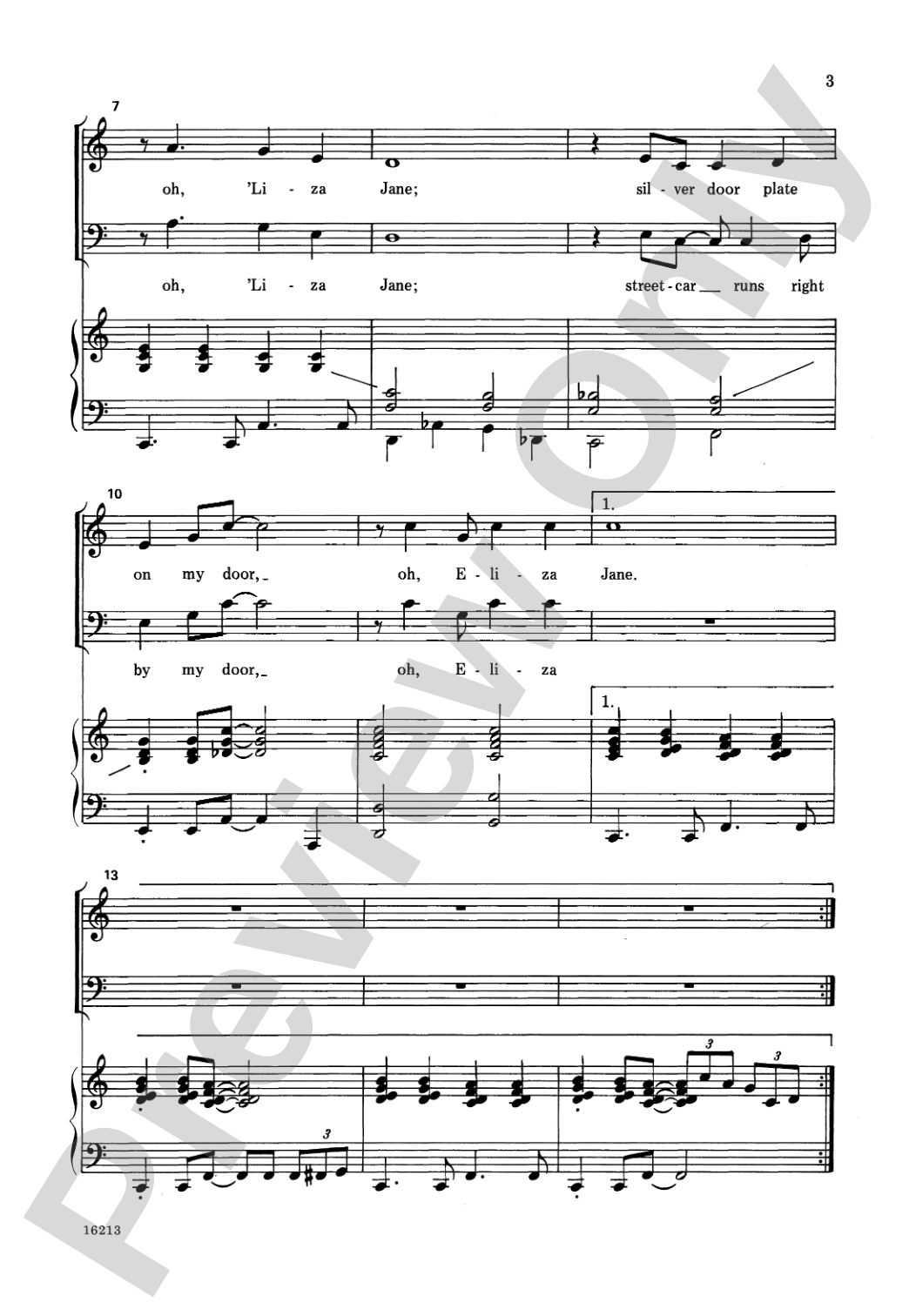

'Liza Jane: SAB Choral Octavo
Arr. Jay Althouse
Item: 00-PO-0007956
$1.85
Minimum order quantity: 20 copies
Pickup currently not available
Description
An up-beat, swing arrangement of this favorite. The light jazz treatment is voiced to insure a successful experience. This one will make your group sparkle. Don't miss it! InstruPax includes: director's score, trumpet, 2 alto saxes, trombone, rhythm.


Discover MakeMusic Cloud: thousands of interactive titles your students can play along with today.
Sample Audio
1
Audio File
--:--
0:00
0:00
Sample Video
No sample videos found.
Additional Details
Series:
Alfred Choral Designs
Publisher:
Alfred Music
Page Count:
8
SKU:
00-PO-0007956
More about this title
About the Arranger: Jay Althouse

Jay Althouse holds degrees in Music Education and Music from Indiana University of Pennsylvania, where he was recognized as a Distinguished Alumni. His career spans both the publishing side of music education and prolific composition; he spent eight years managing rights and licenses for a major educational publisher and served on the Executive Board of the Music Publishers Association of America. With more than 800 choral works in print, his compositions reach ensembles worldwide and have earned him regular ASCAP Special Awards.
Beyond arranging and composing, Althouse has shaped music education through numerous publications: he co-authored The Complete Choral Warm-up Book and Accent on Composers, created classroom resources like Ready to Read Music and Sixty Music Quizzes, and compiled respected vocal collections including Folk Songs for Solo Singers. His collaborative work with his wife Sally K. Albrecht includes children's musicals and I Hear America Singing, performed by the San Francisco Girls and Boys Choirs at President Obama's 2009 Inauguration. Currently based in North Carolina, he serves on the National Advisory Board of the Folk Art Society of America.
Why we love this
Althouse's swing treatment respects the folk melody while giving it genuine ensemble swagger. The SAB voicing sits comfortably across mixed voices without requiring soloists to stretch, and the optional instrumental parts (trumpet, saxes, trombone, rhythm) transform this from a vocal number into a full jazz combo experience without demanding pit musicians. Your singers will remember this one.
What to expect
Crisp and joyful, with that loose confidence of a jazz standard. The arrangement has a conversational quality; voices trade phrases and layer in ways that feel natural, not stiff. There's real sparkle here, and the ensemble will feel it.
Who it's for
Developing choirs with SAB voicing needs who want something contemporary sounding yet rooted in a familiar tune. Groups adding their first instrumental pieces will find this an approachable entry point, since the parts are written to support rather than expose.
How to get the most out of it
- Establish the swing feel early in rehearsal by having the ensemble listen to the recorded accompaniment before singing a single note; the rhythm section pocket is what makes this arrangement work.
- Balance the three parts carefully in the opening statement so the melody reads clearly while the inner voices support the harmonic color.
- If you're adding instruments, let the rhythm section lock first, then layer in the horns; they'll sit much better against a solid foundation.
- Keep the energy bright throughout without rushing; swing time feels faster than it is, so trust your tempo and let the groove breathe.
How to use it
Schedule this as a closer on a spring or end-of-year concert, especially if you're pairing it with a mix of styles. It works beautifully as a palate cleanser between heavier repertoire, and if you've got instrumental players in the building, it's the perfect showcase for a small ensemble within your larger performance.
Skills your students will build
- Sight-reading jazz chords and swing articulations
- Balancing three independent melodic lines in close harmony
- Counting and executing a backbeat rhythm in 4/4
- Blending tone across SAB ranges
- Responding to instrumental accompaniment cues