
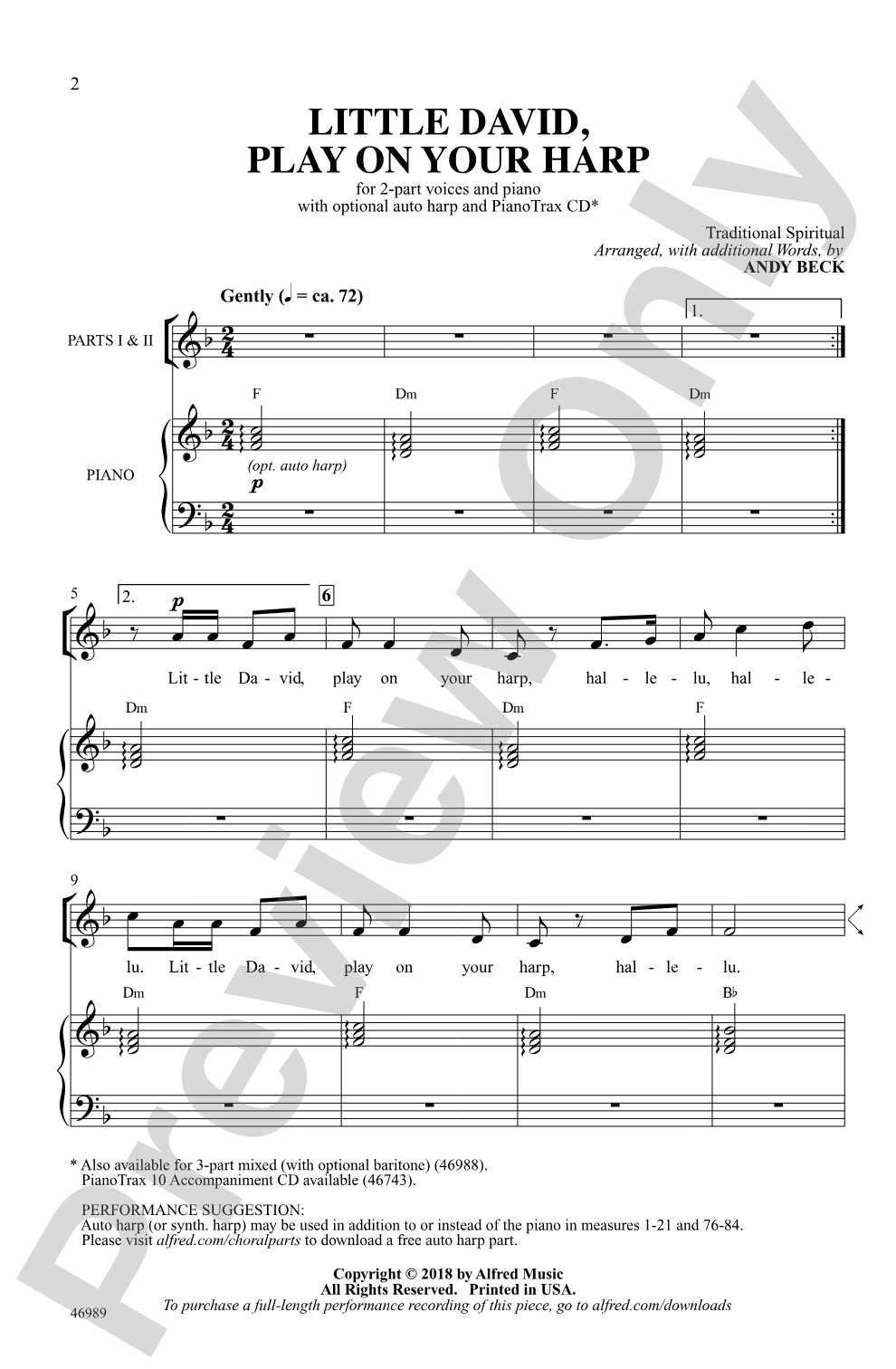

Little David, Play on Your Harp: 2-Part Choral Octavo
Traditional Spiritual / arr., with additional words, by Andy Beck
Item: 00-PO-0005846
$2.05
Minimum order quantity: 20 copies
Pickup currently not available
Description
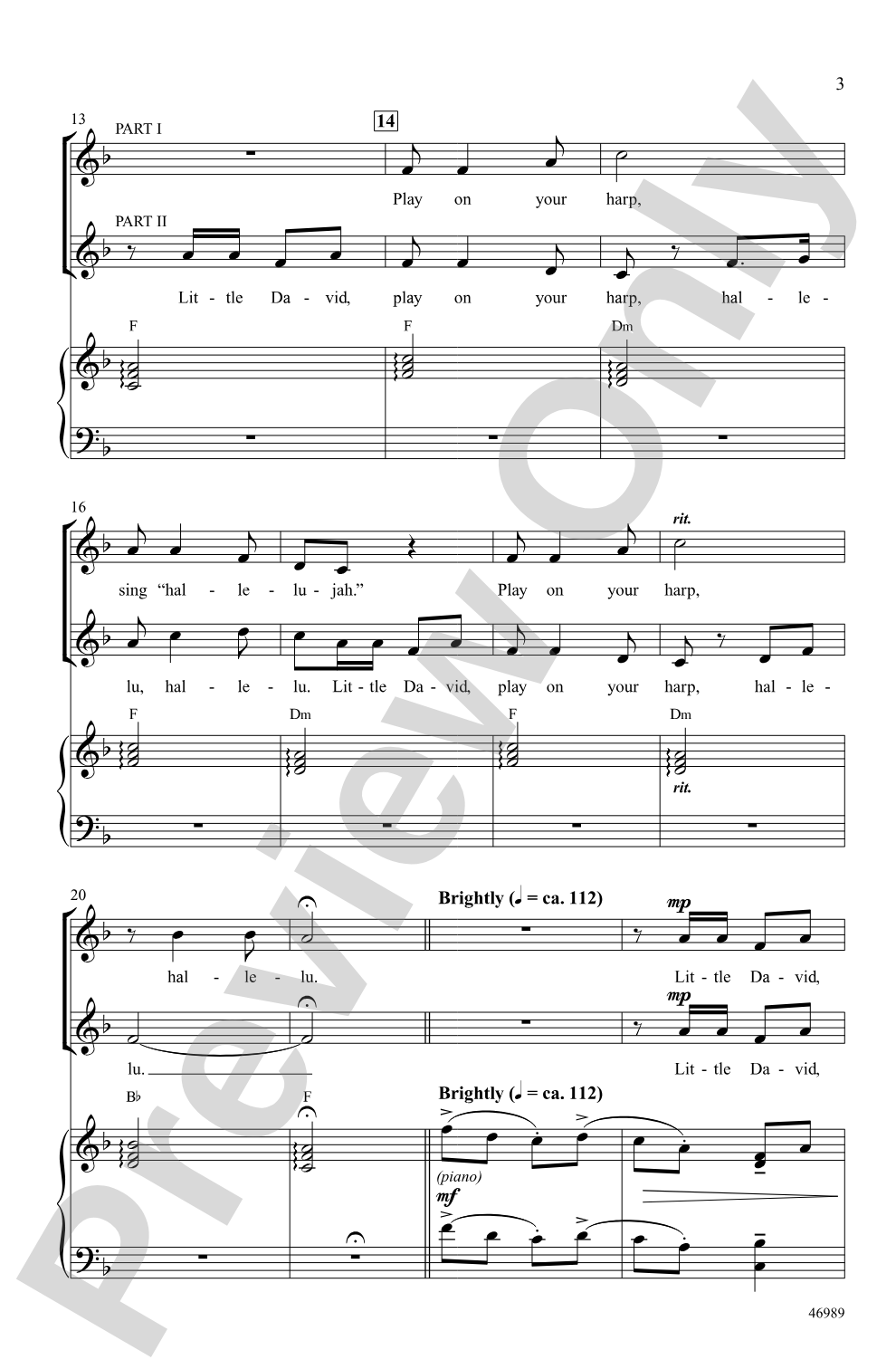
A clever arrangement of the traditional spiritual that includes a surprise nod to Handel's "Hallelujah Chorus" plus an optional part for autoharp! The pentatonic chorus is great for teaching or reinforcing solfège, while the harmonies are appropriately independent for developing singers. A few new words tell us more about the heroic boy, David. A terrific teaching piece that kids will enjoy!


Little David, Play on Your Harp: 2-Part Choral Octavo isn't in MakeMusic Cloud just yet...but it could be. Let us know you'd like to see it, and you'll help shape what comes next. In the meantime, start a free trial and dive into thousands of interactive titles your students can play along with today.
Request This Title
Tell us you want it.
Start Your Free Trial
Explore everything that's ready to play right now.
Sample Audio
1
Audio File
--:--
0:00
0:00
Sample Video
Additional Details
Series:
Alfred Choral Designs
Publisher:
Alfred Music
Page Count:
8
SKU:
00-PO-0005846
More about this title
About the Arranger: Andy Beck

Andy Beck directs choral publications at Alfred Music and has established himself as one of the most widely performed arrangers in American choral music, with over 450 works in active use by school and community choirs. His educational resources for sight singing and vocal technique have shaped how singers across the country approach musicianship, and his guest conducting and adjudication work keeps him connected to the real challenges music educators face in rehearsal.
Beyond his publishing role, Beck remains an active performer and director, singing with the North Carolina Master Chorale Chamber Choir and directing musical theatre productions. His training at Ithaca College and Northwest Missouri State University grounded him in both pedagogy and performance, a combination that consistently shows in arrangements designed for singers who are still building independence and confidence.
Why we love this
Beck's arrangement respects what kids can actually sing while giving them something genuinely fun to perform. The pentatonic chorus serves a real pedagogical purpose for reinforcing solfège work, yet the added verses with new text and that unexpected Handel moment keep singers engaged rather than letting them coast through a familiar tune. The optional autoharp part opens the door to collaboration and adds texture without complicating the vocal writing.
What to expect
There's a playful spirit here that honors the spiritual tradition while inviting singers into a story about courage and resourcefulness. The pentatonic melody has an almost folk-like simplicity that feels immediate and singable, yet the harmonic language underneath keeps things musically interesting throughout.
Who it's for
This arrangement works for developing 2-part choirs in grades 4-7, as well as younger high school singers building foundational part-singing skills. Teachers working with mixed abilities will find the pentatonic writing accessible while the independent harmonies challenge singers to maintain their line without doubling the melody.
How to get the most out of it
- Balance the two parts by having singers anchor the lower pitches of the pentatonic melody rather than reaching for the upper line. This clarity will make the harmonic movement land more effectively.
- If using the autoharp part, rehearse it separately first so singers aren't distracted during their own part-learning phase. Bring it in once both vocal parts feel secure.
- Shape the Handel reference as a moment of recognition rather than a parody. Singers will enjoy the discovery if you let them hear it emerging organically from the texture.
How to use it
Pair this with other spirituals or folk arrangements in a concert focused on traditional American music, or use it as a lighter moment in a more formal program where its pedagogical value supports your solfège curriculum. It's equally effective in a spring concert or as part of a sacred music showcase, and the moderate length (8 pages) makes it manageable alongside longer concert works.
Skills your students will build
- Pentatonic singing and solfège reinforcement
- Independent part-singing in the context of harmonic movement
- Textual storytelling and expression within a spiritual arrangement
- Listening for compositional references and musical allusions
- Part confidence without doubling the melody