
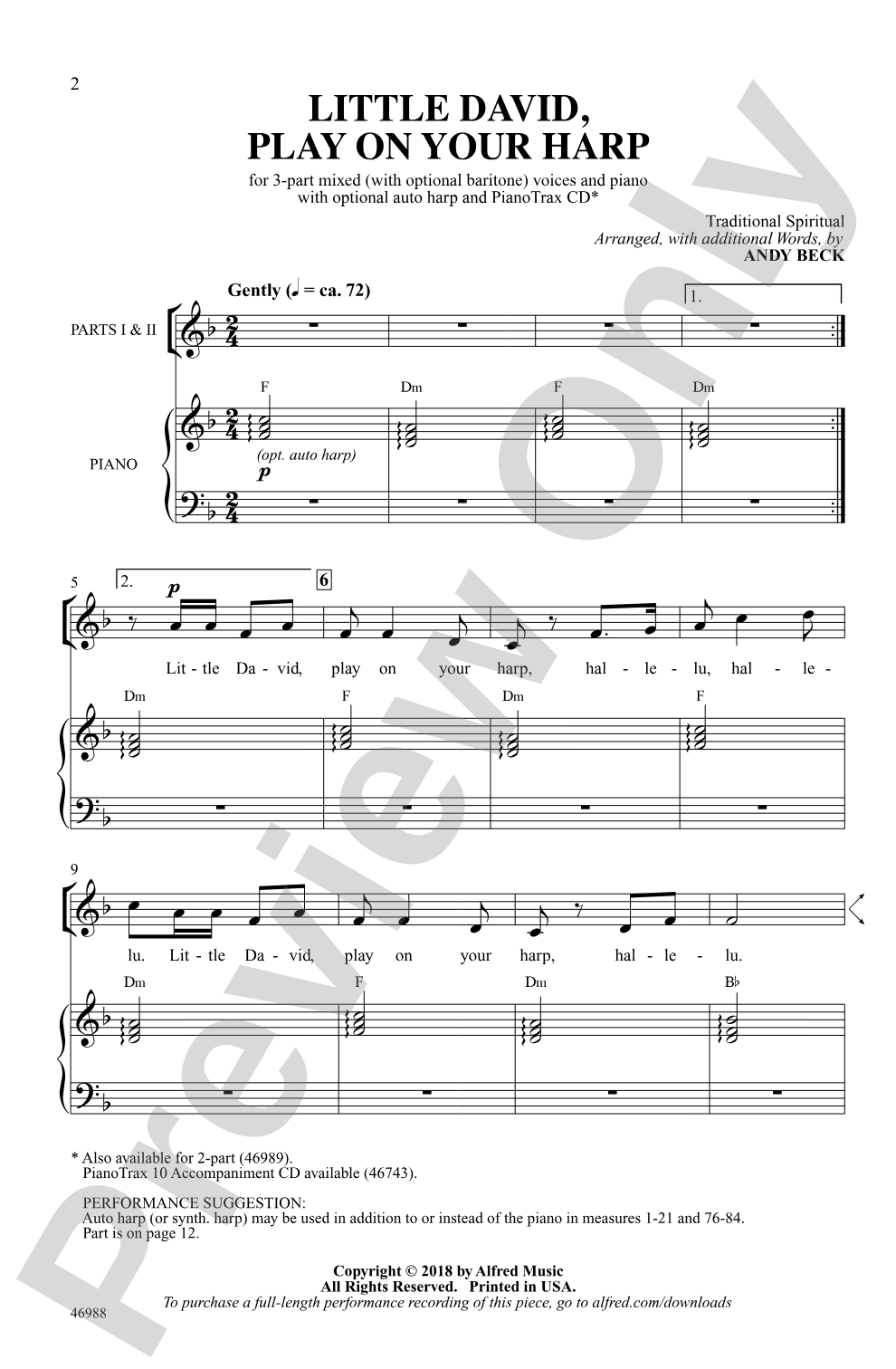
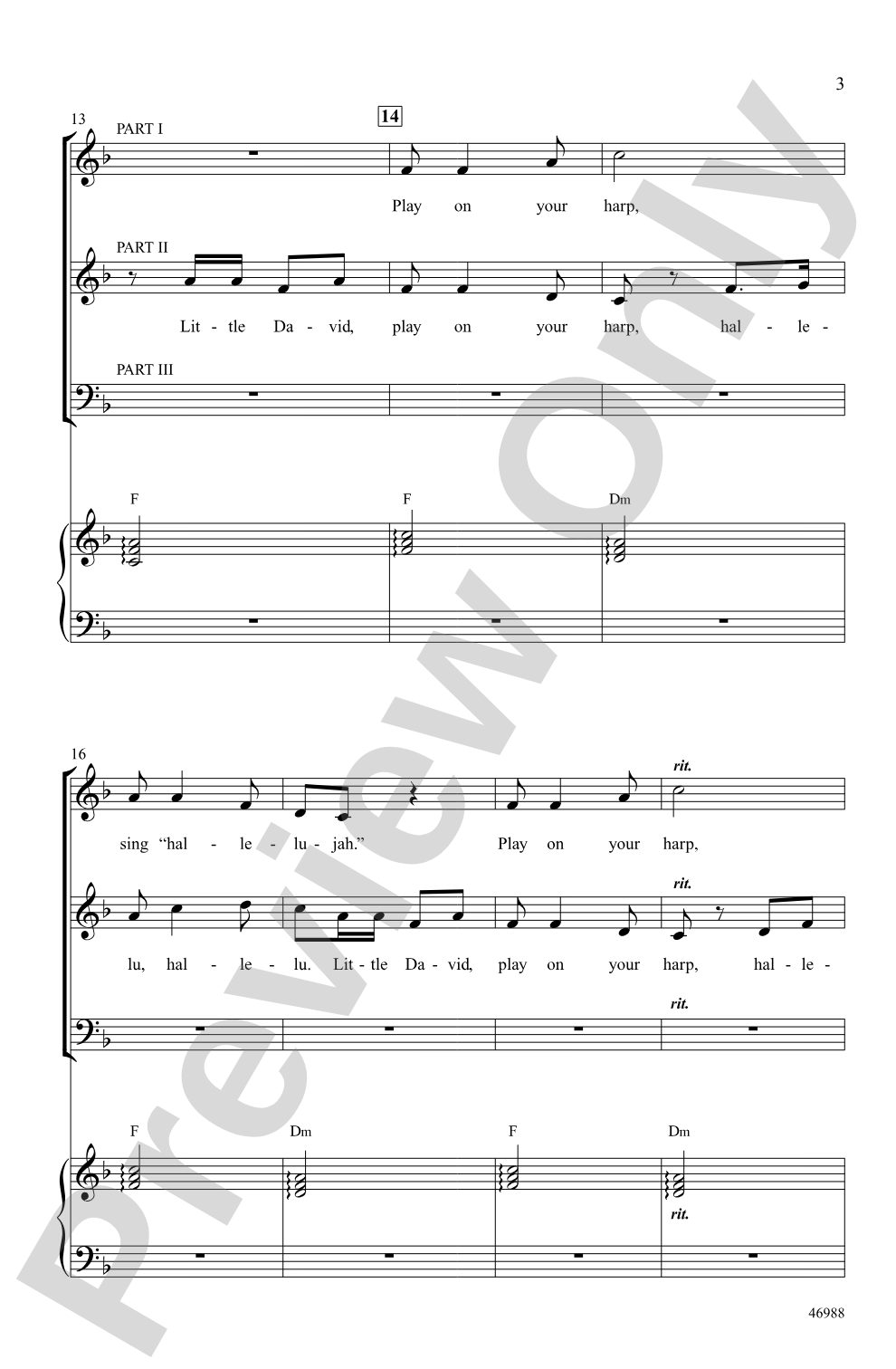
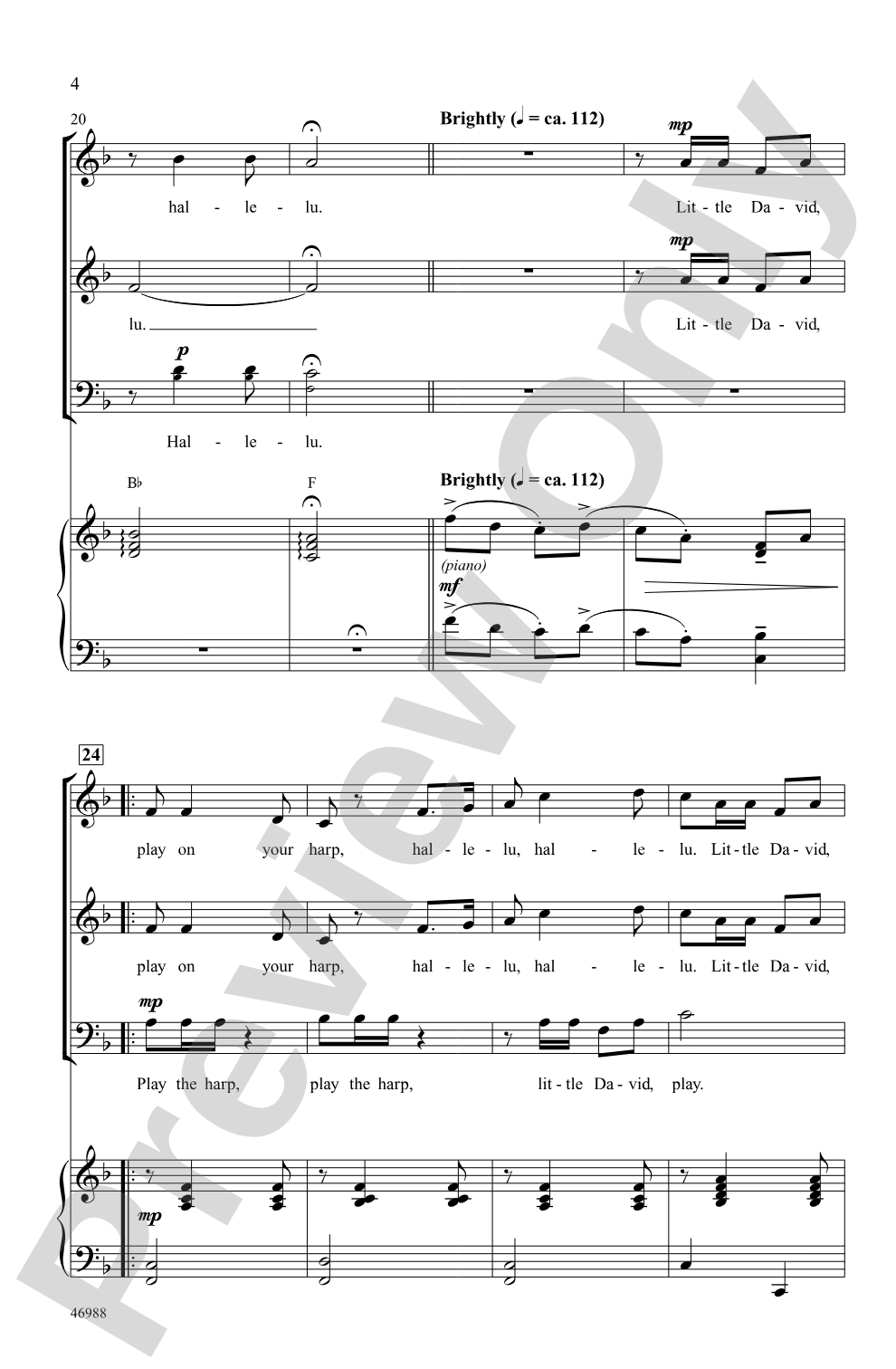

Little David, Play on Your Harp: 3-Part Mixed Choral Octavo
Traditional Spiritual / arr., with additional words, by Andy Beck
Item: 00-PO-0005845
$2.05
Minimum order quantity: 20 copies
Pickup currently not available
Description
A clever arrangement of the traditional spiritual that includes a surprise nod to Handel's "Hallelujah Chorus" plus an optional part for autoharp! The pentatonic chorus is great for teaching or reinforcing solfège, while the harmonies are appropriately independent for developing singers. A few new words tell us more about the heroic boy, David. A terrific teaching piece that kids will enjoy!


Little David, Play on Your Harp: 3-Part Mixed Choral Octavo isn't in MakeMusic Cloud just yet...but it could be. Let us know you'd like to see it, and you'll help shape what comes next. In the meantime, start a free trial and dive into thousands of interactive titles your students can play along with today.
Request This Title
Tell us you want it.
Start Your Free Trial
Explore everything that's ready to play right now.
Sample Audio
1
Audio File
--:--
0:00
0:00
Sample Video
No sample videos found.
Additional Details
Series:
Alfred Choral Designs
Publisher:
Alfred Music
Page Count:
12
SKU:
00-PO-0005845
More about this title
About the Arranger: Andy Beck

Andy Beck directs choral publications at Alfred Music and has built a catalog of more than 450 choral arrangements, vocal resources, and children's musicals. His work spans from concert pieces to pedagogical materials, including the widely adopted resources Sing at First Sight, Foundations in Choral Sight Singing, and Vocalize! 45 Vocal Warm-Ups That Teach Technique. A trained tenor with degrees in music education from Ithaca College and Northwest Missouri State University, Beck performs with the North Carolina Master Chorale Chamber Choir and has contributed as a studio singer to Alfred Music since 1992.
Beck's influence extends across the United States through guest conducting, adjudication, and clinician work. He has served as a commissioned composer and guest conductor for state and regional honor choirs, bringing his deep understanding of both pedagogy and performance to choirs of all age levels. His output reflects a sustained commitment to making choral music accessible, singable, and musically rewarding for developing musicians.
Why we love this
Beck's arrangement captures the spiritual's narrative power while creating genuine teaching moments. The pentatonic chorus makes solfège instruction feel integral rather than imposed, and the independent SAB writing gives each section real work without overwhelming developing singers. The Handel quotation feels organic rather than gimmicky, and the optional autoharp part opens the piece to mixed ensemble contexts.
What to expect
The piece radiates the quiet confidence of a spiritual retold with fresh details about David's heroism. The pentatonic melody sits naturally in the voice, and when the SAB harmonies bloom, singers discover their parts have genuine melodic interest rather than support duty. That Handel moment arrives like a wink between friends, grounded and joyful.
Who it's for
Developing SAB choirs in middle school, high school, and community settings looking for repertoire that teaches while entertaining. Directors seeking a spiritual arrangement that balances cultural authenticity with accessible pedagogy will find this particularly useful.
How to get the most out of it
- Emphasize the rhythmic clarity of the pentatonic section to make the solfège work visible to your audience; this is singing and teaching simultaneously.
- Balance the SAB parts carefully during harmonized sections so that no voice part dominates; developing choirs often need reminding that independence doesn't mean prominence.
- If using the autoharp, integrate it during rehearsals from the beginning so singers adjust to its harmonic support rather than encountering it only at performance.
- Shape the surprise Handel moment with slight dynamic lift and a breath that signals the shift; audiences appreciate the clever reference when it lands clearly.
How to use it
Program this as a bridge between spirituals and art song programming, or as a concert opener that sets a thoughtful, accessible tone. Its teaching value makes it especially strong in festival contexts where adjudicators appreciate pedagogy embedded in performance, and its length allows it to fit easily into varied program structures.
Skills your students will build
- Sight-reading in SAB voicing with independent parts
- Pentatonic singing and solfège application in ensemble context
- Intonation control in three-part harmony
- Cultural awareness and respectful interpretation of spiritual tradition
- Listening to and blending with optional instrumental accompaniment