
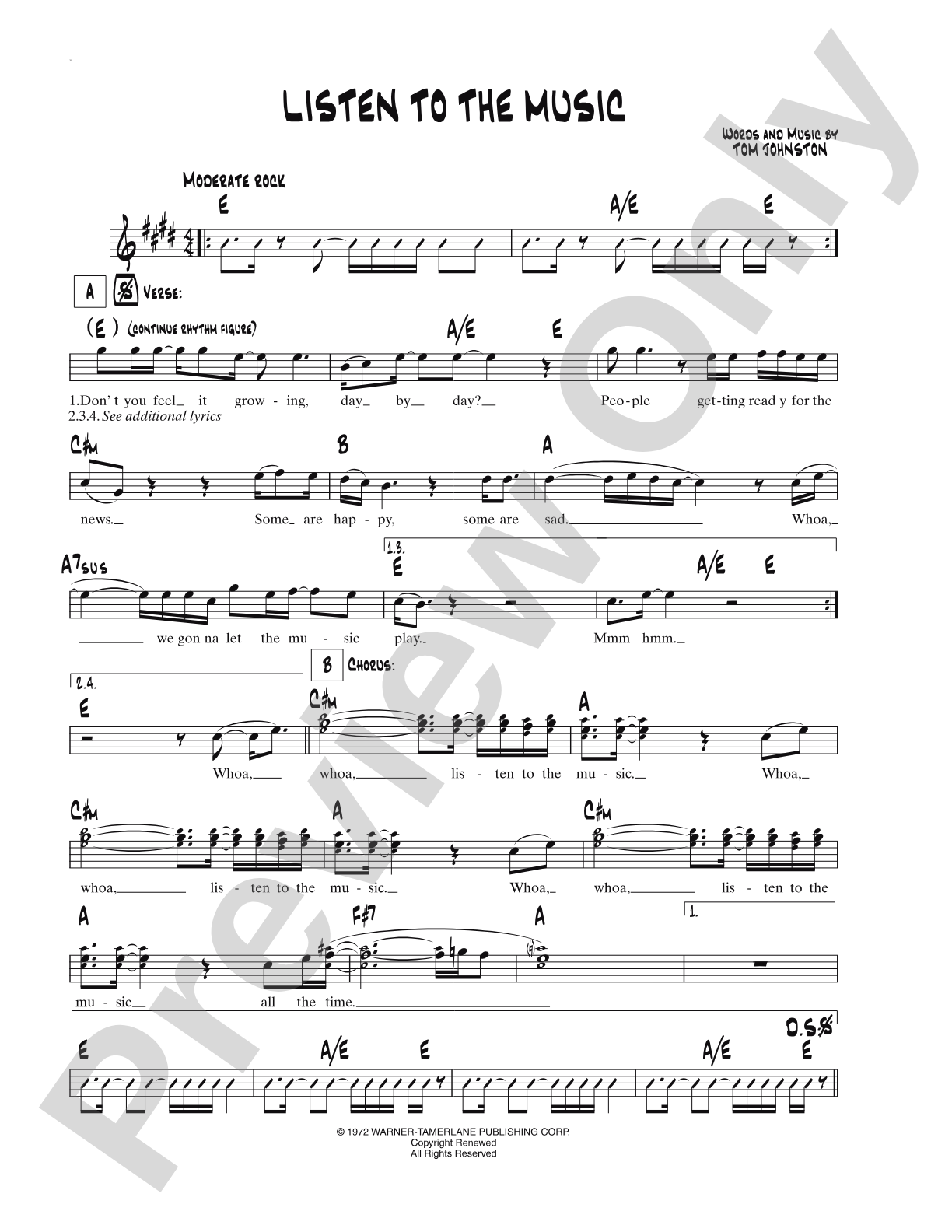

Listen To The Music: Lead Sheet
The Doobie Brothers
Item: 00-PSL-000612
$4.99
One moment…
Description
As one of the most popular Californian pop/rock bands of the '70s, the Doobie Brothers racked up a string of gold and platinum albums, and No. 1 radio hits. Guitarists will love playing these classic titles: Black Water * China Grove * It Keeps You Runnin' * Jesus Is Just Alright * Listen to the Music * Long Train Runnin' * Minute by Minute * Real Love * Rockin' Down the Highway * South City Midnight Lady * Take Me in Your Arms * Takin' It to the Streets * What a Fool Believes.


Listen To The Music: Lead Sheet isn't in MakeMusic Cloud just yet...but it could be. Let us know you'd like to see it, and you'll help shape what comes next. In the meantime, start a free trial and dive into thousands of interactive titles your students can play along with today.
Request This Title
Tell us you want it.
Start Your Free Trial
Explore everything that's ready to play right now.
Sample Audio
No sample audio found.
Sample Video
No sample videos found.
Additional Details
Series:
Guitar Anthology Series
Publisher:
Alfred Music
Page Count:
88
SKU:
00-PSL-000612
More about this title
About the Artist: The Doobie Brothers
The Doobie Brothers emerged from San Jose in the late 1960s to become one of California's most successful rock acts. The band cycled through several lineups across its peak decades, with guitarists Tom Johnston and Jeff "Skunk" Baxter anchoring the instrumental sound while vocalists rotated between Johnston, Patrick Simmons, and Michael McDonald. Their catalog spans boogie-rock energy, sophisticated pop hooks, and R&B-influenced grooves, landing them multiple Grammy Awards and a string of hits that defined FM radio in the 1970s and 1980s.
For guitarists, the Doobie Brothers catalog represents a masterclass in accessible rock playing. Their songs balance straightforward rhythm work with memorable lead lines, clean technique over flash, and the kind of groove-oriented approach that rewards steady practice and band awareness.
Why we love this
This collection spans the band's essential repertoire with tablature that honors both rhythm and lead parts. You get recognizable hits that students already know and want to play, paired with arrangements detailed enough to capture the original character without overwhelming sight readers.
What to expect
Warm, groove-heavy, and immediately satisfying. These songs breathe with the kind of California rock confidence that feels effortless to listen to and rewarding to play once you lock into the pocket. The mix of rhythm work and lead moments keeps ensemble playing engaging without demanding virtuosity.
Who it's for
Guitarists who want to expand their repertoire with songs people recognize and enjoy hearing. This collection suits players comfortable reading tab who are ready to work on dynamics, groove, and band coordination rather than just technical chops.
How to get the most out of it
- Dial in the pocket on rhythm parts first. These songs live in the groove; nailing the timing and feel matters more than speed.
- Pay close attention to the recorded versions for dynamics and phrasing. The studio recordings show you where volume swells, where notes breathe, and where the band locks in.
- When trading lead passages, lock the rhythm guitar parts with bass and drums as a unit. The Doobie Brothers' arrangements depend on tight communication between instruments.
- Study the chord voicings in context. The band's guitarists use specific fingerings and positions that color the sound; tabs show you what they played, not just what pitches work.
How to use it
Build a '70s rock showcase around these titles, or pull individual hits for a popular music segment in a concert. These songs work well in informal settings, open houses, and student jam sessions where the goal is musical enjoyment and audience connection.
Skills your students will build
- Reading authentic guitar tablature across rhythm and lead contexts
- Understanding groove-oriented rhythm guitar and its role in the band
- Translating studio recordings into performance decisions about dynamics and phrasing
- Playing clean, economical lead lines without overcomplication
- Locking in with bass and drums as an ensemble unit