
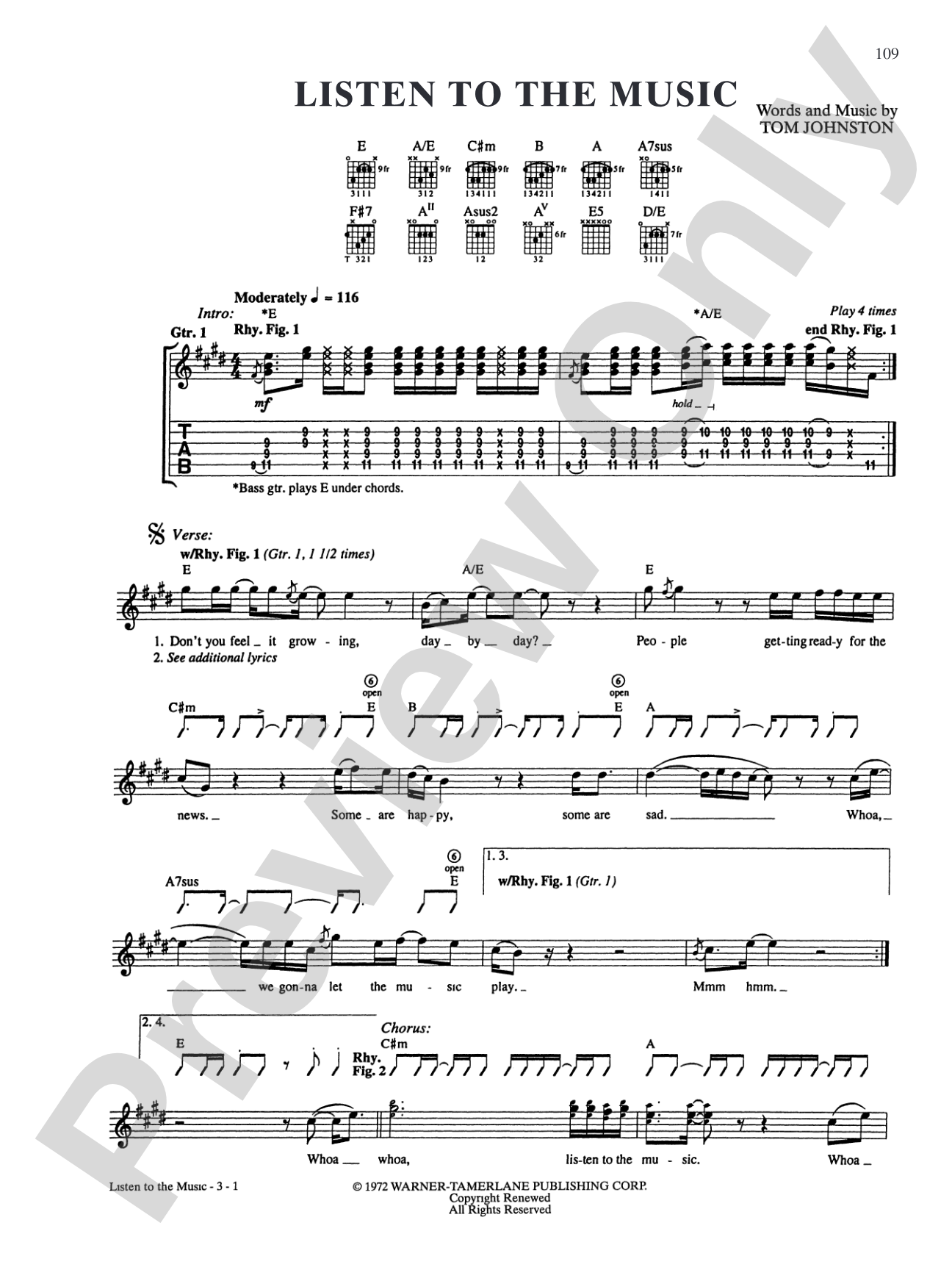

Listen To The Music: Authentic Guitar TAB
The Doobie Brothers
Item: 00-PSG-000052
$4.99
One moment…
Description
As one of the most popular Californian pop/rock bands of the '70s, the Doobie Brothers racked up a string of gold and platinum albums, and No. 1 radio hits. Guitarists will love playing these classic titles: Black Water * China Grove * It Keeps You Runnin' * Jesus Is Just Alright * Listen to the Music * Long Train Runnin' * Minute by Minute * Real Love * Rockin' Down the Highway * South City Midnight Lady * Take Me in Your Arms * Takin' It to the Streets * What a Fool Believes.


Listen To The Music: Authentic Guitar TAB isn't in MakeMusic Cloud just yet...but it could be. Let us know you'd like to see it, and you'll help shape what comes next. In the meantime, start a free trial and dive into thousands of interactive titles your students can play along with today.
Request This Title
Tell us you want it.
Start Your Free Trial
Explore everything that's ready to play right now.
Sample Audio
No sample audio found.
Sample Video
No sample videos found.
Additional Details
Series:
Guitar Anthology Series
Publisher:
Alfred Music
Page Count:
88
SKU:
00-PSG-000052
More about this title
About the Artist: The Doobie Brothers
Formed in 1970 in San Jose, California, the Doobie Brothers became one of the most successful rock bands of the 1970s with a distinctive blend of rock, soul, and country influences. The band's lineup evolved throughout their career, but their core sound remained rooted in tight vocal harmonies, infectious grooves, and guitar work that defined the era. Their albums earned multiple platinum certifications, and songs like "Listen to the Music" and "What a Fool Believes" became radio staples that still resonate with audiences today.
The Doobie Brothers' catalog showcases the craft of songwriting and arrangement that made them enduring figures in popular music. Their compositions reward careful study of rhythm guitar, fingerpicking patterns, and the interplay between lead and rhythm parts. For guitarists, the band's work offers accessible yet musically substantive material that builds technique while delivering the satisfaction of playing recognizable hits.
Why we love this
These thirteen songs capture the essence of 1970s California rock at its most groove-oriented and melodically rich. Every track in this collection has earned its place in popular memory, which means your students will recognize them immediately and want to master them. The guitar arrangements span rhythm work, lead lines, and fingerpicking patterns that teach real musicianship without feeling like exercises.
What to expect
Warm, groovy, and immediately familiar. These songs breathe with the confidence of a band in its prime, balancing tight musical precision with an easygoing, soulful attitude. Whether it's the gentle fingerpicking of a slow burn or the locked-in energy of a driving groove, every track captures the spirit of a band that knew how to write songs people wanted to hear again and again.
Who it's for
Guitarists at the intermediate level and beyond who want to expand their repertoire with authentic, professional arrangements of songs they actually want to play. This collection works well for students exploring 1970s rock styles and for players preparing material for jam sessions, recitals, or band contexts.
How to get the most out of it
- Pay close attention to the rhythm section pocket in songs like "China Grove" and "Rockin' Down the Highway." The guitar's relationship to the drums and bass defines these grooves; lock in with a metronome first, then layer in the nuance.
- Study the fingerpicking patterns in "Black Water" and "South City Midnight Lady" as complete musical statements, not just technical hurdles. These patterns carry the melody and harmony simultaneously.
- Use the vocal melodies as a guide for phrasing in lead sections. The Doobie Brothers' singing style is conversational and rhythmically loose in places; bring that same sensibility to your guitar voicings and fills.
- Balance the volume between rhythm and lead guitar parts when playing multiple tracks. The band's signature sound depends on clear separation between these layers, especially in the fuller arrangements.
How to use it
Assign individual songs as recital pieces or as part of a unit on 1970s rock guitar styles. Several tracks work beautifully as duets or band arrangements, making them ideal for ensemble projects alongside more traditional classical repertoire. This collection also serves as engaging supplementary material for students who need motivation to continue lessons.
Skills your students will build
- Groove-based rhythm guitar playing with attention to feel and pocket
- Fingerpicking patterns in rock and pop contexts
- Lead guitar lines and improvisation over chord changes
- Reading and playing authentic TAB notation
- Phrasing and dynamics in rock contexts
- Integrating rhythm and lead playing in the same song