
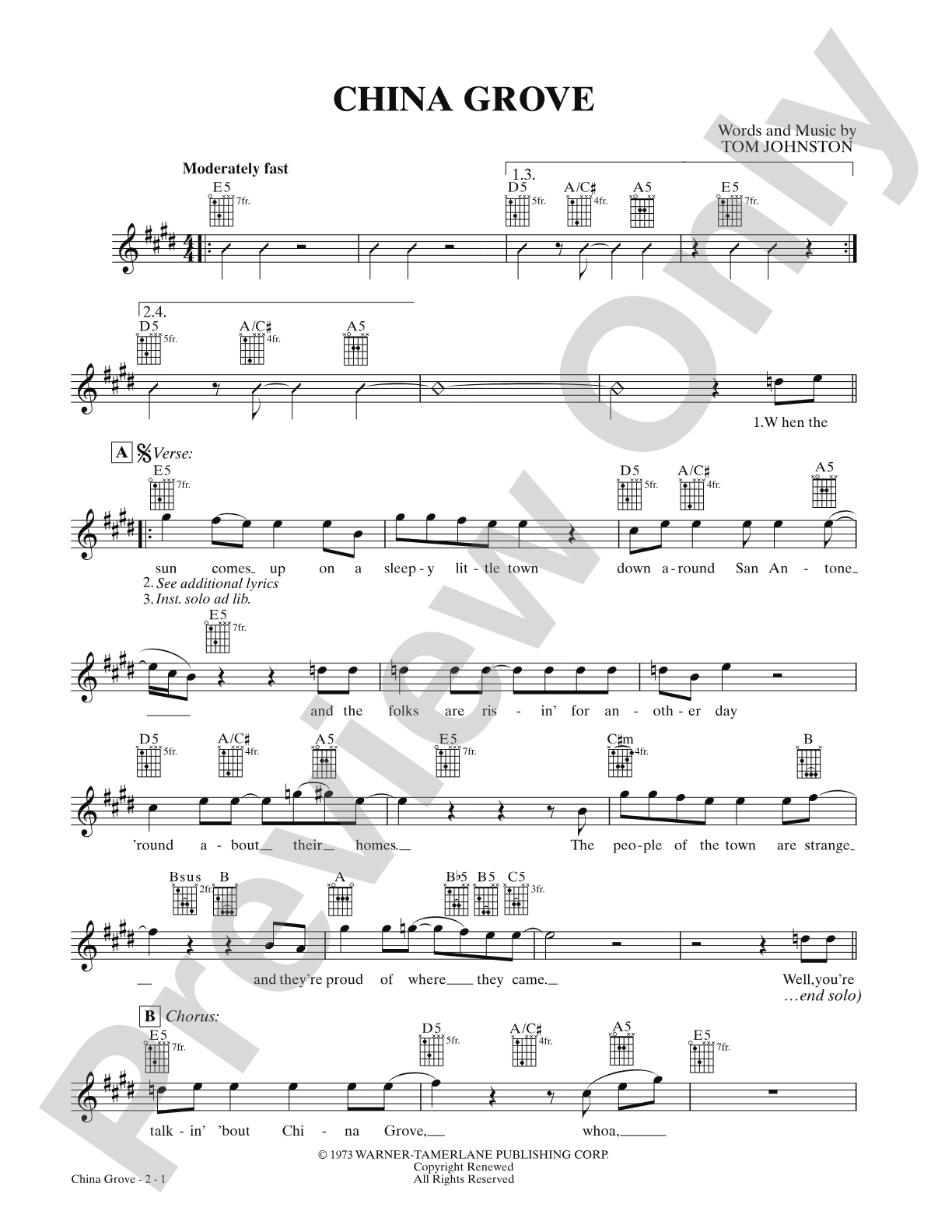

China Grove: Lead Sheet
The Doobie Brothers
Item: 00-PSL-000702
$4.99
One moment…
Description
As one of the most popular Californian pop/rock bands of the '70s, the Doobie Brothers racked up a string of gold and platinum albums, and No. 1 radio hits. Guitarists will love playing these classic titles: Black Water * China Grove * It Keeps You Runnin' * Jesus Is Just Alright * Listen to the Music * Long Train Runnin' * Minute by Minute * Real Love * Rockin' Down the Highway * South City Midnight Lady * Take Me in Your Arms * Takin' It to the Streets * What a Fool Believes.


China Grove: Lead Sheet isn't in MakeMusic Cloud just yet...but it could be. Let us know you'd like to see it, and you'll help shape what comes next. In the meantime, start a free trial and dive into thousands of interactive titles your students can play along with today.
Request This Title
Tell us you want it.
Start Your Free Trial
Explore everything that's ready to play right now.
Sample Audio
No sample audio found.
Sample Video
No sample videos found.
Additional Details
Series:
Guitar Anthology Series
Publisher:
Alfred Music
Page Count:
88
SKU:
00-PSL-000702
More about this title
About the Artist: The Doobie Brothers
The Doobie Brothers emerged from San Jose, California, in the late 1960s and became one of the defining rock bands of the 1970s. Their sound blended rock, soul, and pop sensibilities, powered by intricate guitar work and tight vocal harmonies. The band's lineup evolved throughout their career, but their commitment to musicianship remained constant, earning them multiple Grammy Awards and a string of platinum albums.
Known for crafting infectious hooks and sophisticated arrangements, the Doobie Brothers created songs that showcased both technical guitar prowess and accessible melodies. Their influence on rock music education extends beyond their chart success; their recorded work serves as a masterclass in voice leading, rhythm guitar interplay, and the role of lead guitar in pop/rock songwriting.
Why we love this
These lead sheets capture some of the most recognizable rock guitar signatures of the 1970s, giving players the chance to decode the exact voicings and rhythmic feels that made these songs radio staples. The collection spans thirteen essential tracks, so you can program a full set of Doobie Brothers material or cherry-pick standouts for students at different skill levels. Every song rewards careful listening to the original recordings, turning transcription into genuine musical investigation.
What to expect
These songs pulse with the confidence of a band that knew how to make people move. There's a smoothness to the grooves, a warmth in the guitar tones, and a craftsmanship in every arrangement that reflects a group playing at the height of their powers. From the immediately catchy to the subtly sophisticated, each song captures a different facet of 1970s rock radio at its finest.
Who it's for
Guitarists who want to understand the harmonic and rhythmic language of 1970s rock will find a complete education in these thirteen transcriptions. This collection works well for intermediate to advanced players who can read lead sheets and translate them into performance. Players studying songwriting, arrangement, and rock guitar style will discover the blueprint for how the Doobie Brothers constructed their hits.
How to get the most out of it
- Listen carefully to the original recordings before reading the lead sheet. The Doobie Brothers' guitar tones and rhythmic phrasing contain nuances that notation alone cannot capture.
- Pay attention to the syncopation between rhythm and lead guitar parts. Many of these songs feature interlocking guitar lines that create the song's signature groove.
- Study the voicing choices throughout each chart. The band's signature sound relies on specific chord colors that extend beyond basic triads.
- Lock into the pocket by counting the exact subdivision in which each phrase sits. The songs that feel effortless on record require precision in execution.
How to use it
Use individual songs from this collection as models when teaching harmonic analysis or groove-based songwriting. The variety across these thirteen tracks allows you to select pieces that match your students' current focus, whether studying dominant chords, suspended voicings, or rhythm guitar textures. Programming a medley of Doobie Brothers hits works especially well for rock ensemble concerts or recitals that celebrate classic California rock.
Skills your students will build
- Reading and interpreting lead sheet notation with chord symbols and rhythmic cues
- Identifying and playing jazz-influenced voicings in a rock context
- Synchronizing rhythm guitar with lead guitar lines
- Understanding groove and pocket in 1970s pop/rock style
- Transcribing from recorded sources and matching lead sheet notation to original recordings