
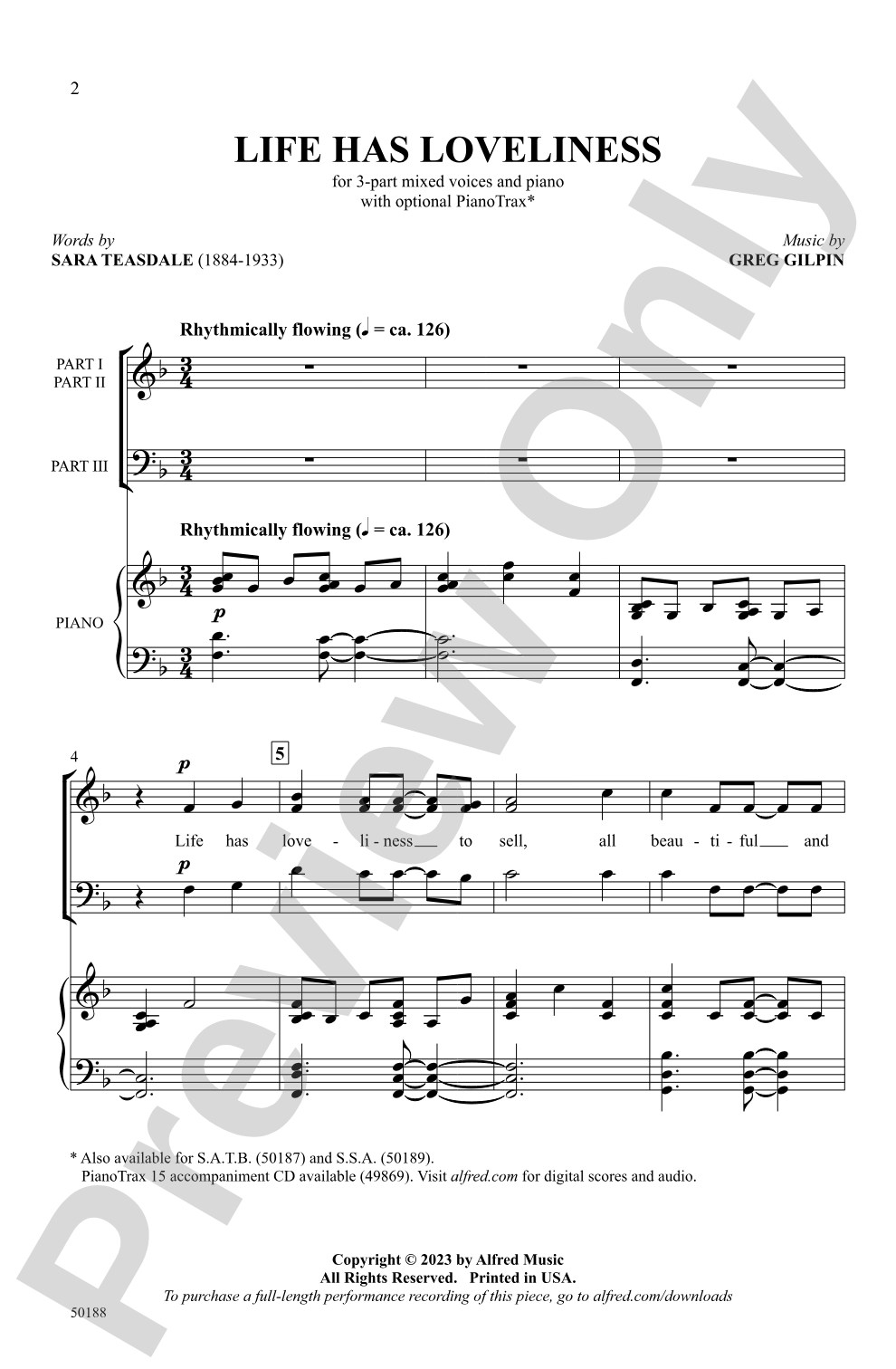

Life Has Loveliness: 3-Part Mixed Choral Octavo
Words by Sara Teasdale, music by Greg Gilpin
Item: 00-PO-0007044
$2.05
Minimum order quantity: 20 copies
Pickup currently not available
Related Items
Life Has Loveliness: PianoTrax Digital Audio Download |
$9.99
|
View | |
Life Has Loveliness: SATB Choral Octavo |
$2.05
|
View | |
Life Has Loveliness: SSA Choral Octavo |
$2.05
|
View | |
Life Has Loveliness: SATB Choral Octavo |
$2.05
|
View | |
Life Has Loveliness: 3-Part Mixed Choral Octavo |
$2.05
|
View | |
Life Has Loveliness: SSA Choral Octavo |
$2.05
|
View |
Description
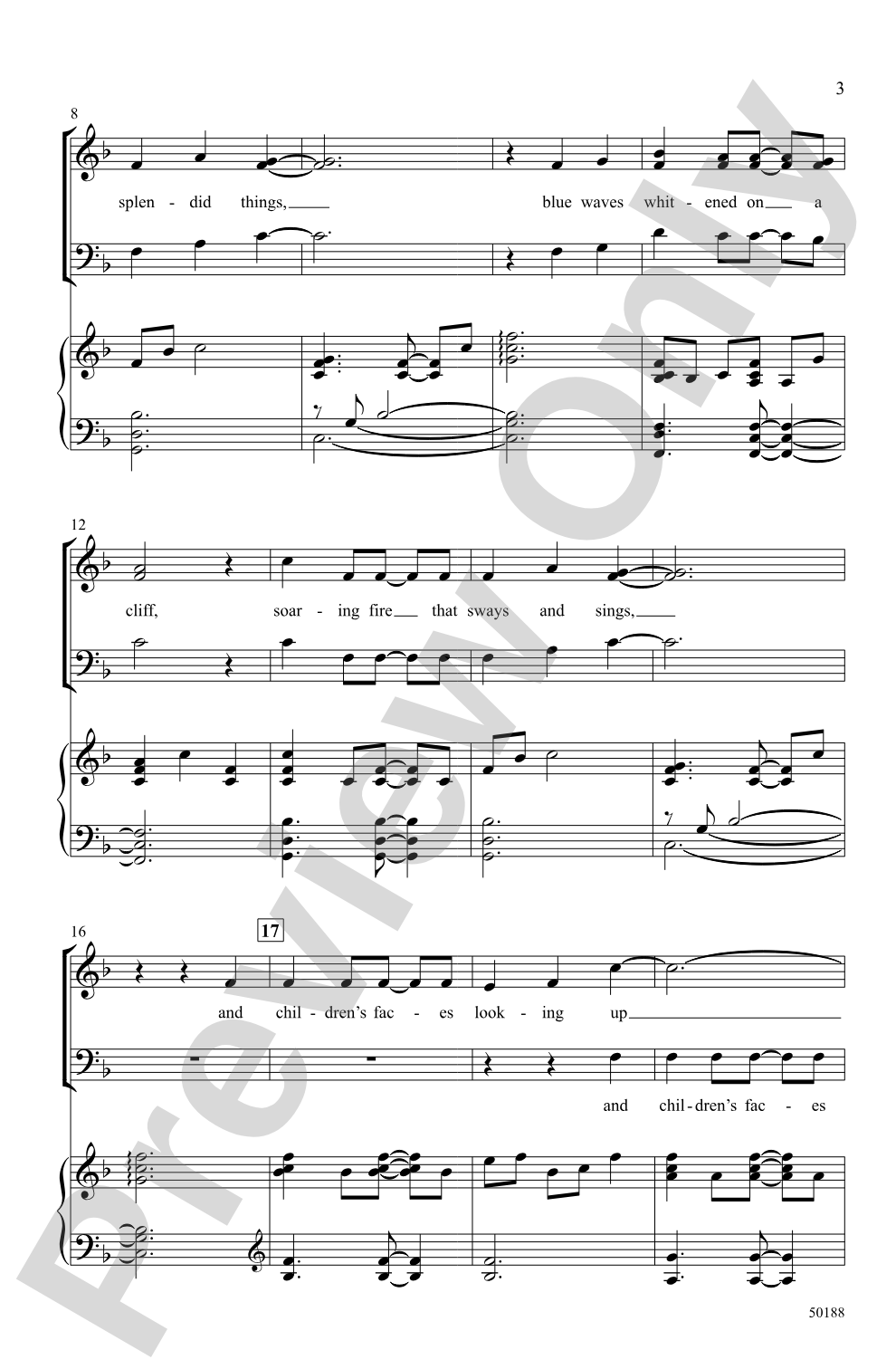
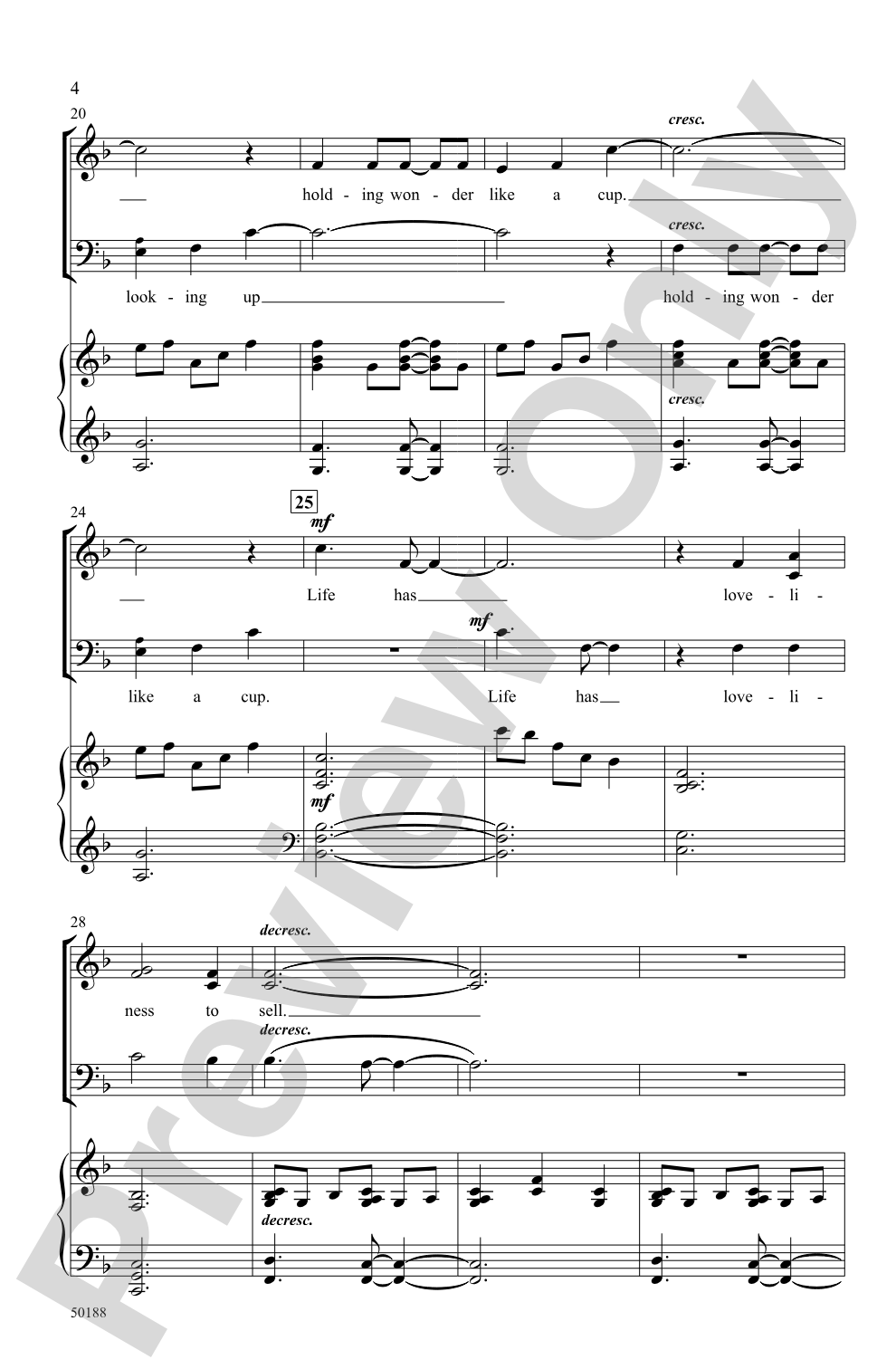
Acknowledge life's many gifts with this splendid setting of Sara Teasdale's poem that reminds us to "spend all you have for loveliness." A lilting rhythmic flow and some refreshing mixed meter moments create a buoyant effect. Greg's tuneful lines and sensible part writing are satisfying to sing and pave the way to success. Absolutely delightful!


Life Has Loveliness: 3-Part Mixed Choral Octavo isn't in MakeMusic Cloud just yet...but it could be. Let us know you'd like to see it, and you'll help shape what comes next. In the meantime, start a free trial and dive into thousands of interactive titles your students can play along with today.
Request This Title
Tell us you want it.
Start Your Free Trial
Explore everything that's ready to play right now.
Sample Audio
1
Audio File
--:--
0:00
0:00
Sample Video
Additional Details
Series:
Alfred Choral Designs
Publisher:
Alfred Music
Page Count:
12
SKU:
00-PO-0007044
More about this title
About the Composer: Greg Gilpin

Greg Gilpin is an ASCAP award-winning composer and conductor whose work has been performed at prestigious venues including Carnegie Hall, Lincoln Center, Ryman Auditorium, Sydney Opera House, Royal Festival Hall, and Harpa Concert Hall. As Director of Educational Choral Publications for Shawnee Press, he shapes choral repertoire for schools and community ensembles nationwide.
Beyond the concert hall, Gilpin has expanded his creative reach into film scoring and recording production. His 2021 score for the short film "Rosie's Rescue" earned Best Score honors, and he collaborated with opera singer Angela Brown on a new arrangement of "What Child is This?" premiered with the Indianapolis Symphonic Choir. A member of ACDA, NAfME, SAG-AFTRA, and a Life Loyal Member of Phi Mu Alpha Sinfonia, Gilpin brings both artistic depth and educational commitment to every project.
Why we love this
Gilpin's gift for clear, singable lines makes this piece immediately accessible to developing mixed choirs without sacrificing musical interest. The shifting meters feel organic rather than awkward, and the text setting reinforces Teasdale's message about appreciating life's beauty in a way that feels earned rather than sentimental.
What to expect
The piece has a bright, forward-moving quality that mirrors Teasdale's celebration of life's gifts. Mixed meters create moments of gentle surprise, keeping singers engaged while the tuneful lines ensure the whole ensemble enjoys singing it.
Who it's for
This works beautifully for high school choirs and community ensembles seeking repertoire that's musically rewarding without excessive technical demand. It's equally suited to mixed and SAB choirs and sits perfectly in a graduation concert or end-of-year festival program.
How to get the most out of it
- Maintain the lilting rhythmic flow as your primary interpretive focus; think of the meter changes as gentle shifts rather than technical obstacles that need special attention.
- Balance the three parts carefully during the mixed meter passages so each voice group remains clear and confident, which will actually help audiences feel the buoyancy rather than any uncertainty.
- Let the poetry guide your phrasing and dynamic choices; find places where Teasdale's language naturally suggests a breath or a swell without forcing editorial marks.
How to use it
Pair this with other uplifting secular choral works on a graduation or spring concert, or use it as a festival selection where the literary text and accessible difficulty will appeal to adjudicators. Its moderate length and 12-page score make it practical for groups with limited rehearsal time.
Skills your students will build
- Reading mixed meters (common time and 3/4) and executing confident rhythm transitions
- Balancing three-part mixed voicing with attention to texture and clarity
- Text-based interpretation and phrase shaping in secular choral music
- Ensemble awareness and independence within the SAB texture