
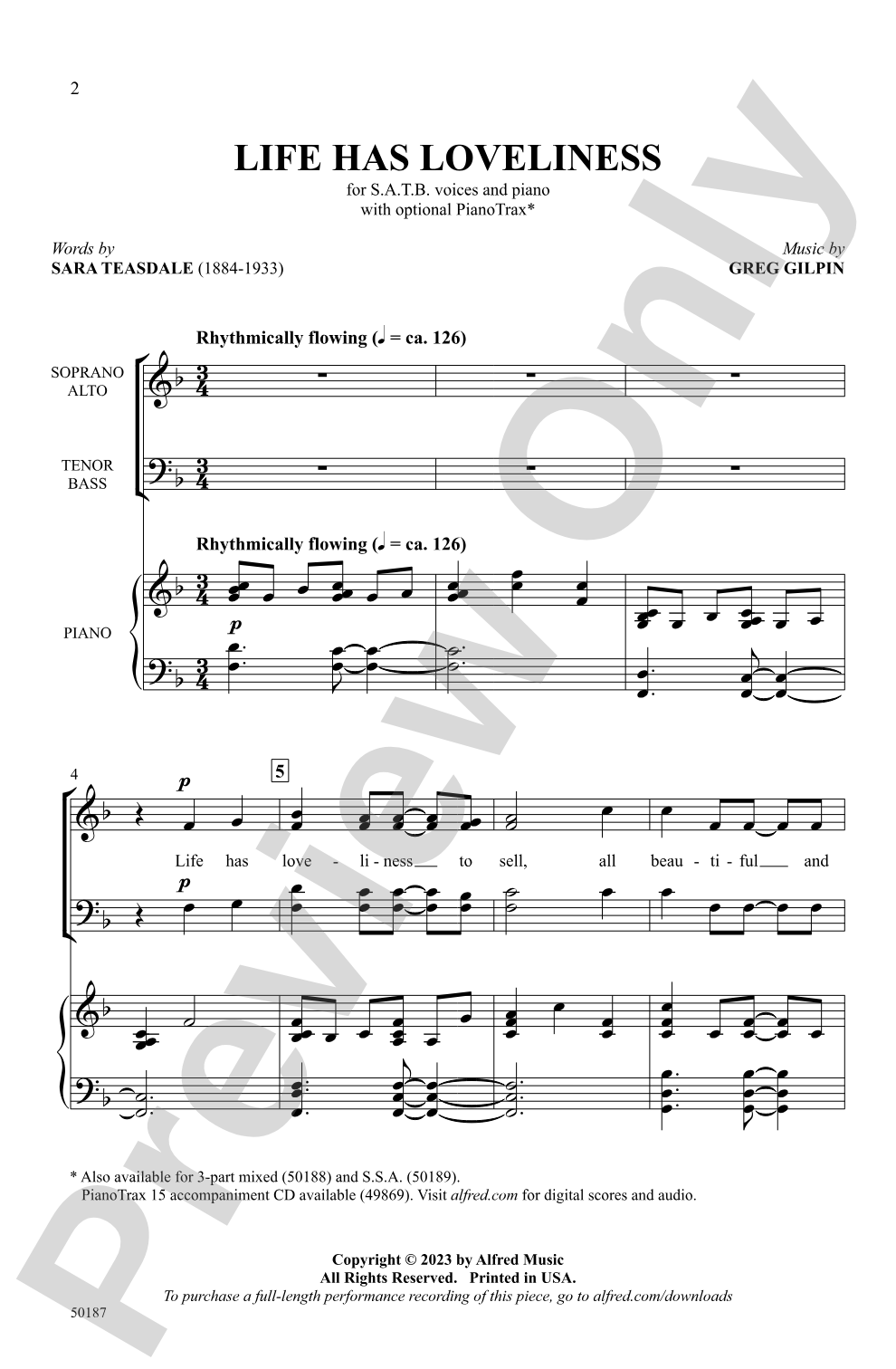

Life Has Loveliness: SATB Choral Octavo
Words by Sara Teasdale, music by Greg Gilpin
Item: 00-PO-0007043
$2.05
Minimum order quantity: 20 copies
Pickup currently not available
Related Items
Life Has Loveliness: PianoTrax Digital Audio Download |
$9.99
|
View | |
Life Has Loveliness: 3-Part Mixed Choral Octavo |
$2.05
|
View | |
Life Has Loveliness: SSA Choral Octavo |
$2.05
|
View | |
Life Has Loveliness: SATB Choral Octavo |
$2.05
|
View | |
Life Has Loveliness: 3-Part Mixed Choral Octavo |
$2.05
|
View | |
Life Has Loveliness: SSA Choral Octavo |
$2.05
|
View |
Description
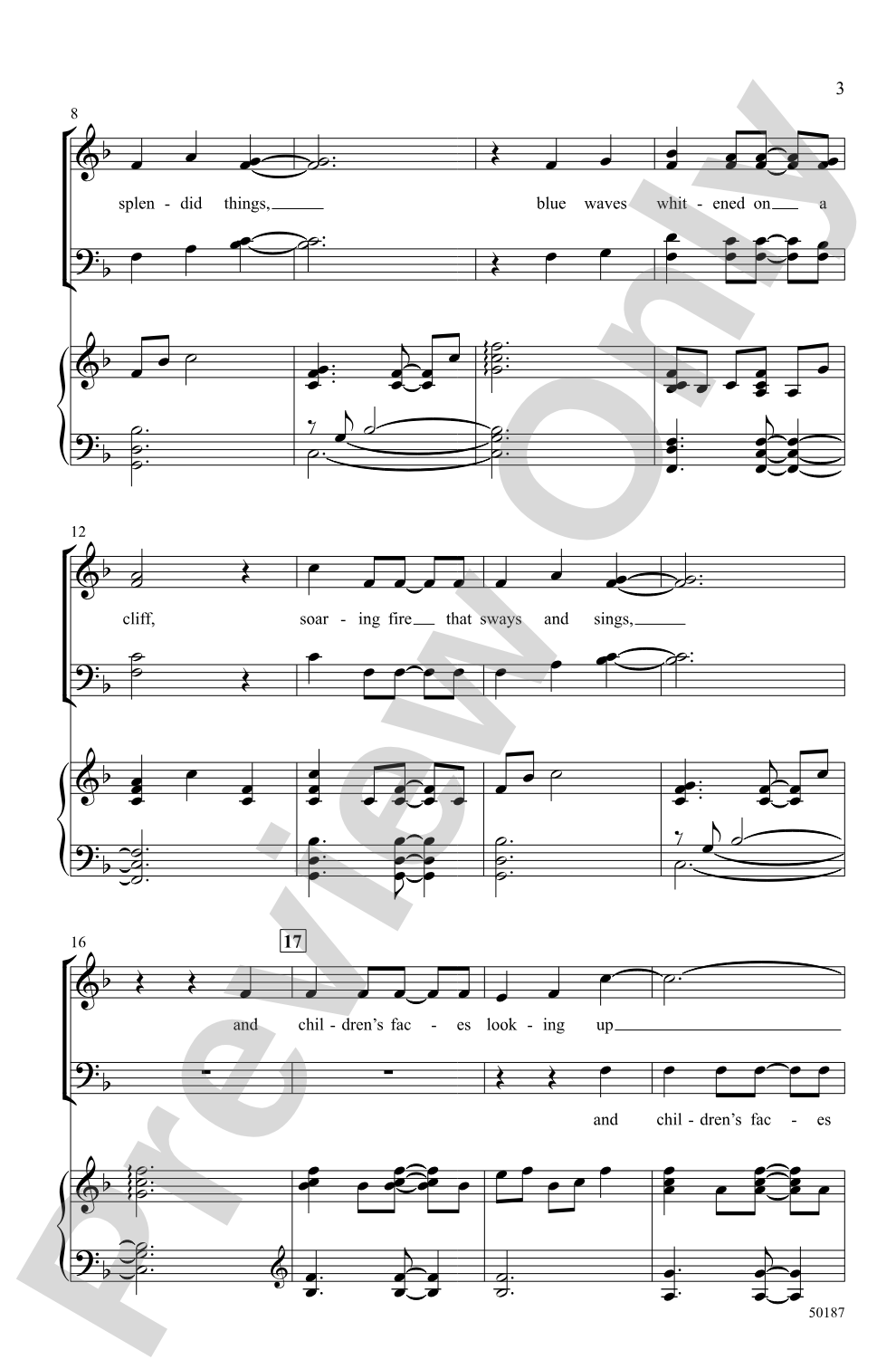
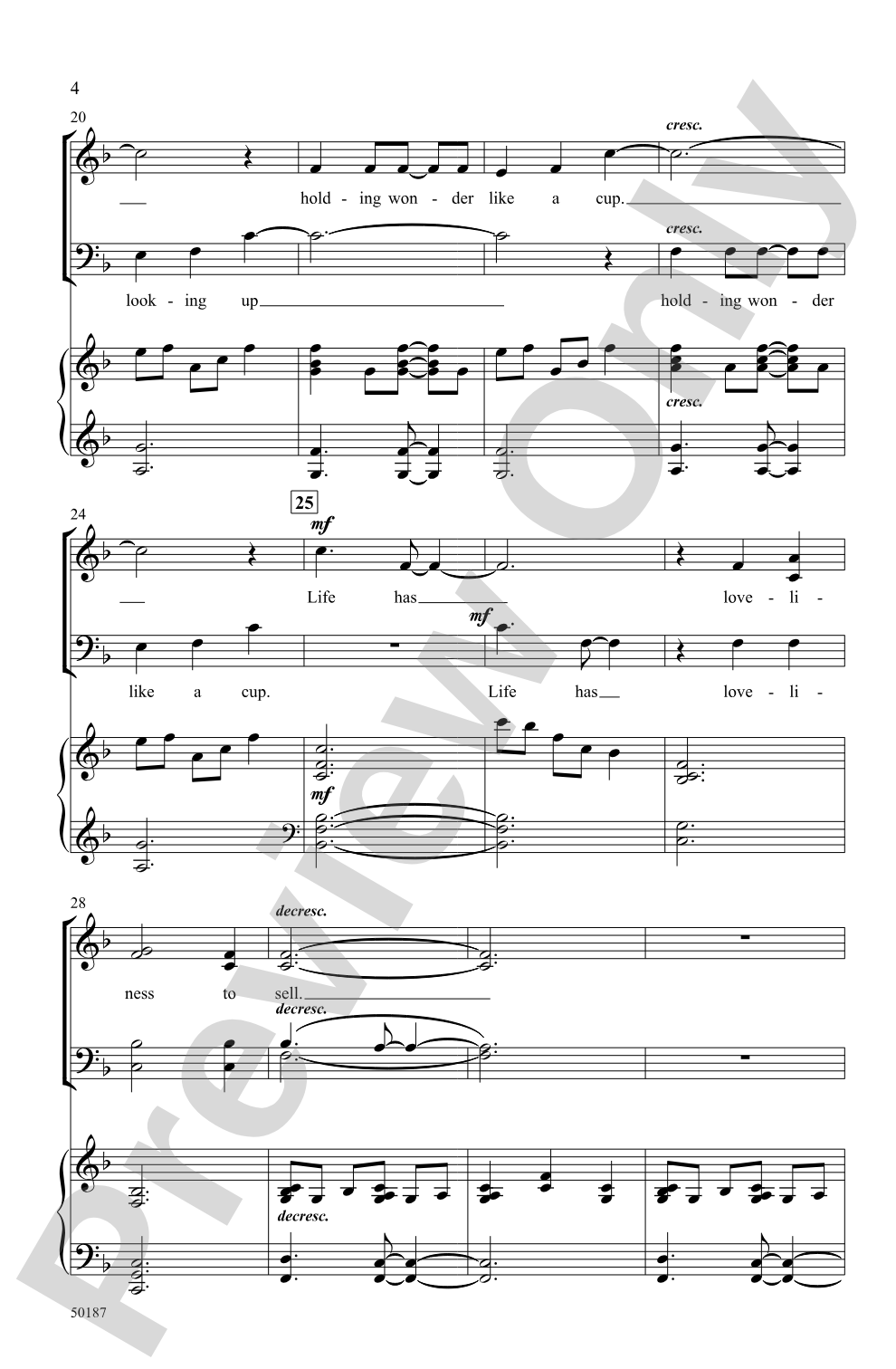
Acknowledge life's many gifts with this splendid setting of Sara Teasdale's poem that reminds us to "spend all you have for loveliness." A lilting rhythmic flow and some refreshing mixed meter moments create a buoyant effect. Greg's tuneful lines and sensible part writing are satisfying to sing and pave the way to success. Absolutely delightful!


Life Has Loveliness: SATB Choral Octavo isn't in MakeMusic Cloud just yet...but it could be. Let us know you'd like to see it, and you'll help shape what comes next. In the meantime, start a free trial and dive into thousands of interactive titles your students can play along with today.
Request This Title
Tell us you want it.
Start Your Free Trial
Explore everything that's ready to play right now.
Sample Audio
1
Audio File
--:--
0:00
0:00
Sample Video
Additional Details
Series:
Alfred Choral Designs
Publisher:
Alfred Music
Page Count:
12
SKU:
00-PO-0007043
More about this title
About the Composer: Greg Gilpin

Greg Gilpin has established himself as one of America's most prolific and performed choral composers, with his works regularly heard in concert halls from Carnegie Hall and Lincoln Center to Ryman Auditorium and beyond. His international conducting engagements have taken him to the Sydney Opera House, Royal Festival Hall in London, and Harpa Concert Hall in Reykjavik, reflecting the global reach of his compositional voice.
An ASCAP award winner and director of educational choral publications for Shawnee Press, Gilpin brings both creative vision and deep understanding of what singers need to succeed. His career extends into film scoring, recording production, and professional organizing, making him a multifaceted artist equally at home in the choral rehearsal room and the recording studio. He holds membership in ACDA, NAfME, SAG-AFTRA, and serves as a Life Loyal Member of Phi Mu Alpha Sinfonia.
Why we love this
Gilpin's setting captures the hopeful spirit of Teasdale's poem without oversimplifying it. The mixed meter shifts feel organic rather than showy, and the part writing gives every voice something genuinely musical to sing, which means your singers will stay engaged whether they're on the melody line or supporting harmony.
What to expect
There's an infectious lightness here that propels the music forward. The mixed meters create subtle syncopation that keeps listeners alert, while the tuneful melodies and clear harmonies create a sense of warmth and affirmation. Singing this feels like being reminded to notice and cherish what matters.
Who it's for
This octavo works beautifully for high school and adult choirs seeking concert repertoire with literary substance and immediate musical appeal. It's especially fitting for graduation, spring concerts, and festival programming where you want something that feels celebratory without becoming saccharine.
How to get the most out of it
- Emphasize the lilting rhythmic quality by maintaining a flexible, dance-like pulse through the mixed meter passages rather than rigidly counting every beat change.
- Balance the tuneful soprano and alto lines with just enough harmonic weight from the men's voices to let the text shine through clearly.
- Use the recorded accompaniment to help singers internalize the rhythm during early rehearsals, then gradually remove it to develop stronger ensemble independence.
- Shape phrases around the text and meaning of Teasdale's poem rather than treating section breaks as hard stops; let the music breathe between thoughts.
How to use it
This piece sits comfortably alongside other contemporary secular choral works in a spring or graduation concert; pair it with something more introspective to create programming depth. Its moderate length and approachable difficulty also make it an excellent choice for festival competitions where you want to showcase your singers' musicality and diction.
Skills your students will build
- Reading and performing mixed meters (3/4 and 4/4 alternation or shifts)
- Balancing melodic lines across voice parts while maintaining harmonic integrity
- Singing with text-driven phrasing and expressive control
- Ensemble precision through rhythmic complexity that remains musically natural