
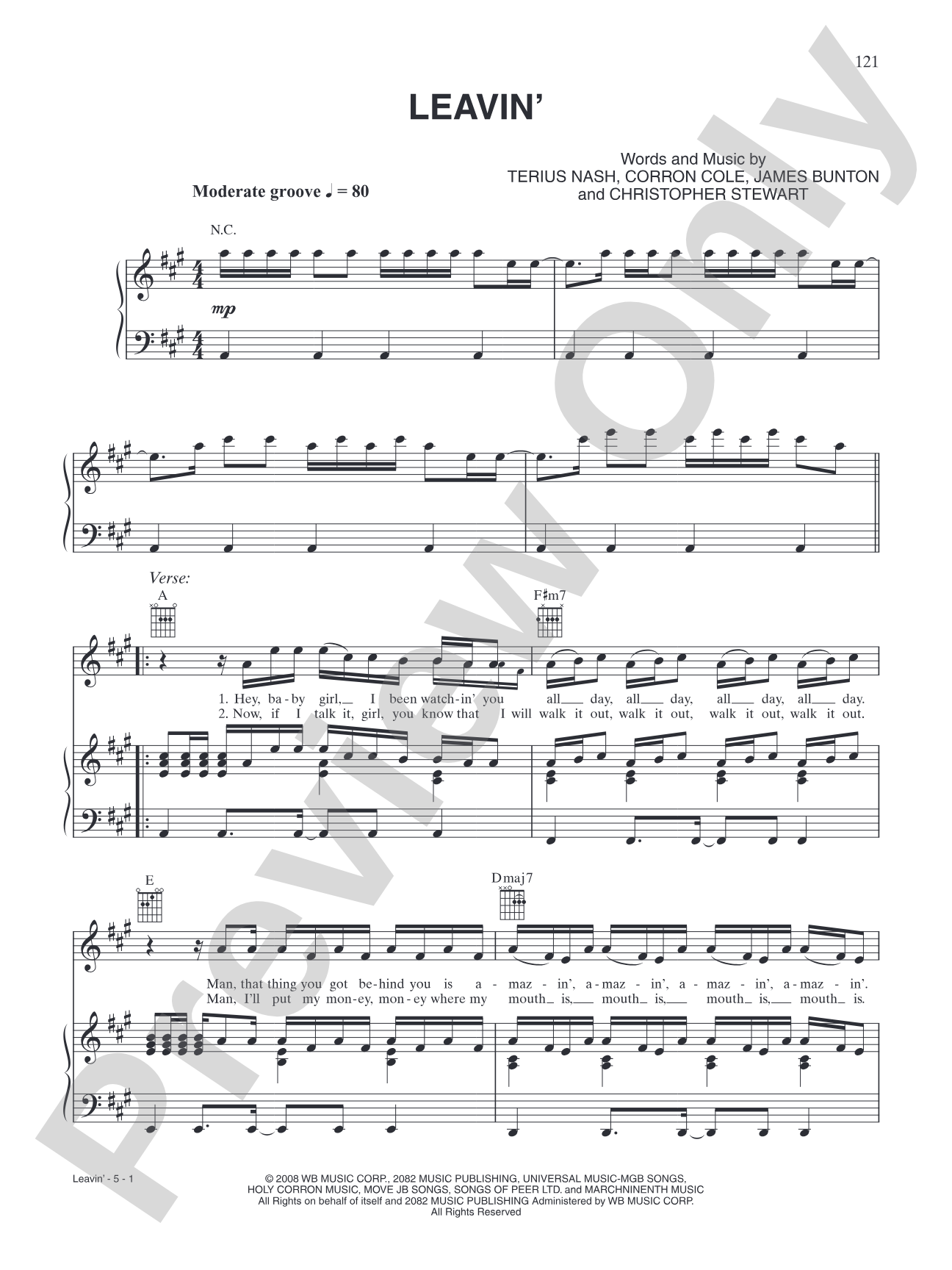

Leavin': Piano/Vocal/Chords
Songs That Made the Year!
Item: 00-PS-0010948
$4.99
One moment…
Related Items
Praying for Time: Piano/Vocal/Chords |
$4.99
|
View | |
Sorry: Piano/Vocal/Chords |
$4.99
|
View | |
Lost: Piano/Vocal/Chords |
$5.99
|
View | |
That's What You Get: Piano/Vocal/Chords |
$5.99
|
View | |
Psycho: Piano/Vocal/Chords |
$5.99
|
View | |
The Story: Piano/Vocal/Chords |
$5.99
|
View | |
4 Minutes: Piano/Vocal/Chords |
$5.99
|
View | |
Paralyzer: Piano/Vocal/Chords |
$5.99
|
View | |
Whatever it Takes: Piano/Vocal/Chords |
$5.99
|
View | |
Porcelain Doll: Piano/Vocal/Chords |
$5.99
|
View |
Description
Titles: 4 Minutes (Madonna and Justin Timberlake) * All Summer Long (Kid Rock) * Almost Lover (A Fine Frenzy) * A-Punk (Vampire Weekend) * Auld Lang Syne (Mairi Campbell and Dave Francis) * Crush (David Archuleta) * Do You Believe Me Now (Jimmy Wayne) * Don't Stop the Music (Rihanna) * Everything (Michael Bublé) * Falling Slowly (from Once) (Glen Hansard and Marketa Irglova) * Goodbye Philadelphia (Peter Cincotti) * Halo 3 Theme: One Final Effort (Martin O'Donnell and Michael Salvatori) * Hey There Delilah (Plain White T's) * Home (Blake Shelton) * Hot N Cold (Katy Perry) * I Kissed a Girl (Katy Perry) * In Love with a Girl (Gavin DeGraw) * In My Arms (Plumb) * Just Got Started Lovin' You (James Otto) * Last Name (Carrie Underwood) * Leavin' (Jesse McCartney) * Lost (Michael Bublé) * New Soul (Yael Naïm) * One Step at a Time (Jordin Sparks) * Our Time Now (Plain White T's) * Paralyzer (Finger Eleven) * Porcelain Doll (Megan McCauley) * Praying for Time (Carrie Underwood) * Psycho (Puddle of Mudd) * Sorry (Buckcherry) * The Story (Brandi Carlile) * That's What You Get (Paramore) * What About Now (Daughtry) * Whatever It Takes (Lifehouse).


Leavin': Piano/Vocal/Chords isn't in MakeMusic Cloud just yet...but it could be. Let us know you'd like to see it, and you'll help shape what comes next. In the meantime, start a free trial and dive into thousands of interactive titles your students can play along with today.
Request This Title
Tell us you want it.
Start Your Free Trial
Explore everything that's ready to play right now.
Sample Audio
No sample audio found.
Sample Video
No sample videos found.
Additional Details
Series:
Sheet Music Playlist
Publisher:
Alfred Music
Page Count:
208
SKU:
00-PS-0010948
More about this title
About the Composer: Terius Nash
Terius Nash, known professionally as The-Dream, is a Grammy-winning producer and songwriter who has shaped modern pop and R&B across three decades. His work spans production, composition, and songwriting for major artists across multiple genres, from hip-hop to pop to country crossovers. Nash's influence on contemporary music reaches far beyond the studio, making him a significant figure in the catalog of songs students encounter in popular music education.
Why we love this
This collection captures the exact moment when pop and rock music teachers need accessible, singable arrangements without sacrificing contemporary appeal. The mix of chart hits, indie favorites, and storytelling songs gives students genuine repertoire choices that feel current while remaining within reach for most skill levels. Programming 2008-era pop alongside folk standards and video game themes signals to students that all musical styles belong in the rehearsal room.
What to expect
This is a snapshot of early-to-mid 2000s pop culture frozen in sheet music. You'll move from Katy Perry's pop hooks to Plain White T's indie charm to Michael Bublé's sophisticated jazz-pop in a single folio, creating a collision of styles that mirrors how modern listeners actually consume music. The collection feels like flipping through a playlist, not a textbook.
Who it's for
This collection serves singers and pianists who want to perform contemporary pop and rock alongside acoustic singer-songwriter material. Teachers will find it useful for choral programs, piano studio recitals, and music electives where students want repertoire that reflects their listening lives.
How to get the most out of it
- Pay close attention to chord voicings in the piano part; many of these arrangements use inversions and extensions that define the song's character, so accuracy matters as much as tempo.
- Treat the vocal melody as a conversation with the keyboard rather than a solo over accompaniment. The interplay between voice and piano is what makes these arrangements work.
- Reference the original recordings for phrasing and dynamics. These songs depend on style and nuance that notation alone cannot capture, especially in contemporary pop songs where the groove sits slightly behind the beat.
- Use the chords symbol to experiment with reharmonization if you're performing with a full band; the piano/vocal arrangement provides the scaffolding, but flexibility in the rhythm section can freshen the sound for different performance contexts.
How to use it
Use individual songs as audition repertoire or solo recital pieces for singers of varying levels and stylistic interests. In a piano studio, this folio works as supplementary performance material that lets students choose songs they love, which often translates to more invested practice. For choral programs, select arrangements to build a contemporary pop concert or as occasional relief between classical repertoire in longer rehearsals.
Skills your students will build
- Reading lead sheet notation and interpreting chord symbols
- Translating contemporary pop style into vocal phrasing and dynamics
- Managing piano accompaniment that ranges from sparse to rhythmically complex
- Analyzing the relationship between melody, harmony, and lyrical content across diverse pop and rock styles
- Performing with stylistic authenticity rather than classical technique as the primary goal