

Lascia Ch'io Pianga (from Rinaldo): SATB Choral Octavo
From Rinaldo
Words and music by George Frideric Handel / ed. and arr. Russell Robinson
Item: 00-PO-0002033
$1.85
Minimum order quantity: 20 copies
Pickup currently not available
Related Items
Lascia Ch'io Pianga: PianoTrax Digital Download |
$9.99
|
View | |
Lascia Ch'io Pianga (from Rinaldo): 3-Part Mixed Choral Octavo |
$1.85
|
View | |
Lascia Ch'io Pianga (from Rinaldo): SSA Choral Octavo |
$1.85
|
View | |
Lascia Ch'io Pianga: SATB Choral Octavo |
$1.85
|
View | |
Lascia Ch'io Pianga: 3-Part Mixed Choral Octavo |
$1.85
|
View | |
Lascia Ch'io Pianga: SSA Choral Octavo |
$1.85
|
View |
Description
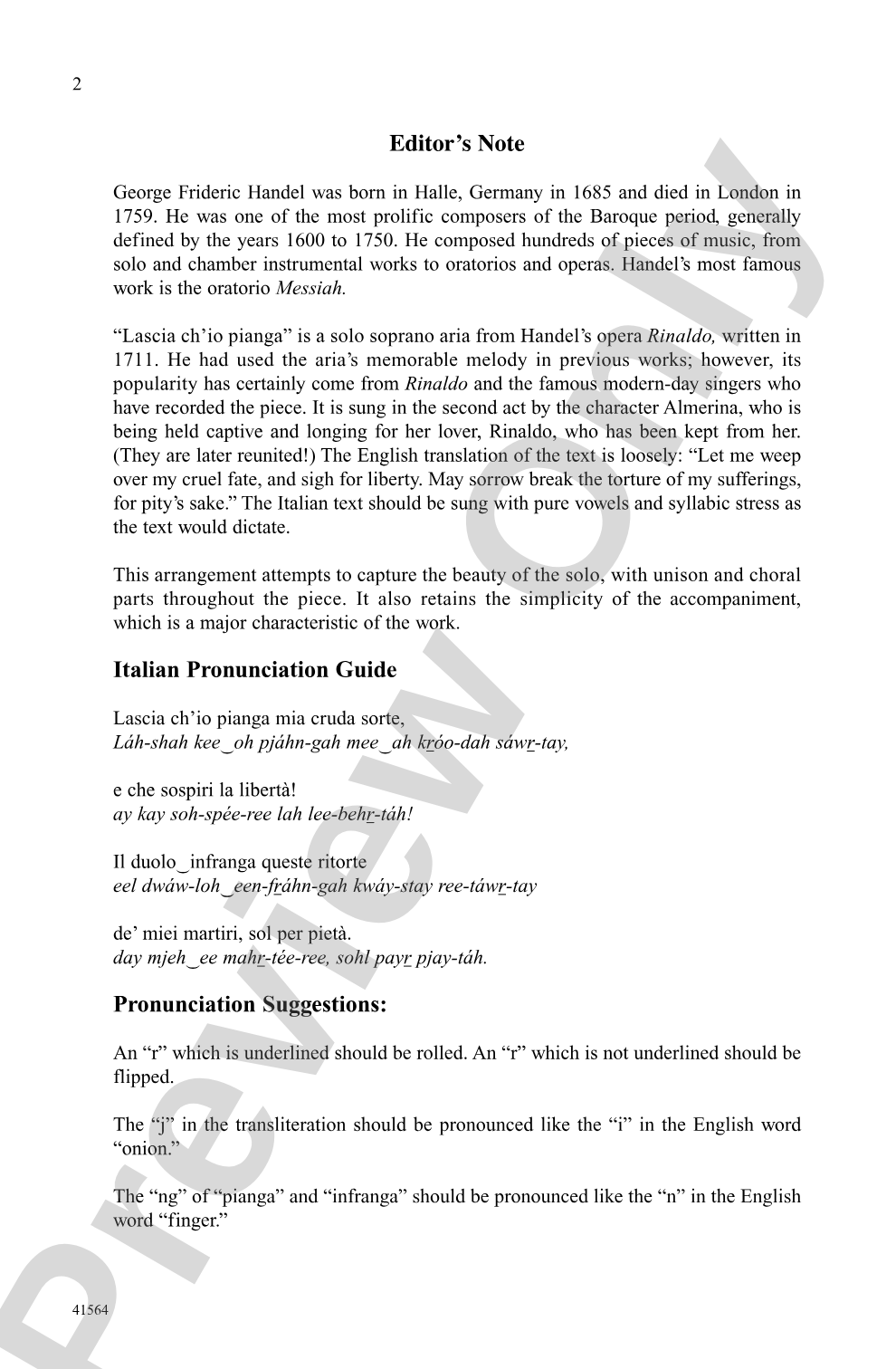
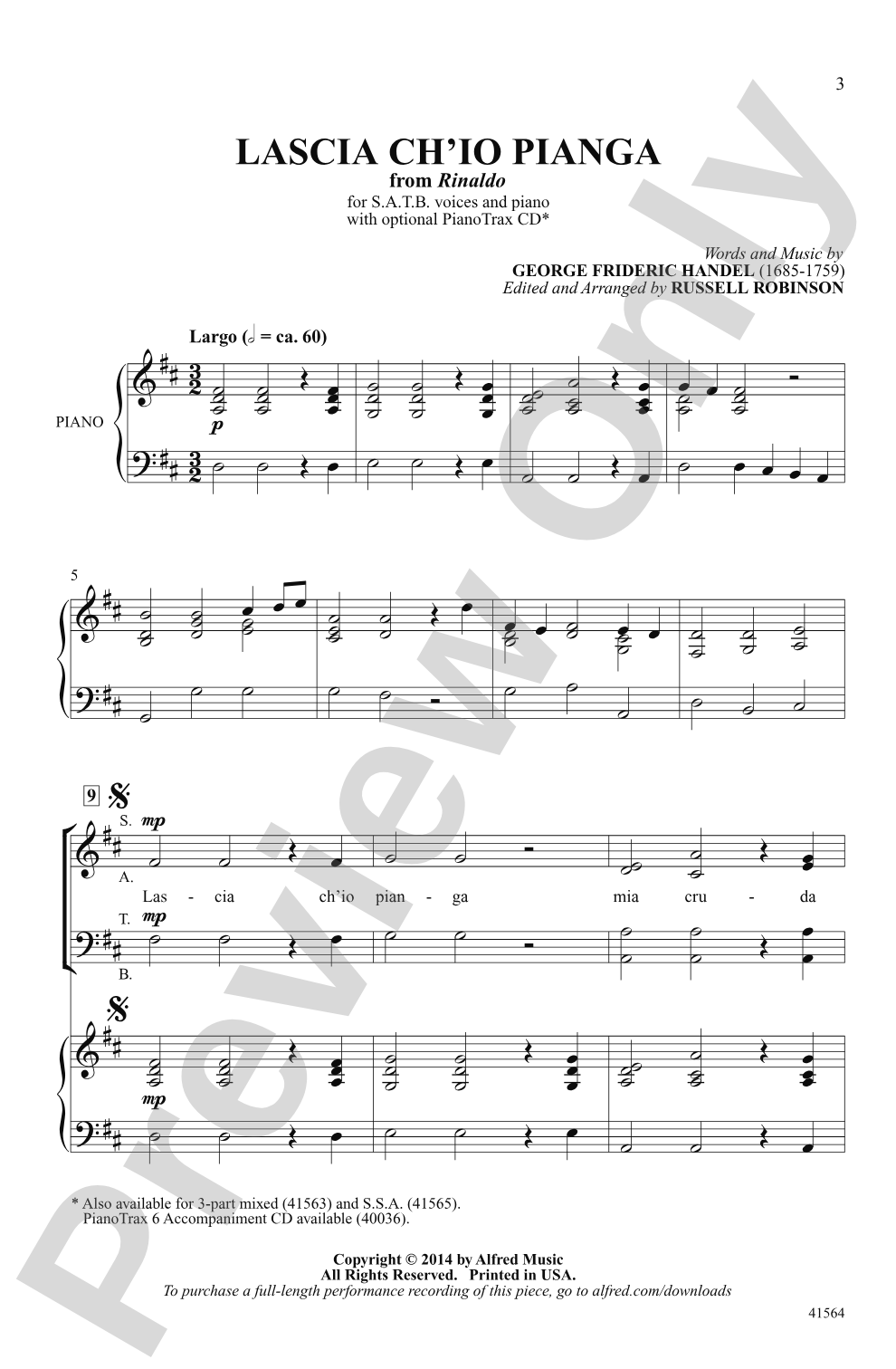
Singers have long cherished this staple of the solo repertoire, and now it is beautifully set for choral groups of any size. Teach all of the same lessons you learned from your favorite vocal instructor as you share this baroque aria with a new generation. Not difficult, but rewarding.


Lascia Ch'io Pianga (from Rinaldo): SATB Choral Octavo isn't in MakeMusic Cloud just yet...but it could be. Let us know you'd like to see it, and you'll help shape what comes next. In the meantime, start a free trial and dive into thousands of interactive titles your students can play along with today.
Request This Title
Tell us you want it.
Start Your Free Trial
Explore everything that's ready to play right now.
Sample Audio
1
Audio File
--:--
0:00
0:00
Sample Video
No sample videos found.
Additional Details
Series:
Alfred Choral Designs
Publisher:
Alfred Music
Page Count:
8
SKU:
00-PO-0002033
More about this title
About the Composer: George Frideric Handel
George Frideric Handel (1685-1759) was a German-born composer who spent much of his career in England, where he became the dominant figure in opera and oratorio. His command of melody, harmonic language, and vocal writing set the standard for Baroque music across Europe. Handel's ability to craft instantly memorable lines that sit naturally for the human voice made him one of history's most performed composers, and his works remain central to choral and solo repertoire today.
Why we love this
Russell Robinson's arrangement captures everything that makes this aria treasured by solo singers while giving it new life as an ensemble piece. Directors get the musical substance and emotional depth of Baroque masterwork without the demands of a full operatic staging. The writing is transparent enough for younger singers to navigate with confidence, yet it never sacrifices the elegance that has sustained this piece for nearly 300 years.
What to expect
The aria unfolds with the restraint and nobility characteristic of Baroque vocal writing. Handel's melody carries a quiet intensity, full of yearning and dignity. The harmonic language supports rather than interrupts the text, allowing words like "lascia" (let) and "pianga" (weep) to resonate with their full expressive weight.
Who it's for
This arrangement serves choirs of any size who want to perform a recognized masterwork without the preparation demands of a complex modern composition. It works equally well for festival performances, worship settings, and concert programming. Singers familiar with Handel's vocal writing, or those encountering this aria for the first time, will find the text and music emotionally direct and immediately engaging.
How to get the most out of it
- Shape long phrases through the text rather than the bar line. Handel's melodic arcs often span multiple measures, so maintain direction even through rests or inner-part activity.
- Balance inner voices carefully so the soprano line remains audible as the primary melody. SATB texture can obscure the tune if alto and tenor aren't kept lighter.
- Approach the aria's lyrical quality with genuine warmth rather than formal reserve. The emotional directness of the text deserves singers who commit to its sentiment.
- Let the accompaniment (organ or piano) establish the harmonic foundation. Singers should listen for harmonic anchors rather than locking exclusively to the melody.
How to use it
Program this alongside lighter choral fare to show your singers' range of interpretive skill and musical maturity. It pairs naturally with other Baroque sacred or secular selections, or can stand alone as a concert centerpiece that demonstrates ensemble musicianship. This is particularly effective when you want to highlight soprano leadership and showcase the sustained singing your choir has developed over the season.
Skills your students will build
- Reading and performing Baroque melodic line and phrasing
- Maintaining textual clarity within four-part writing
- Balancing soprano melody against harmonic inner voices
- Shaping extended phrases using text inflection and harmonic direction
- Singing with historical awareness of style and period vocal aesthetics