

Lascia Ch'io Pianga (from Rinaldo): 3-Part Mixed Choral Octavo
From Rinaldo
Words and music by George Frideric Handel / ed. and arr. Russell Robinson
Item: 00-PO-0002032
$1.85
Minimum order quantity: 20 copies
Pickup currently not available
Related Items
Lascia Ch'io Pianga: PianoTrax Digital Download |
$9.99
|
View | |
Lascia Ch'io Pianga (from Rinaldo): SATB Choral Octavo |
$1.85
|
View | |
Lascia Ch'io Pianga (from Rinaldo): SSA Choral Octavo |
$1.85
|
View | |
Lascia Ch'io Pianga: SATB Choral Octavo |
$1.85
|
View | |
Lascia Ch'io Pianga: 3-Part Mixed Choral Octavo |
$1.85
|
View | |
Lascia Ch'io Pianga: SSA Choral Octavo |
$1.85
|
View |
Description
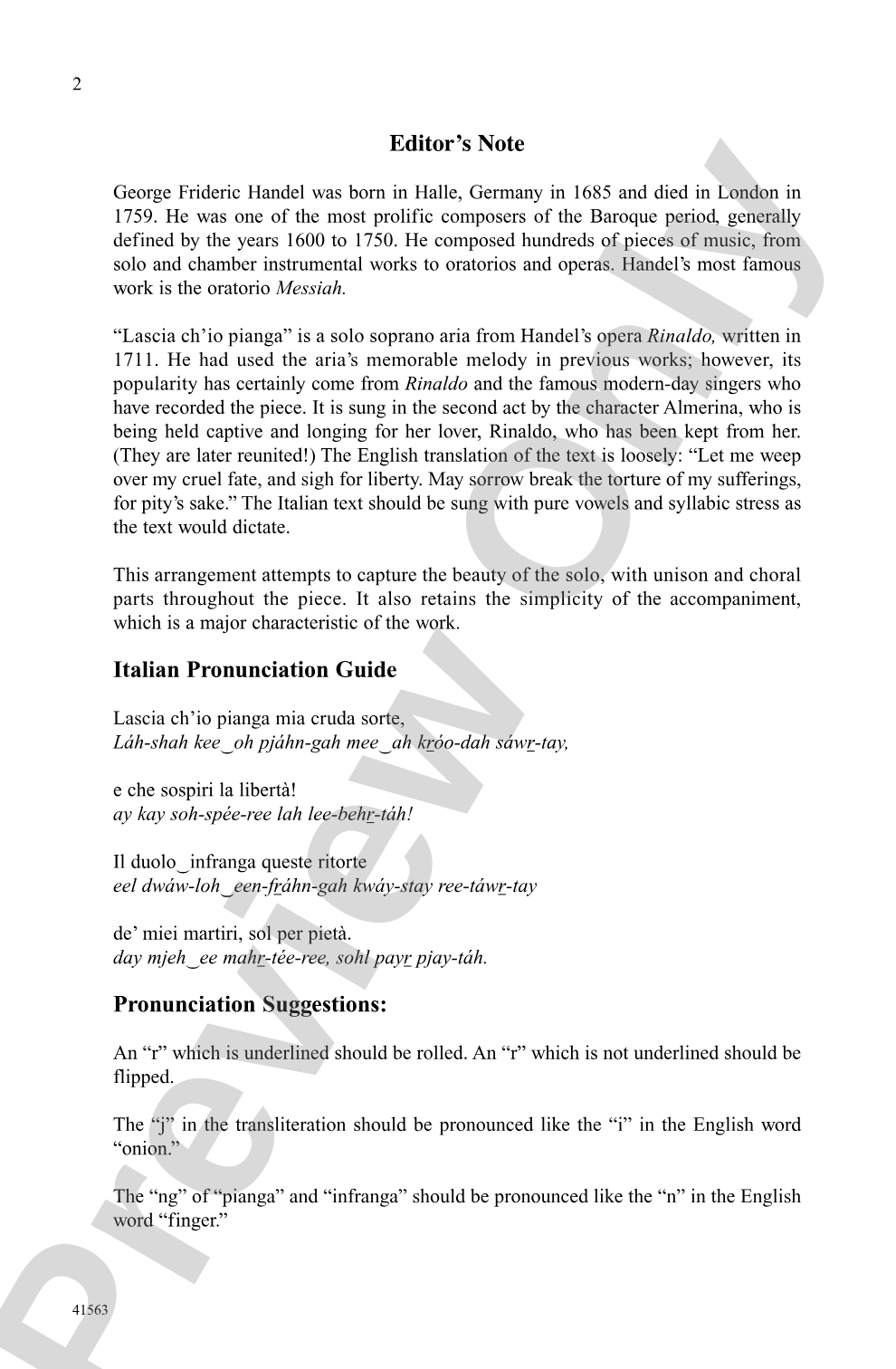
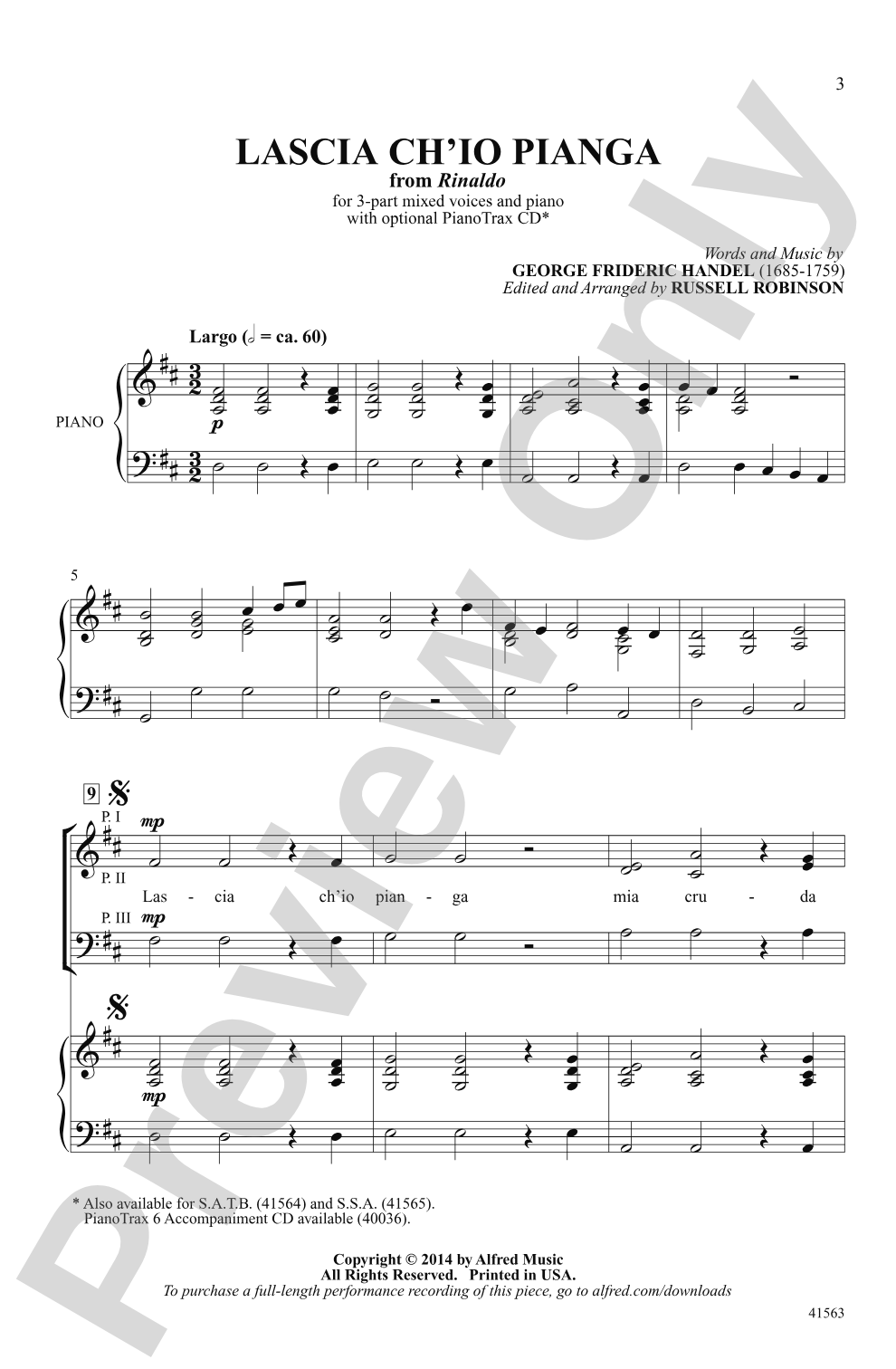
Singers have long cherished this staple of the solo repertoire, and now it is beautifully set for choral groups of any size. Teach all of the same lessons you learned from your favorite vocal instructor as you share this baroque aria with a new generation. Not difficult, but rewarding.


Lascia Ch'io Pianga (from Rinaldo): 3-Part Mixed Choral Octavo isn't in MakeMusic Cloud just yet...but it could be. Let us know you'd like to see it, and you'll help shape what comes next. In the meantime, start a free trial and dive into thousands of interactive titles your students can play along with today.
Request This Title
Tell us you want it.
Start Your Free Trial
Explore everything that's ready to play right now.
Sample Audio
1
Audio File
--:--
0:00
0:00
Sample Video
No sample videos found.
Additional Details
Series:
Alfred Choral Designs
Publisher:
Alfred Music
Page Count:
8
SKU:
00-PO-0002032
More about this title
About the Composer: George Frideric Handel
George Frideric Handel (1685-1759) was a German-born composer who spent most of his career in England, where he became the dominant figure in opera and oratorio. His dramatic gift for melody and his command of counterpoint made him one of the most influential composers of the Baroque era. Handel's vocal writing remains a standard against which choral arrangers measure their work.
As a teacher, Handel shaped vocal technique through his demanding operatic roles and his sacred choral works. His arias have educated generations of singers in phrasing, breath control, and expressive legit singing. This arrangement extends that pedagogical legacy, allowing choirs to experience the same musical and technical lessons that soloists have drawn from his work for nearly three centuries.
Why we love this
Russell Robinson's arrangement preserves the nobility and emotional depth of the original aria while making it fully accessible to three-part choirs. The writing avoids the trap of oversimplification; singers encounter genuine harmonic language and expressive demands that feel authentic to Handel's style. This is the rare arrangement that teaches choral singers the same vocal and musical lessons that a solo soprano would learn from the original version.
What to expect
The aria unfolds with the restraint and grace characteristic of Handel's operatic writing. There's genuine pathos in the melody, but it never tips into sentimentality; instead, it invites singers into a formal, almost architectural elegance. Performing this piece should feel like stepping into a moment of quiet dignity and expressive depth.
Who it's for
This octavo works for any intermediate to advanced choral ensemble, from high school concert choirs to community and college groups. It's an excellent choice for directors who want their singers to engage with genuine Baroque repertoire without the complexity of a four-part texture or extensive divisi writing.
How to get the most out of it
- Shape the long legato lines by thinking of them as vocal phrases rather than instrumental passages. Each phrase should have a clear arc, with careful attention to where Handel places the natural peak of the melody.
- Balance the three parts so that the top voice emerges clearly without overwhelming the inner harmony. The beauty of this arrangement lies in how the parts support and enhance the primary melodic line.
- Allow the text to shape your articulation and phrasing. 'Lascia ch'io pianga' (Let me weep) demands expressive, almost improvisatory breathing that won't always align with barlines.
- Use the sustained sections to teach your singers the difference between holding a note and singing through a note. Handel wrote stillness that requires active vocal support.
How to use it
This works beautifully as a concert centerpiece, especially when programmed alongside other Baroque or early music selections. Consider pairing it with lighter choral works to showcase the range of your group's expressiveness. It's also a strong choice for festivals and competitions where the judging values musicianship and proper vocal technique over novelty.
Skills your students will build
- Legato phrasing in Baroque style, including breath placement within melodic lines
- Balance and independence of three-part writing
- Text expression in Italian with historically informed phrasing
- Sustained vocal technique and breath control over longer phrases
- Recognition and execution of Baroque harmonic progressions