

Lascia Ch'io Pianga (from Rinaldo): SSA Choral Octavo
From Rinaldo
Words and music by George Frideric Handel / ed. and arr. Russell Robinson
Item: 00-PO-0001803
$1.85
Minimum order quantity: 20 copies
Pickup currently not available
Related Items
Lascia Ch'io Pianga: PianoTrax Digital Download |
$9.99
|
View | |
Lascia Ch'io Pianga (from Rinaldo): SATB Choral Octavo |
$1.85
|
View | |
Lascia Ch'io Pianga (from Rinaldo): 3-Part Mixed Choral Octavo |
$1.85
|
View | |
Lascia Ch'io Pianga: SATB Choral Octavo |
$1.85
|
View | |
Lascia Ch'io Pianga: 3-Part Mixed Choral Octavo |
$1.85
|
View | |
Lascia Ch'io Pianga: SSA Choral Octavo |
$1.85
|
View |
Description
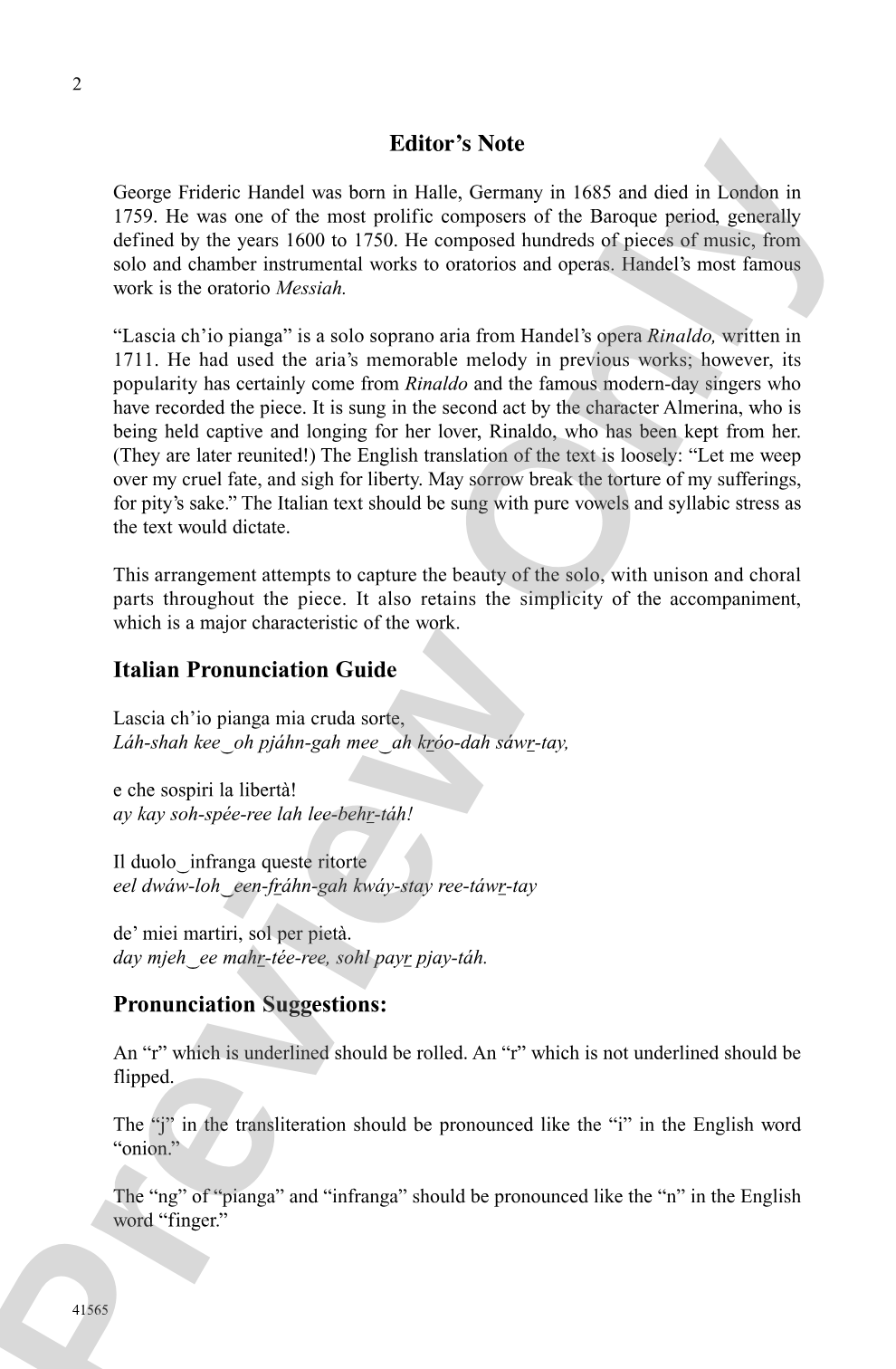
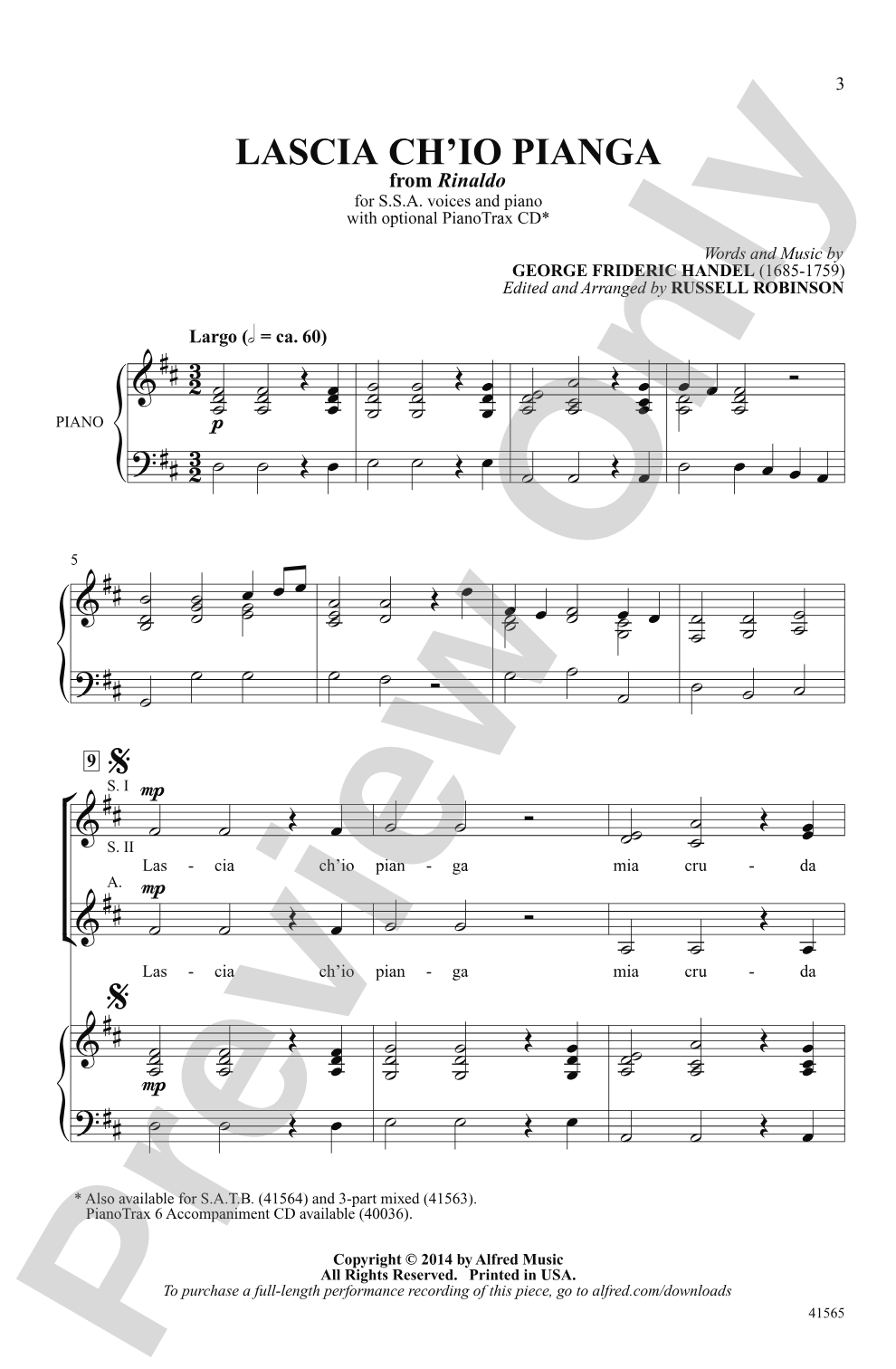
Singers have long cherished this staple of the solo repertoire, and now it is beautifully set for choral groups of any size. Teach all of the same lessons you learned from your favorite vocal instructor as you share this baroque aria with a new generation. Not difficult, but rewarding.


Lascia Ch'io Pianga (from Rinaldo): SSA Choral Octavo isn't in MakeMusic Cloud just yet...but it could be. Let us know you'd like to see it, and you'll help shape what comes next. In the meantime, start a free trial and dive into thousands of interactive titles your students can play along with today.
Request This Title
Tell us you want it.
Start Your Free Trial
Explore everything that's ready to play right now.
Sample Audio
1
Audio File
--:--
0:00
0:00
Sample Video
No sample videos found.
Additional Details
Series:
Alfred Choral Designs
Publisher:
Alfred Music
Page Count:
8
SKU:
00-PO-0001803
More about this title
About the Composer: George Frideric Handel
George Frideric Handel (1685-1759) dominated the musical life of early 18th-century London, establishing himself as a master of both opera and oratorio. His gift for melody was unmatched; his arias remain touchstones of vocal writing because they balance technical brilliance with emotional directness.
Handel's influence on music education extends far beyond his lifetime. His works teach singers about phrasing, text expression, and the baroque approach to ornamentation. Directors return to his arias repeatedly because they reward careful study and reveal new dimensions with each rehearsal.
Why we love this
This arrangement preserves everything that makes the original aria essential repertoire while opening it to choirs that might never tackle a full operatic solo. Russell Robinson's setting respects Handel's melodic architecture and allows treble voices to inhabit the same expressive world that generations of soloists have explored. It works equally well as a concert piece or festival entry, and the modest technical demands mean your singers can focus on musicality rather than survival.
What to expect
The aria unfolds with the unhurried dignity of baroque vocal writing. There is space in this music, and singers discover that restraint and clarity speak louder than volume or speed. The harmonic language glows with warmth; this is Handel at his most lyrical, where sorrow and beauty are inseparable.
Who it's for
Choirs of any size with treble voices who want an authentic entry point into baroque repertoire. This works for high school and college choirs, community ensembles, and church choirs seeking contest or concert material that demands musicianship without requiring specialized vocal technique.
How to get the most out of it
- Shape the phrases according to the text's emotional arc rather than the printed barlines. Handel expected singers to breathe where the sense dictates, not where notation suggests.
- Balance the melody against inner voices with intention. This is not a melody-dominated texture; the SSA voicing creates opportunities for harmonic color if singers resist the urge to disappear.
- Approach the baroque ornamentation (if present in this arrangement) with restraint. One clean, purposeful embellishment communicates more than rushed decoration.
- Let the harmonic progressions breathe. Handel's chord changes often carry emotional weight; resist the temptation to rush through slower harmonic rhythm sections.
How to use it
Program this alongside other baroque choral works to build a coherent set, or place it as a contrasting selection in a mixed-era concert. It pairs naturally with other Handel choruses or secular baroque repertoire. The modest page count and performance time make it ideal for festival entries where you want to demonstrate musical maturity in a single, well-crafted statement.
Skills your students will build
- Baroque phrasing and text expression
- Harmonic listening within SSA voicing
- Sustained vocal line control
- Intonation across slower harmonic rhythm
- Historical context and performance practice awareness