

Kyrie (from Mass in G): SSA Choral Octavo
From the Mass in G
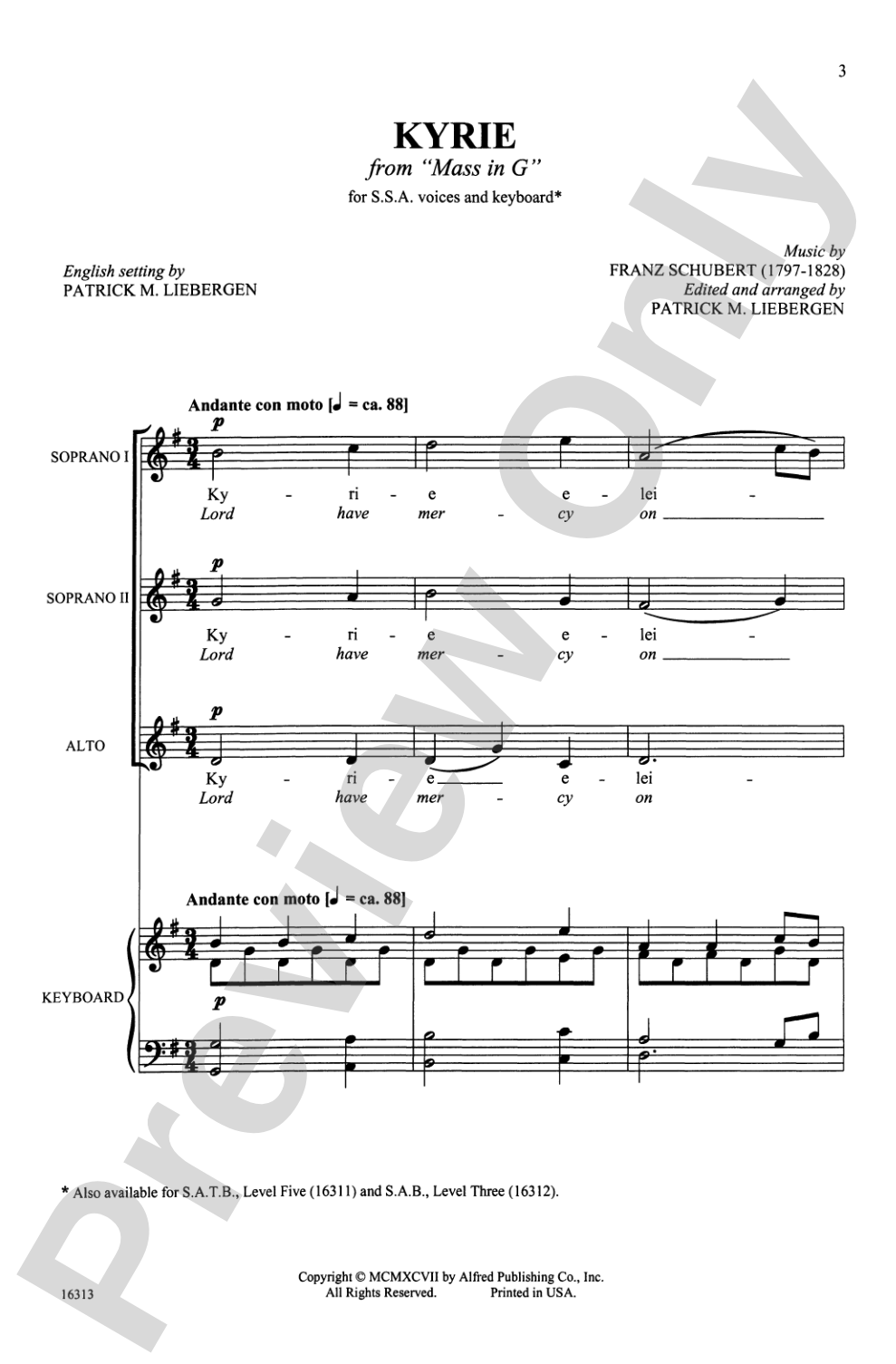
Music by Franz Schubert / ed. Patrick M. Liebergen
Item: 00-PO-0003962
$2.95
Minimum order quantity: 20 copies
Pickup currently not available
Description
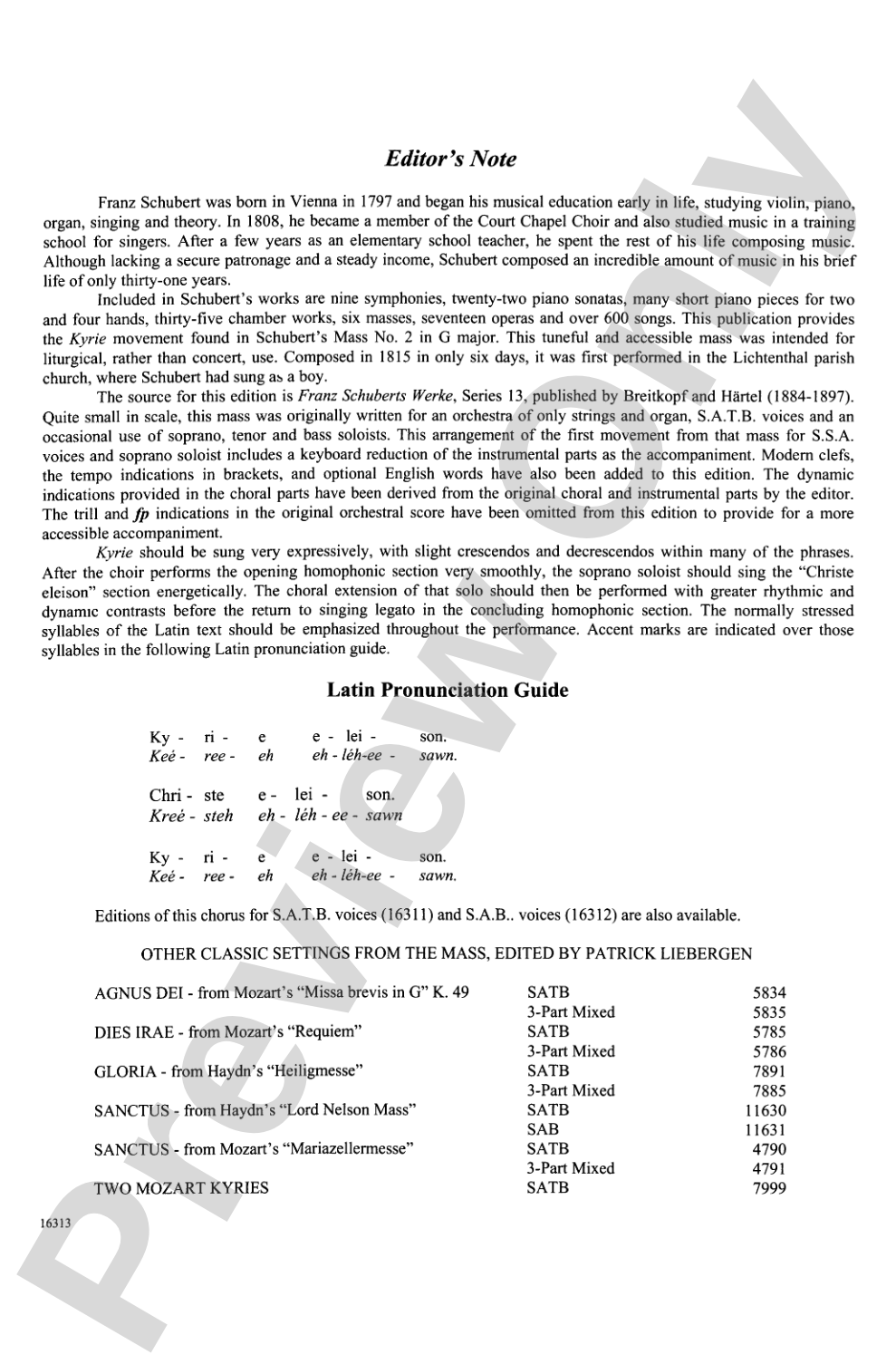
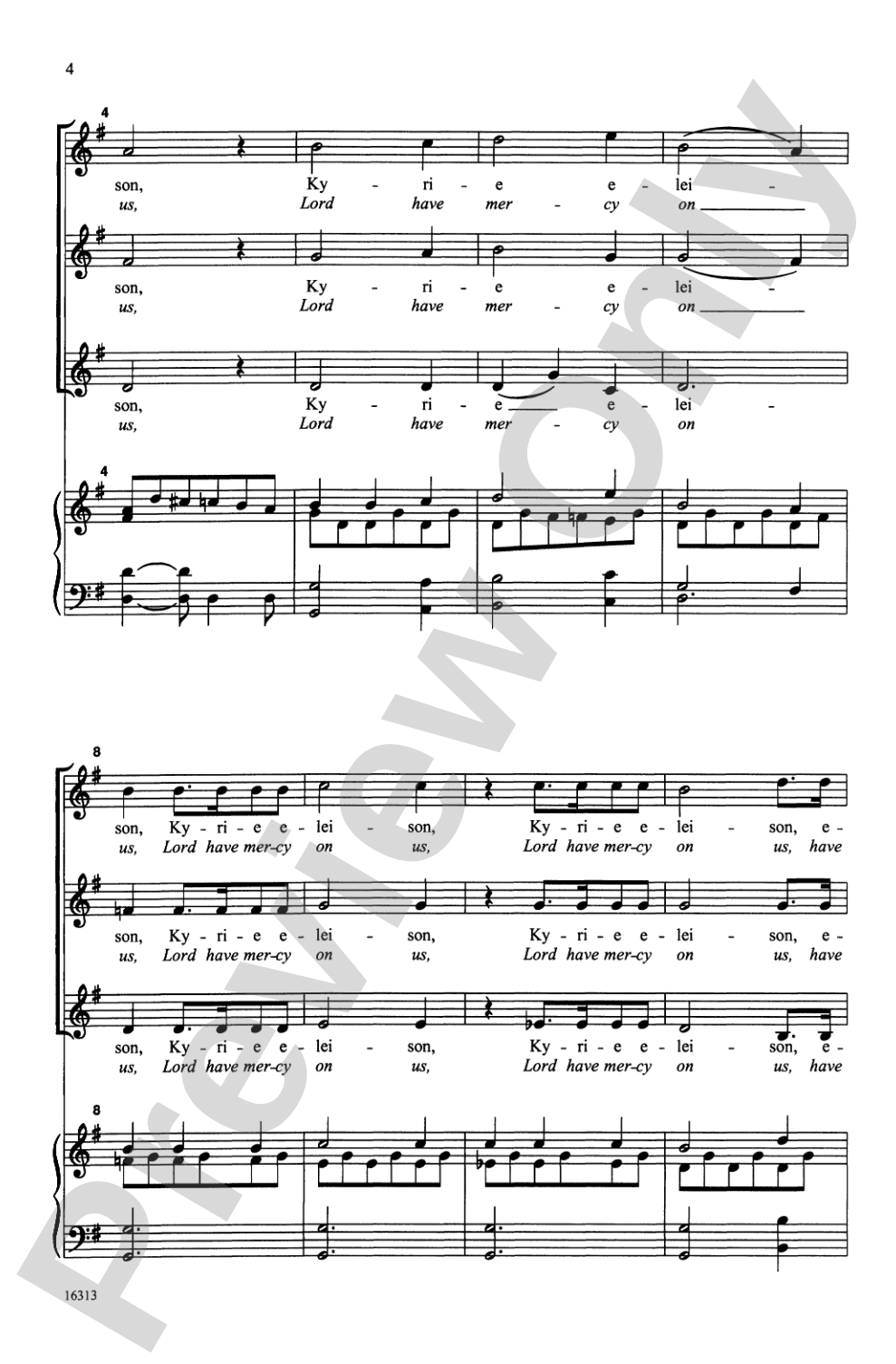
Superb edition for today's choir of a work from Schubert's famous "Mass in G" (1815). This largely homophonic work remains at a constant tempo throughout and includes only one simple, brief contrapuntal passage. Includes historical and biographical information (excellent for program notes) and a Latin pronunciation guide.


Kyrie (from Mass in G): SSA Choral Octavo isn't in MakeMusic Cloud just yet...but it could be. Let us know you'd like to see it, and you'll help shape what comes next. In the meantime, start a free trial and dive into thousands of interactive titles your students can play along with today.
Request This Title
Tell us you want it.
Start Your Free Trial
Explore everything that's ready to play right now.
Sample Audio
No sample audio found.
Sample Video
No sample videos found.
Additional Details
Series:
Alfred Archive Edition: Alfred Choral Designs
Publisher:
Alfred Music
Page Count:
16
SKU:
00-PO-0003962
More about this title
About the Composer: Franz Schubert
Franz Schubert (1797-1828) composed prolifically across every major genre despite his short life, leaving nearly 1,000 works that bridge Classical form and Romantic expression. His sacred music, including six complete masses, shows his gift for blending architectural clarity with emotional depth, and his Mass in G stands among the most frequently performed in choral settings today.
Schubert's approach to the mass differs markedly from his predecessors: his settings prioritize accessibility and singability without sacrificing sophistication. The Kyrie from this mass exemplifies his ability to write music that moves listeners while remaining practical for amateur and professional choirs alike.
Why we love this
Schubert's Kyrie rewards SSA choirs with music that sits beautifully in the upper register while maintaining harmonic richness and structural integrity. The predominantly homophonic texture keeps learning curves manageable, while that single contrapuntal passage provides just enough textural contrast to sustain musical interest and challenge singers to refine their part independence. Programs need sacred work of genuine substance that doesn't demand soloists or require a full four-part texture—this delivers both.
What to expect
The Kyrie unfolds with quiet dignity and gentle reverence, its steady harmonic progression creating a sense of forward motion without urgency. There is a quality of earnest sincerity here—the music asks for devotion rather than virtuosity, and singers experience the profound contentment that comes from producing pure, sustained ensemble sound.
Who it's for
SSA choirs seeking substantial sacred repertoire that remains accessible without being trivial. This edition works for intermediate and advanced amateur choirs, high school treble choirs, and community ensembles looking to add Classical-era music that engages audiences and builds singers' understanding of Schubert's compositional voice.
How to get the most out of it
- Maintain steady breath support through the homophonic sections; the simplicity of texture can tempt singers to release tone, but sustained resonance is what carries Schubert's harmonic language.
- Approach the contrapuntal passage as a carefully coordinated moment rather than a technical showcase; clarity comes from precise ensemble listening, not from rushing the parts.
- Use the pronunciation guide to rehearse Latin diction early and often, embedding it into warm-ups so singers internalize it naturally rather than treating it as something to fix in final rehearsals.
- Shape longer phrases with subtle dynamic contours that follow Schubert's harmonic movement; avoid flat delivery even where notation lacks explicit markings.
How to use it
Program this as the centerpiece of a concert pairing Schubert sacred and secular works, or use it to open a program devoted to Classical-era mass movements. It also serves beautifully in a service or liturgical context where the architectural clarity and appropriate length accommodate both rehearsal constraints and the needs of congregational worship. Consider pairing it with contrasting sacred texts in other languages to build singers' confidence with Latin and expand their choral repertoire range.
Skills your students will build
- Reading and performing in Latin with accurate pronunciation
- Sustaining long homophonic passages with ensemble blend and harmonic awareness
- Executing brief contrapuntal writing with independence and coordination
- Shaping Classical-era harmonic progressions through subtle dynamic control