
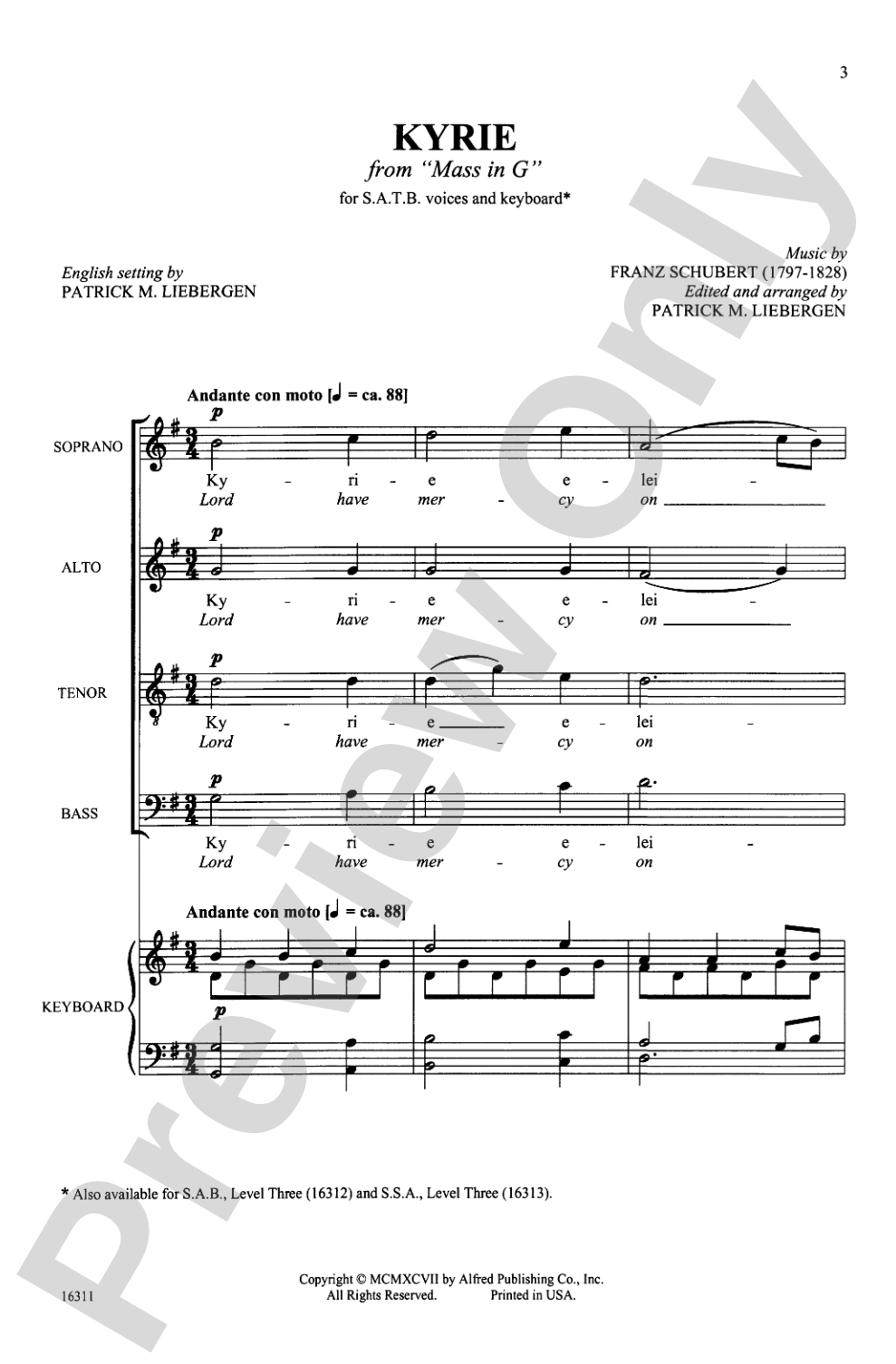

Kyrie (from Mass in G): SATB Choral Octavo
From the Mass in G
Music by Franz Schubert / ed. Patrick M. Liebergen
Item: 00-PO-0003961
$2.95
Minimum order quantity: 20 copies
Pickup currently not available
Description
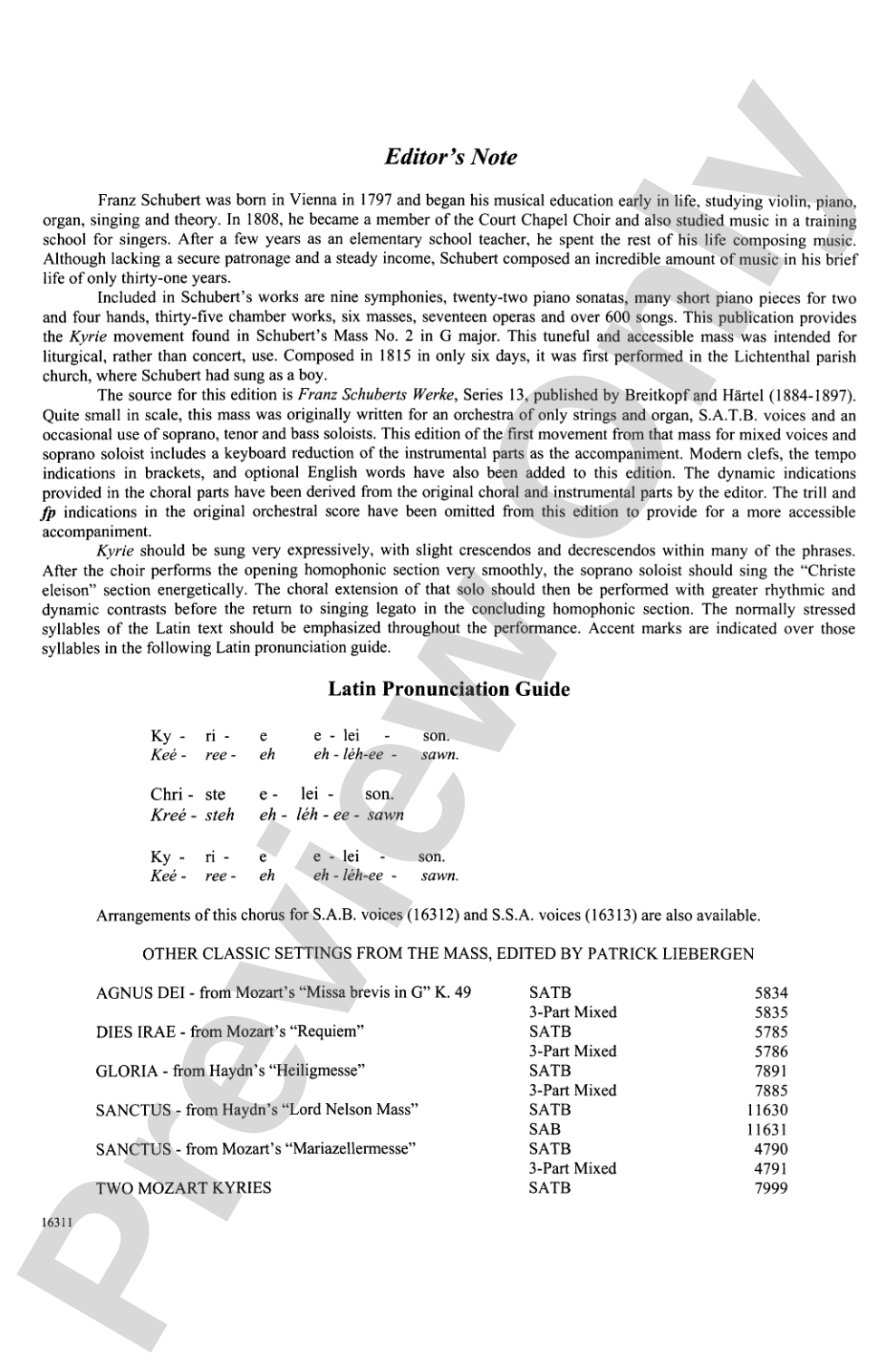
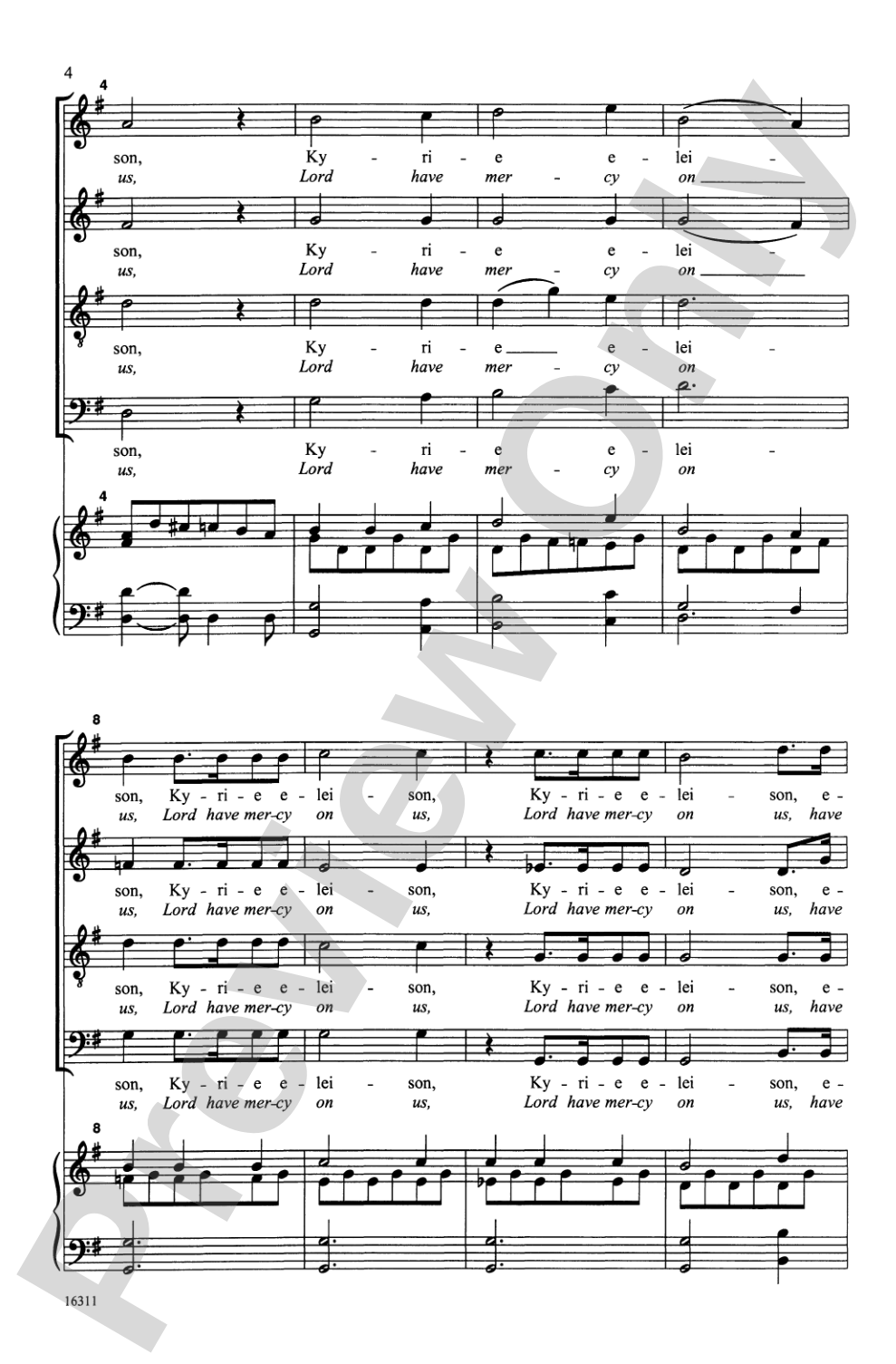
Superb edition for today's choir of a work from Schubert's famous "Mass in G" (1815). This largely homophonic work remains at a constant tempo throughout and includes only one simple, brief contrapuntal passage. Includes historical and biographical information (excellent for program notes) and a Latin pronunciation guide.


Kyrie (from Mass in G): SATB Choral Octavo isn't in MakeMusic Cloud just yet...but it could be. Let us know you'd like to see it, and you'll help shape what comes next. In the meantime, start a free trial and dive into thousands of interactive titles your students can play along with today.
Request This Title
Tell us you want it.
Start Your Free Trial
Explore everything that's ready to play right now.
Sample Audio
No sample audio found.
Sample Video
No sample videos found.
Additional Details
Series:
Alfred Archive Edition: Alfred Choral Designs
Publisher:
Alfred Music
Page Count:
16
SKU:
00-PO-0003961
More about this title
About the Composer: Franz Schubert
Franz Schubert (1797-1828) composed over 600 works across every major genre, yet remained largely unknown outside Vienna during his lifetime. His sacred music, including six complete masses, reveals a composer of profound lyricism and harmonic sophistication who found spiritual depth within Classical forms.
Schubert's masses occupy a unique space in the choral repertoire: they blend the liturgical expectations of early 19th-century Austrian Catholicism with the emotional directness that defines his style. His melodies sing naturally across all voice parts, and his harmonic language, while rooted in tradition, often ventures into unexpected territory. For choral directors, Schubert's sacred works offer the rare combination of accessibility and artistic substance.
Why we love this
This octavo captures Schubert at his most vocally generous. The largely homophonic texture means every voice part remains singable and purposeful, yet the single contrapuntal passage provides just enough complexity to keep singers engaged and the writing sophisticated. The included pronunciation guide and historical notes transform preparation into a deeper learning experience rather than rote rehearsal.
What to expect
The Kyrie unfolds with quiet reverence and lyrical warmth. Schubert's voice leading creates a sense of inevitability, each chord resolving naturally into the next, while his melodies linger in the ear long after rehearsal ends. There is no drama or urgency here, only devotion expressed through pristine harmony.
Who it's for
Choirs with solid intonation and basic part-singing skills will thrive with this work. It suits advanced high school choirs, college choirs, and community ensembles seeking repertoire that is musically substantial without excessive technical demands.
How to get the most out of it
- Maintain the piece's gentle forward momentum by subdividing during held notes; Schubert's constant tempo invites a flowing, almost lyrical approach rather than a static one.
- Mark the brief contrapuntal section clearly in rehearsal and drill it separately. Its textural shift will feel striking after sustained homophony and deserves careful voice independence work.
- Use the Latin pronunciation guide to establish consistent diction across the section before tackling musical elements. Clean Latin vowels brighten Schubert's harmonic writing.
- Balance the four voice parts evenly in the homophonic sections; avoid letting altos or tenors disappear into accompaniment. Each voice carries essential harmony.
How to use it
This work pairs beautifully in a sacred choral concert where it can anchor a program of shorter Sacred literature or sit alongside other Romantic-era masses. Its 16-page length makes it ideal as a centerpiece between lighter works or as the opening piece in a thematic concert exploring faith and music across eras.
Skills your students will build
- Maintaining tonal blend in sustained homophonic textures
- Voice independence within four-part writing
- Latin pronunciation and diction
- Recognizing harmonic movement in Classical and early Romantic music
- Performing with consistent tempo across simple and contrapuntal sections