
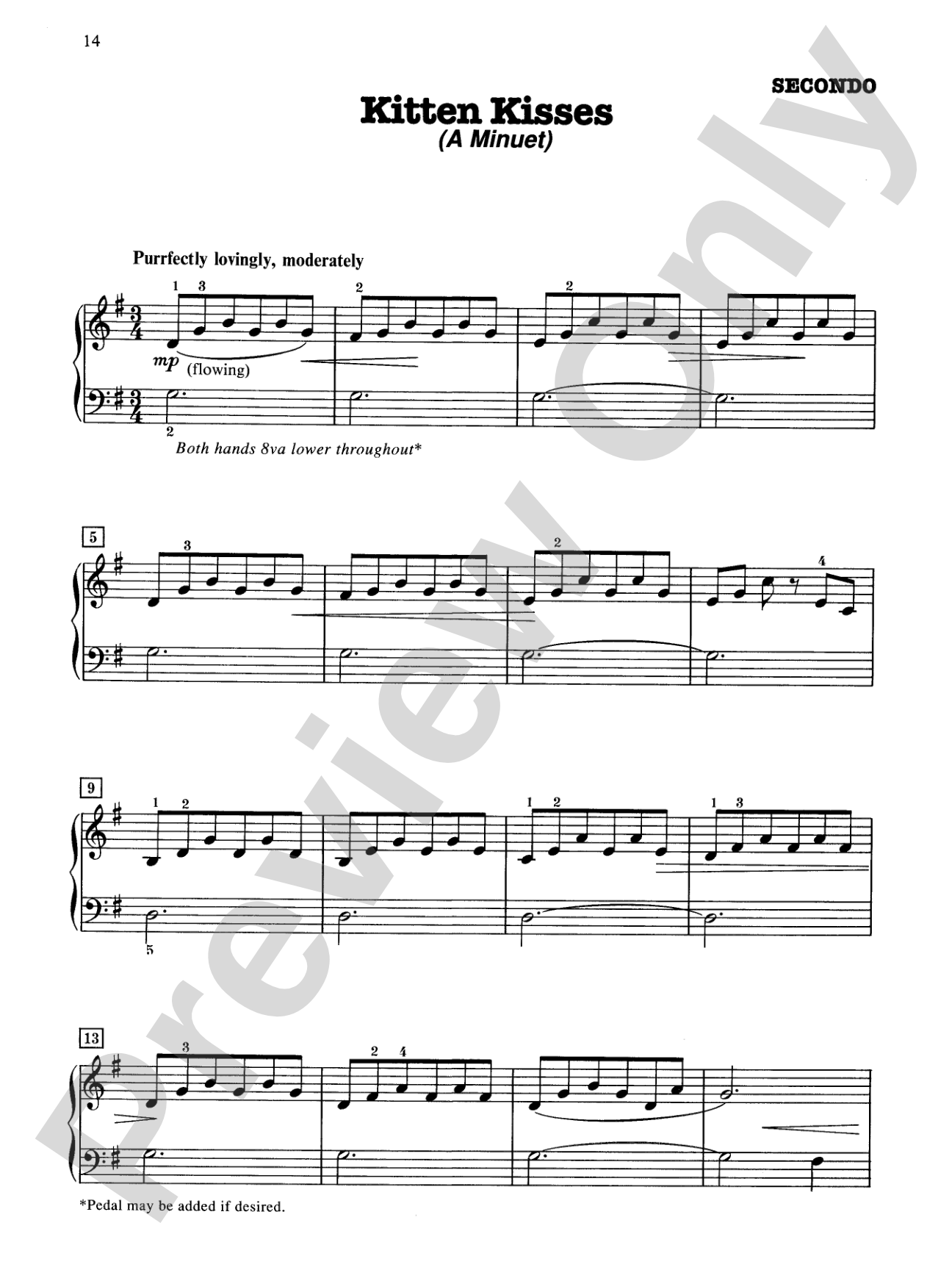

Kitten Kisses (A Minuet) - Piano Duet (1 Piano, 4 Hands): Piano Duet (1 Piano, 4 Hands)
Late Elementary Duets for 1 Piano, 4 Paws
By Margaret Goldston
Level: Late Elementary
Item: 00-PS-0017480
$4.99
Pickup currently not available
Related Items
Meow March - Piano Duet (1 Piano, 4 Hands): Piano Duet (1 Piano, 4 Hands) |
$4.99
|
View | |
Purring Tune - Piano Duet (1 Piano, 4 Hands): Piano Duet (1 Piano, 4 Hands) |
$4.99
|
View | |
Sophisticated Cat - Piano Duet (1 Piano, 4 Hands): Piano Duet (1 Piano, 4 Hands) |
$5.99
|
View | |
Duets for Cat Lovers: Piano Duet (1 Piano, 4 Hands) Book |
$5.99
|
View |
Description
A collection of elementary duets for one piano and four paws! The primo and secondo parts are equal in difficulty and the hand positions are shown for each piece. Some pieces feature easy position shifts. These are indispensible collections to add variety to the lesson plan and help make practicing the piano become less work and more fun! A Federation Festivals 2024-2028 selection.


Discover MakeMusic Cloud: thousands of interactive titles your students can play along with today.
Sample Audio
No sample audio found.
Sample Video
No sample videos found.
Additional Details
Publisher:
Alfred Music
Page Count:
16
SKU:
00-PS-0017480
More about this title
About the Composer: Margaret Goldston

Margaret Goldston built her career as both a composer and studio teacher in North Carolina, working with students across all age levels and earning recognition as Composer of the Year in 1983 and 1994 by the North Carolina Federation of Music Clubs. She completed her Bachelor of Music in piano performance at Louisiana State University and later studied composition privately with Pulitzer Prize winner Robert Ward, work that shaped her accessible yet skillfully crafted approach to writing for young musicians.
Goldston's legacy extends well beyond her lifetime. She conducted masterclasses and clinics throughout the United States and Canada, was honored as an LSU School of Music Alumnus of the Year in 1991, and received posthumous recognition as a Foundation Fellow by the Music Teachers National Association in 2020. Her compositions remain standard repertoire on festival and contest lists, particularly through the National Federation of Music Clubs.
Why we love this
Equal difficulty between primo and secondo parts means neither student feels like they're playing the accompaniment, which builds genuine collaborative musicmaking from the start. The hand positions are marked throughout, eliminating confusion and letting students focus on listening and ensemble balance rather than searching for the right keys. As a Federation Festivals selection, these pieces carry built-in credibility with adjudicators while remaining genuinely enjoyable to perform.
What to expect
Lighthearted and playful, with the whimsical charm suggested by the title. The music invites smiles without condescension, letting young pianists feel accomplished while enjoying the simple pleasure of making sound together at one instrument.
Who it's for
Late elementary pianists ready to experience ensemble playing without the coordination demands of a two-piano setup. These duets work equally well for lesson students exploring duet repertoire or small group classes where multiple pairs of pianists need engaging, manageable material at the same level.
How to get the most out of it
- Balance the melody between hands before adding the second pianist. Have the primo player demonstrate the main tune alone first, then have both parts learn their individual lines before combining.
- Work the position shifts slowly and deliberately, isolating the hand movement without pedal until it becomes automatic. Once secure, the shift will feel natural within the musical phrase.
- Listen across the keyboard. Younger duet partners often lock into their own part and lose awareness of the bigger sound. Regular check-ins about who's playing melody, who's underneath, and how they fit together will sharpen both players' ears.
- Record yourselves and play it back as a team. Hearing their own performance together motivates students in a way that hearing corrections never does.
How to use it
Include one as a student showcase piece at a studio recital or small concert, pairing it with solo selections from the same level. These pieces also fit naturally into a festival or competition program where directors want to include duet work without requiring two pianos or unusual instrumentation.
Skills your students will build
- Reading and maintaining a part independently while a partner plays a different line
- Position shifts in a musical context
- Balance and blend between primo and secondo textures
- Following a conductor or co-musician for ensemble entry and phrasing
- Listening to accompaniment patterns and anchoring melodic lines to underlying harmony