
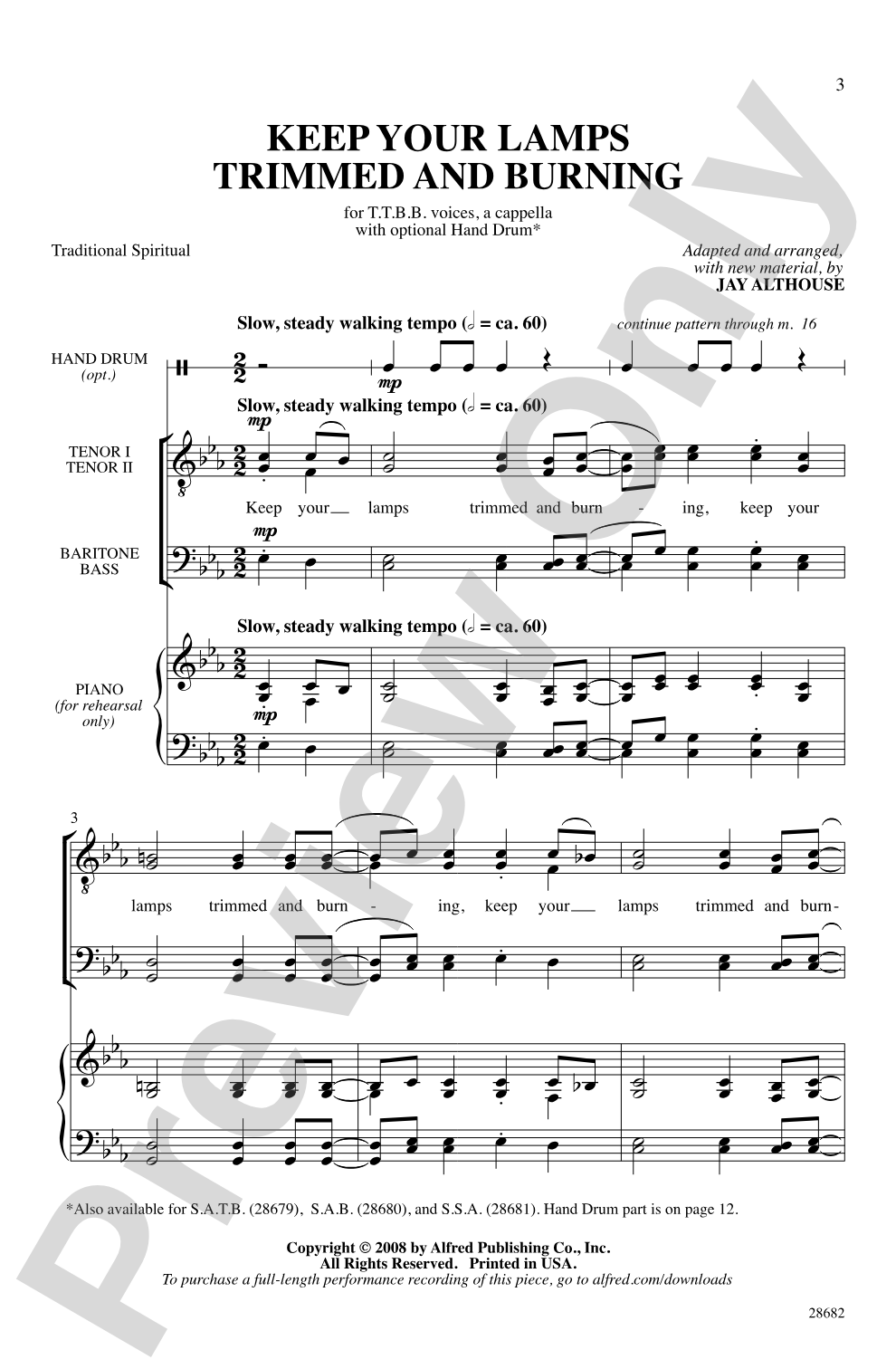
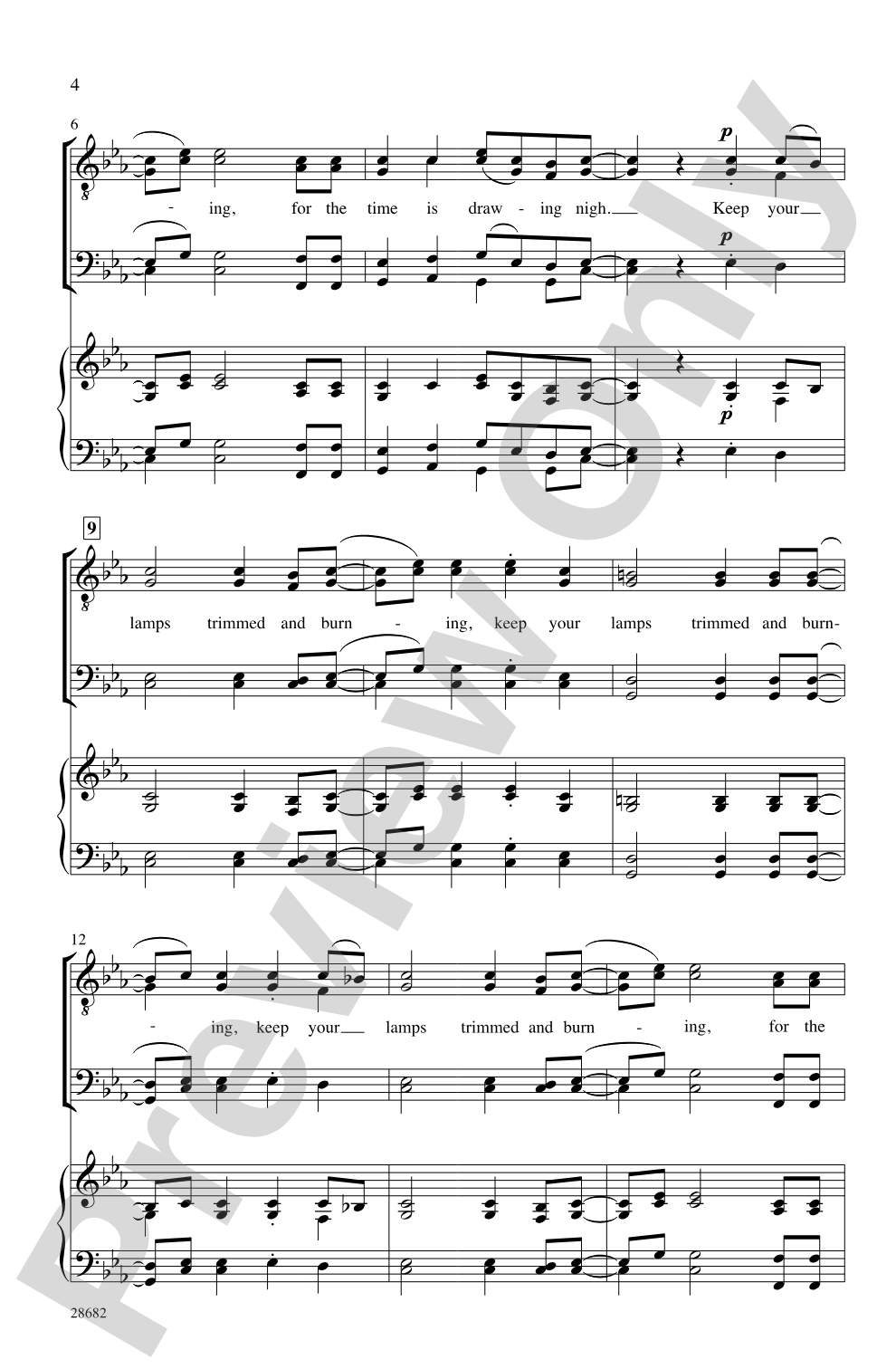

Keep Your Lamps Trimmed and Burning: TTBB, a cappella Choral Octavo
Traditional Spiritual / arr. Jay Althouse
Item: 00-PO-0000531
$1.75
Minimum order quantity: 20 copies
Pickup currently not available
Related Items
Keep Your Lamps Trimmed and Burning: SATB, a cappella Choral Octavo |
$2.05
|
View | |
Keep Your Lamps Trimmed and Burning: SAB, a cappella Choral Octavo |
$2.25
|
View | |
Keep Your Lamps Trimmed and Burning: SSA, a cappella Choral Octavo |
$2.25
|
View | |
Keep Your Lamps Trimmed and Burning: SATB, a cappella Choral Octavo |
$2.05
|
View | |
Keep Your Lamps Trimmed and Burning: SAB, a cappella Choral Octavo |
$2.25
|
View | |
Keep Your Lamps Trimmed and Burning: SSA, a cappella Choral Octavo |
$2.25
|
View |
Description
The strength of this steady, walking-tempo spiritual comes from the powerful dynamic contrasts and solid choral writing. Features brief descant-style female solos. The optional hand drum adds a rhythmic pulse.


Keep Your Lamps Trimmed and Burning: TTBB, a cappella Choral Octavo isn't in MakeMusic Cloud just yet...but it could be. Let us know you'd like to see it, and you'll help shape what comes next. In the meantime, start a free trial and dive into thousands of interactive titles your students can play along with today.
Request This Title
Tell us you want it.
Start Your Free Trial
Explore everything that's ready to play right now.
Sample Audio
1
Audio File
--:--
0:00
0:00
Sample Video
No sample videos found.
Additional Details
Series:
Alfred Choral Designs
Publisher:
Alfred Music
Page Count:
12
SKU:
00-PO-0000531
More about this title
About the Arranger: Jay Althouse

Jay Althouse holds degrees in Music Education and Music from Indiana University of Pennsylvania, where he was honored as a Distinguished Alumni recipient. His career spans both administration and composition; he spent eight years managing rights and licenses for a major educational music publisher and served on the Executive Board of the Music Publishers Association of America. As a composer, he has more than 800 choral works in print across all levels and is widely performed in English-speaking countries.
Althouse is a writer member of ASCAP and a regular recipient of the ASCAP Special Award for his standard music compositions. Beyond choral writing, he has co-written children's musicals with his wife Sally K. Albrecht, compiled notable vocal solo collections including Folk Songs for Solo Singers, and authored or co-authored instructional resources such as The Complete Choral Warm-up Book, Accent on Composers, and Ready to Read Music. He resides in North Carolina and currently serves on the National Advisory Board of the Folk Art Society of America.
Why we love this
Althouse's arrangement captures the spiritual's essential character through economic, elegant choral writing that allows even singers new to TTBB to find secure footing. The dramatic dynamic arc creates real emotional weight without requiring extensive rehearsal to achieve impact, and the inclusion of descant-style solo moments gives your singers opportunities to shine while keeping the ensemble texture grounded and accessible.
What to expect
This spiritual exudes quiet conviction. The steady, walking tempo and grounded harmonies create a meditative foundation, yet the dynamic swells and solo moments introduce urgency and hope. It's a piece that feels both intimate and powerful, rooted in tradition while remaining immediately accessible.
Who it's for
TTBB choirs seeking spirituals with substance and musical authenticity will find this arrangement both singable and dramatically satisfying. The piece works well for secondary school, college, and community men's choruses looking to add American sacred music to their repertoire without sacrificing musicality.
How to get the most out of it
- Shape the dynamic contrasts deliberately. Mark your score with clear crescendo and diminuendo points so singers understand they're building or releasing tension, not simply getting louder or quieter.
- Let the hand drum sit in the pocket with the walking tempo rather than driving ahead of it. The rhythm section's steadiness is what makes this arrangement breathe.
- Tune the close intervals carefully in the TTBB voicing, especially where voices move in parallel motion. Block-building these sections without text first can help intonation lock in.
How to use it
Program this as the centerpiece of a concert devoted to American spirituals or as a thoughtful counterbalance to secular or classical repertoire on a mixed program. It also serves as an excellent closing piece for a concert, leaving audiences with a sense of resolution and sincerity.
Skills your students will build
- Managing dynamic contrast in a cappella singing
- Sustaining intonation across multiple voices in close harmonic writing
- Interpreting spiritual idiom and call-and-response elements
- Balancing solo and ensemble roles within a single arrangement