
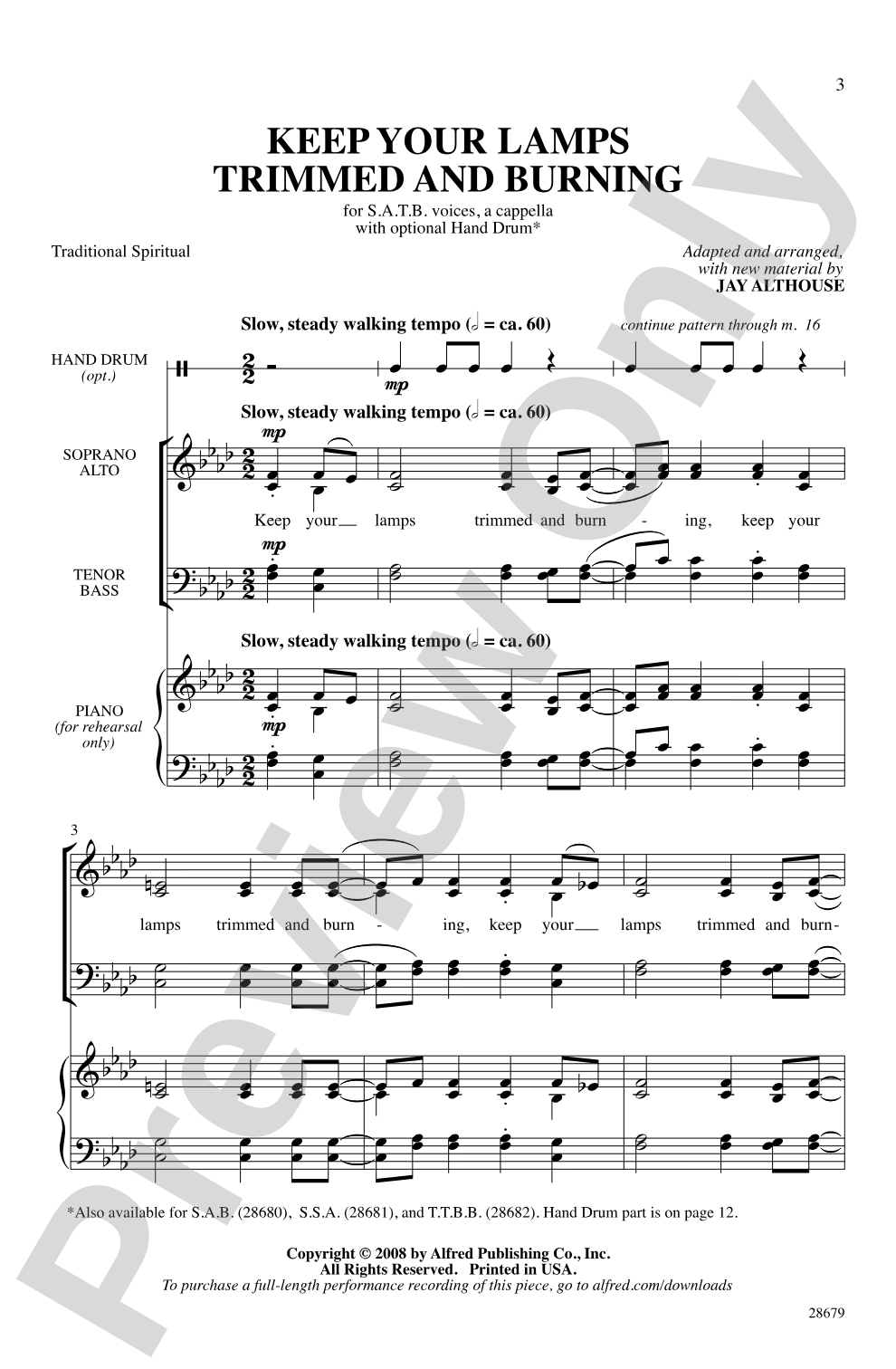

Keep Your Lamps Trimmed and Burning: SATB, a cappella Choral Octavo
Traditional Spiritual / arr. Jay Althouse
Item: 00-PO-0000528
$2.05
Minimum order quantity: 20 copies
Pickup currently not available
Related Items
Keep Your Lamps Trimmed and Burning: SAB, a cappella Choral Octavo |
$2.25
|
View | |
Keep Your Lamps Trimmed and Burning: SSA, a cappella Choral Octavo |
$2.25
|
View | |
Keep Your Lamps Trimmed and Burning: TTBB, a cappella Choral Octavo |
$1.75
|
View | |
Keep Your Lamps Trimmed and Burning: SATB, a cappella Choral Octavo |
$2.05
|
View | |
Keep Your Lamps Trimmed and Burning: SAB, a cappella Choral Octavo |
$2.25
|
View | |
Keep Your Lamps Trimmed and Burning: SSA, a cappella Choral Octavo |
$2.25
|
View |
Description
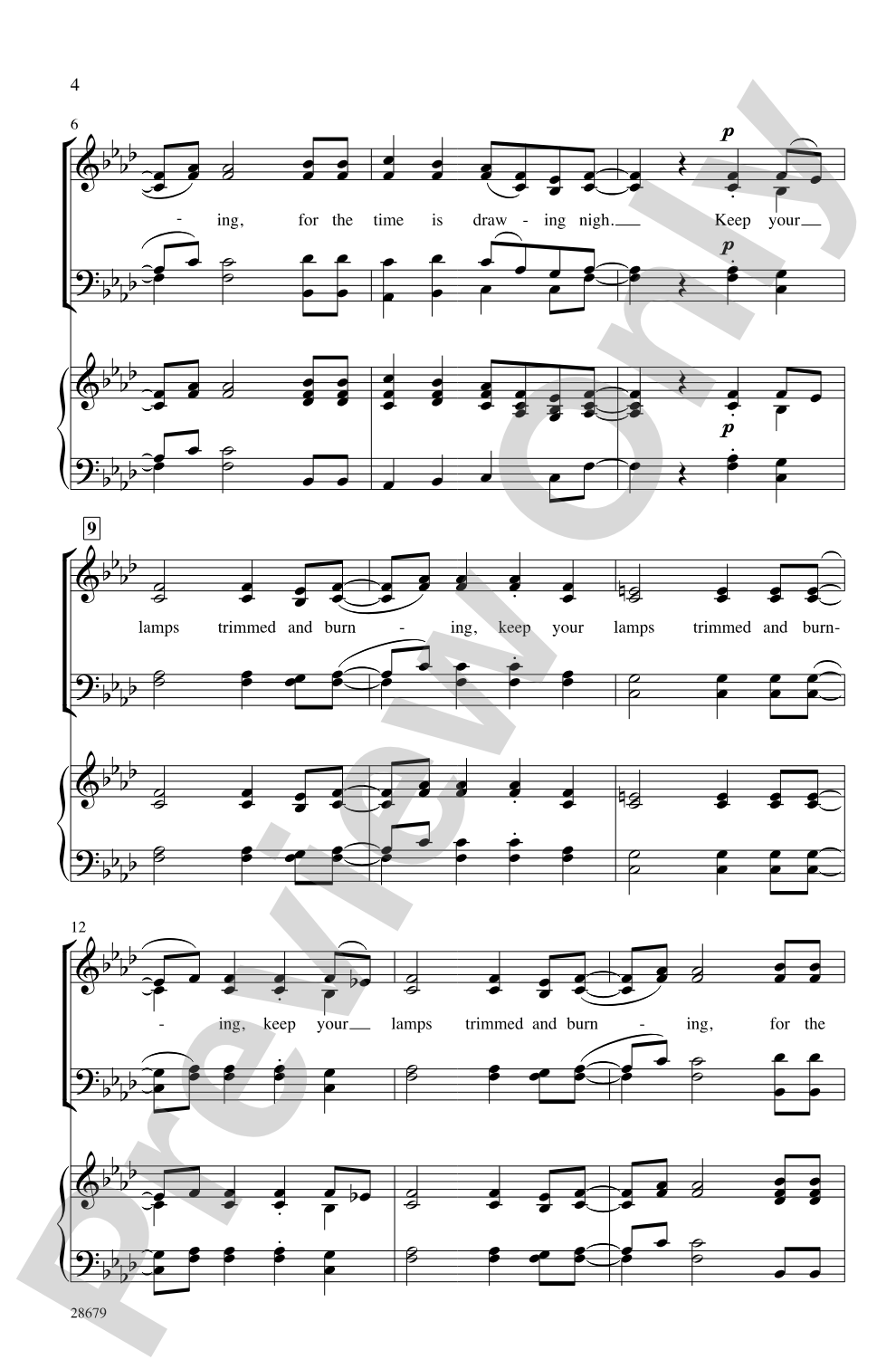
The strength of this steady, walking-tempo spiritual comes from the powerful dynamic contrasts and solid choral writing. Features brief descant-style female solos. The optional hand drum adds a rhythmic pulse.


Keep Your Lamps Trimmed and Burning: SATB, a cappella Choral Octavo isn't in MakeMusic Cloud just yet...but it could be. Let us know you'd like to see it, and you'll help shape what comes next. In the meantime, start a free trial and dive into thousands of interactive titles your students can play along with today.
Request This Title
Tell us you want it.
Start Your Free Trial
Explore everything that's ready to play right now.
Sample Audio
1
Audio File
--:--
0:00
0:00
Sample Video
No sample videos found.
Additional Details
Series:
Alfred Choral Designs
Publisher:
Alfred Music
Page Count:
12
SKU:
00-PO-0000528
More about this title
About the Arranger: Jay Althouse

Jay Althouse studied Music Education and Music at Indiana University of Pennsylvania, where he later received the Distinguished Alumni award. His early career included eight years working as a rights and licenses administrator for a major educational music publisher, a role that gave him deep insight into the choral landscape and the needs of working directors.
With over 800 choral compositions in print, Althouse has established himself as a prolific voice in American choral music, performed extensively across English-speaking countries. Beyond composing, he has shaped music education through collaborations with his wife Sally K. Albrecht on children's musicals and pedagogical resources like The Complete Choral Warm-up Book and Accent on Composers. A writer member of ASCAP and regular recipient of the ASCAP Special Award, Althouse remains active in folk music advocacy through his work with the Folk Art Society of America.
Why we love this
Althouse finds the essence of this spiritual in dynamic contrast rather than complexity. The arrangement sits comfortably in the a cappella idiom while the optional hand drum gives you flexibility: use it for added punch in a concert setting or drop it entirely for contest festivals where you want pure vocal focus. The descant-style solos for women create individual moments that feel earned rather than shoehorned in.
What to expect
Steady, grounded, and resilient. The walking tempo creates momentum that feels inevitable rather than rushed, while dynamic peaks land with real power because they emerge from quieter moments. There's a meditative quality underneath the strength, the kind that comes from music meant to sustain people through difficult times.
Who it's for
Mixed choirs at the high school through adult levels seeking accessible yet substantive spiritual arrangements. Directors programming festival or concert settings will find the a cappella flexibility and moderate technical demands fit well with both advanced and developing ensembles.
How to get the most out of it
- Shape the walking tempo with clear pulse from your rhythm section or hand drum player; resist the urge to rush as intensity builds
- Treat the dynamic shifts as structural markers, not just surface effect. The contrast between softer passages and the full sound tells the spiritual's story
- Balance the female solos carefully so they sit inside the choral texture rather than floating above it. Blend matters as much as presence
- If using the hand drum, establish a steady heartbeat in early rehearsals, then gradually pull back on accompaniment so the drum can breathe on its own
How to use it
Pair this with other spirituals for a focused set, or use it as the emotional center of a mixed-repertoire concert where you need something that bridges traditional and contemporary programming. The moderate length and straightforward narrative make it an ideal choice for festival competitions where impact matters more than technical display.
Skills your students will build
- Dynamic control across full range (pianissimo to forte)
- Balancing solo voices within choral texture
- Maintaining steady tempo and pulse in unaccompanied settings
- Shaping musical phrases through breath and line rather than external accompaniment
- Responding to text-driven emotional arcs in spirituals