
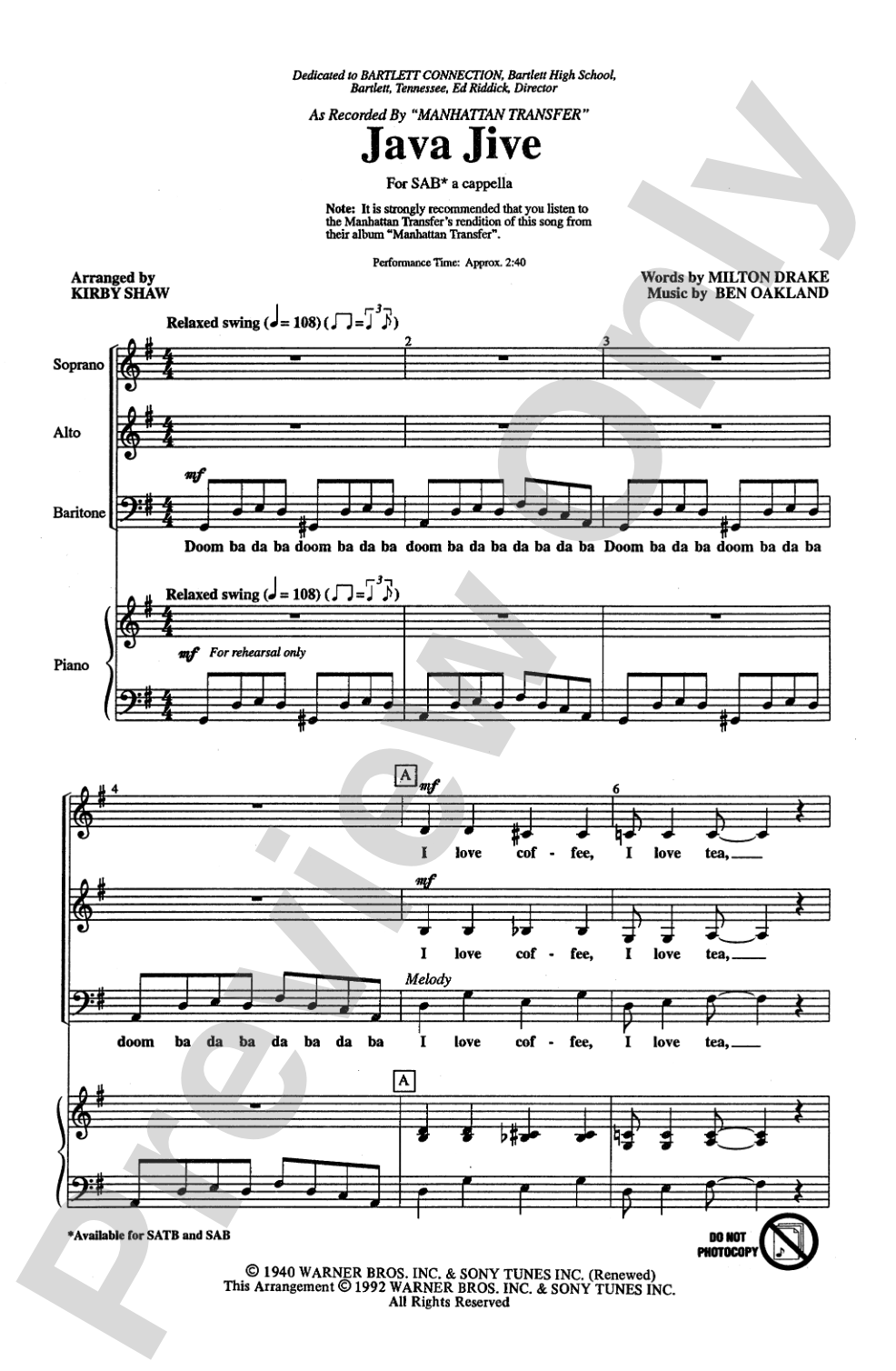
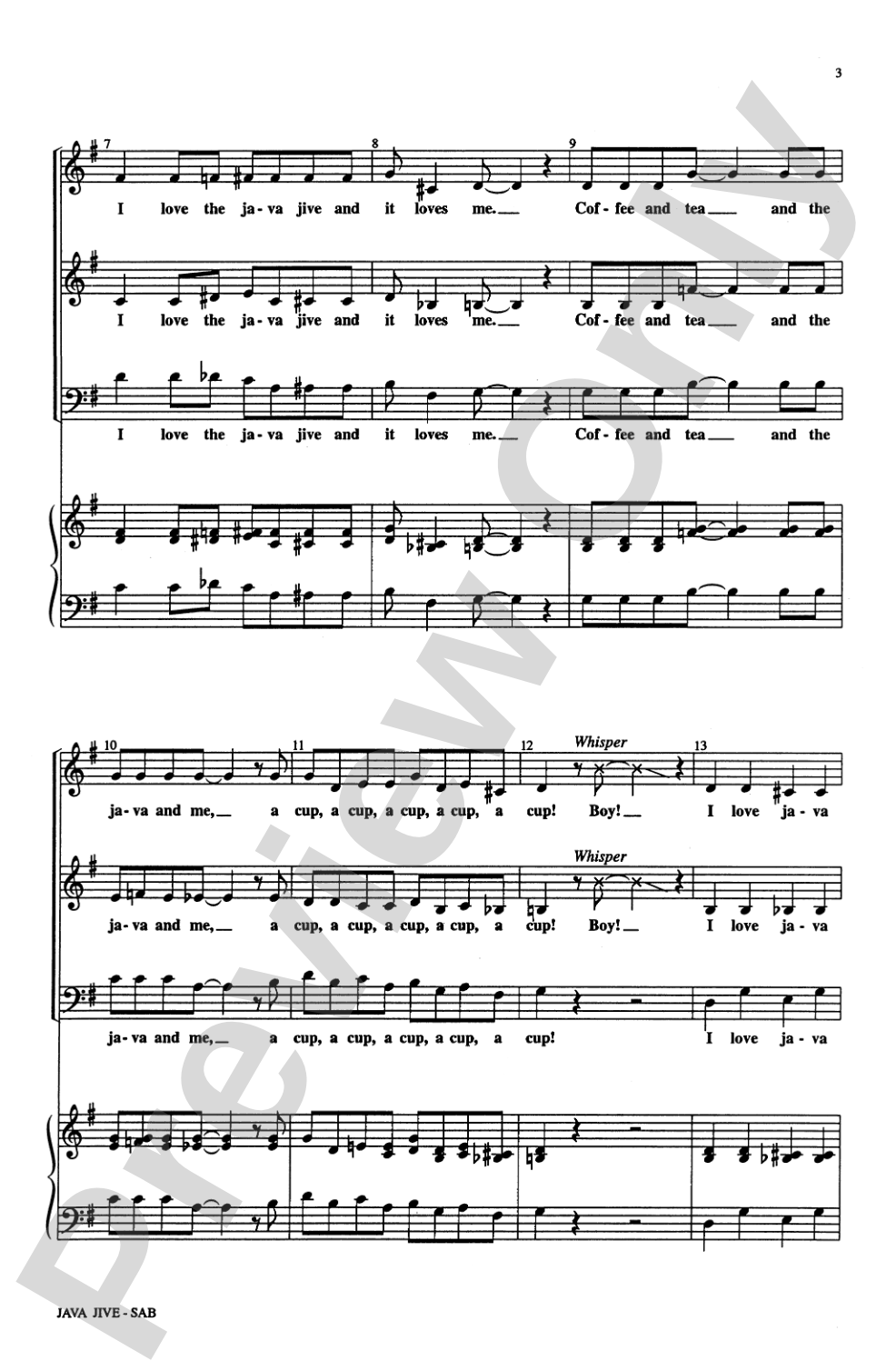
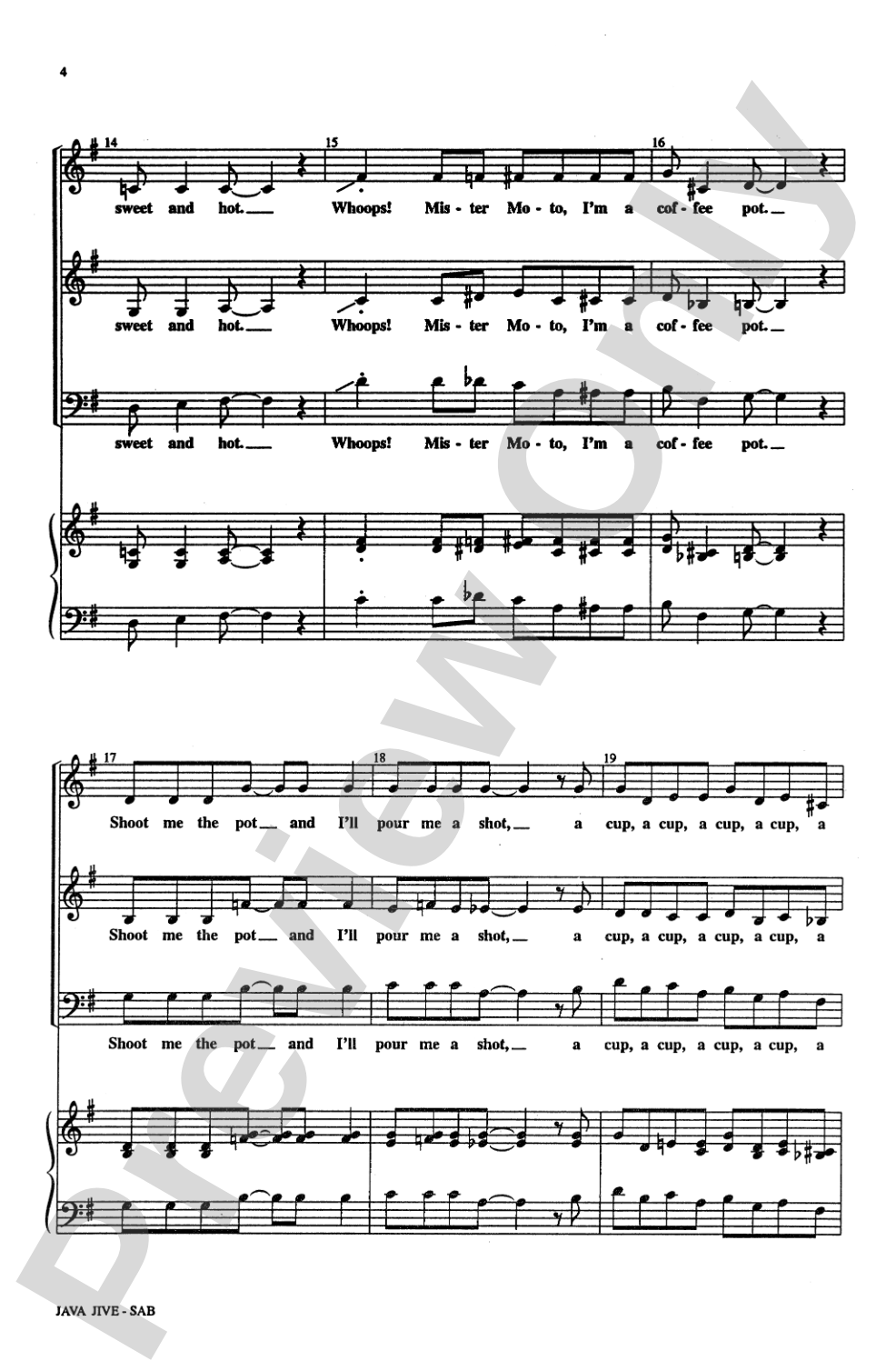

Java Jive: SAB, a cappella Choral Octavo
Arr. Kirby Shaw
Item: 00-PO-0005461
$2.25
Minimum order quantity: 20 copies
One moment…
Description


Java Jive: SAB, a cappella Choral Octavo isn't in MakeMusic Cloud just yet...but it could be. Let us know you'd like to see it, and you'll help shape what comes next. In the meantime, start a free trial and dive into thousands of interactive titles your students can play along with today.
Request This Title
Tell us you want it.
Start Your Free Trial
Explore everything that's ready to play right now.
Sample Audio
No sample audio found.
Sample Video
No sample videos found.
Additional Details
Series:
Alfred Archive Edition: Alfred Pop Choral Series
Publisher:
Alfred Music
Page Count:
12
SKU:
00-PO-0005461
More about this title
About the Arranger: Kirby Shaw
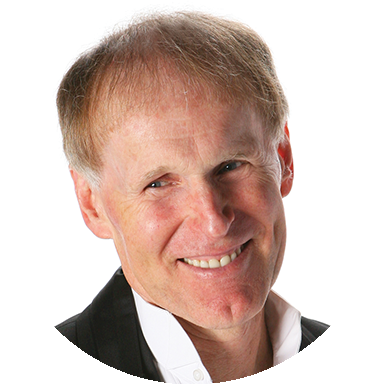
Kirby Shaw has shaped choral music education across North America and internationally, bringing his distinctive blend of technical mastery and infectious energy to ensembles in 45 states and countries including Canada, Australia, Sweden, Italy, Spain, and Germany. He holds degrees in Music Education and Choral Composition from San Jose State University and earned a DMA in Choral Conducting from the University of Washington. His teaching career spans public school music in Mt. Shasta and faculty positions at College of the Siskiyous, Colorado State University, and the University of Missouri at Kansas City, where he founded and directed acclaimed vocal jazz ensembles.
As a composer and arranger, Shaw has created over 2500 works for choral ensembles, with his music performed worldwide and approaching 20 million copies in sales. His work has earned multiple ASCAP awards, and his credits include commissions for the Mormon Tabernacle Choir and recordings spanning hundreds of educational projects, five college albums, and two solo releases. Shaw's musicianship extends to performance; he has studied vocal improvisation with Bobby McFerrin, Al Jarreau, Jon Hendricks, and other jazz luminaries, and he performs with Just 4 Kicks, a jazz-focused a cappella ensemble.
Why we love this
Shaw's arrangement captures the infectious swing and rhythmic snap of the original while crafting parts that sit naturally for SAB voices. The a cappella setting demands vocal independence from all three sections, and Shaw builds in moments where each part can shine without leaning on instrumental support. Programming this alongside other pop or standards-based repertoire gives directors a crowd-pleasing piece with real musicianship beneath the surface.
What to expect
Playful and sophisticated at once, with the easy swing of 1940s pop filtered through modern vocal jazz sensibilities. The a cappella texture creates an intimate, almost conversational feel that lets the arrangement's clever voice-leading and rhythmic interplay shine without instrumental cover.
Who it's for
Intermediate to advanced choirs comfortable with three-part mixed voicing and the rhythmic and harmonic independence required in a cappella jazz-pop arrangements. This works well for high school choirs, college non-majors ensembles, and semi-professional community groups looking to expand beyond classical territory.
How to get the most out of it
- Lock the rhythmic foundation by having the bass section practice their part independently first; Shaw's bass line drives the groove, and precision here lifts the entire arrangement.
- Encourage the altos and sopranos to find the jazz phrasing in their lines by listening to vocal jazz recordings and practicing with swing articulation rather than straight eighth notes.
- Balance the blend so that no single part disappears; SAB voicing can mask the alto line if sopranos and basses aren't singing with awareness of the middle voice.
How to use it
Pair this with other American Songbook standards or pop arrangements to build a set that celebrates vocal music of the 20th century. It works equally well as a pops concert closer or as part of a spring concert that balances classical choral literature with accessible, entertaining repertoire.
Skills your students will build
- Jazz articulation and swing phrasing in an a cappella setting
- Vocal independence and part security without instrumental support
- Blend and balance in three-part mixed voicing
- Rhythmic precision in syncopated pop-jazz material