
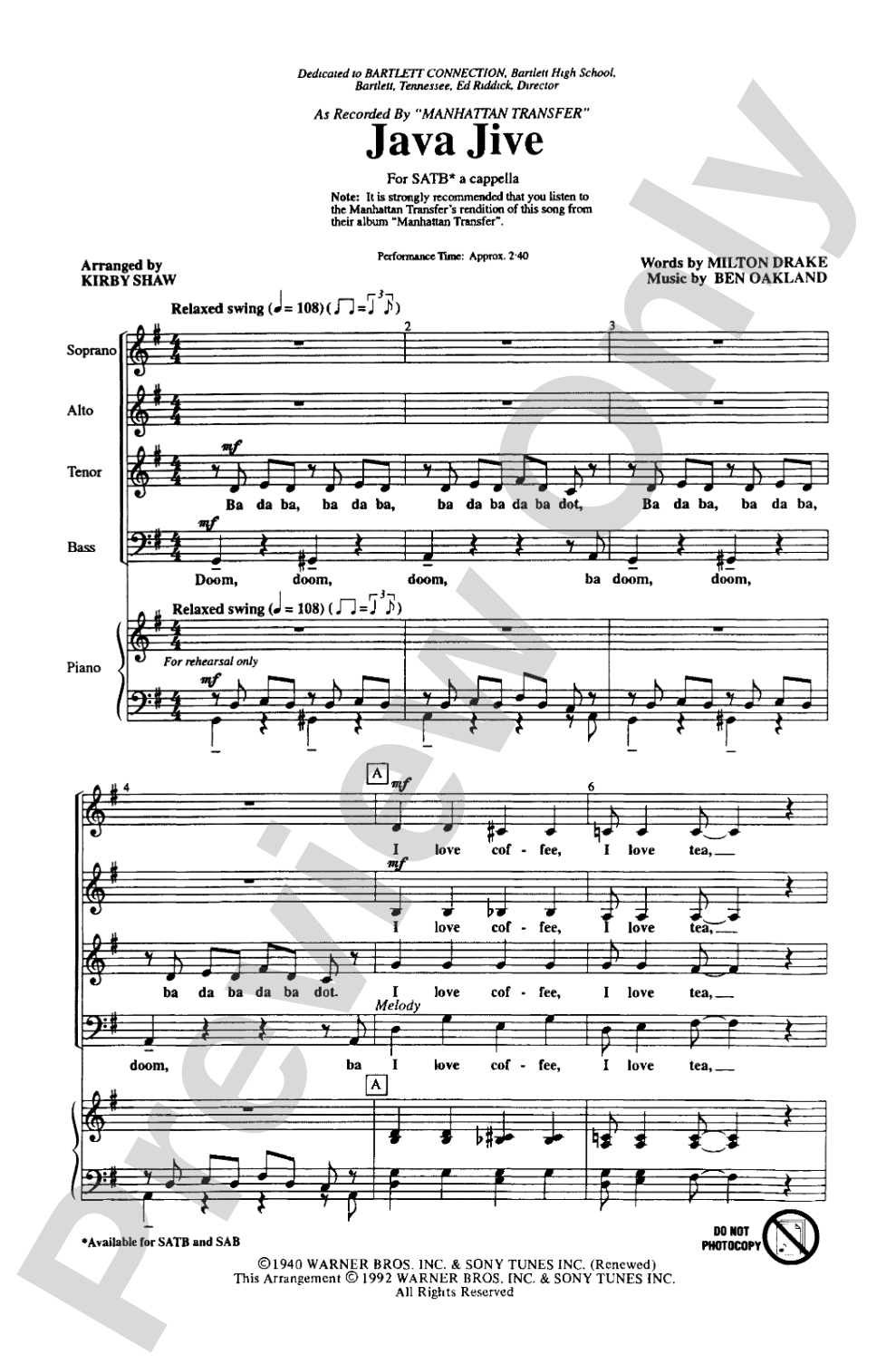
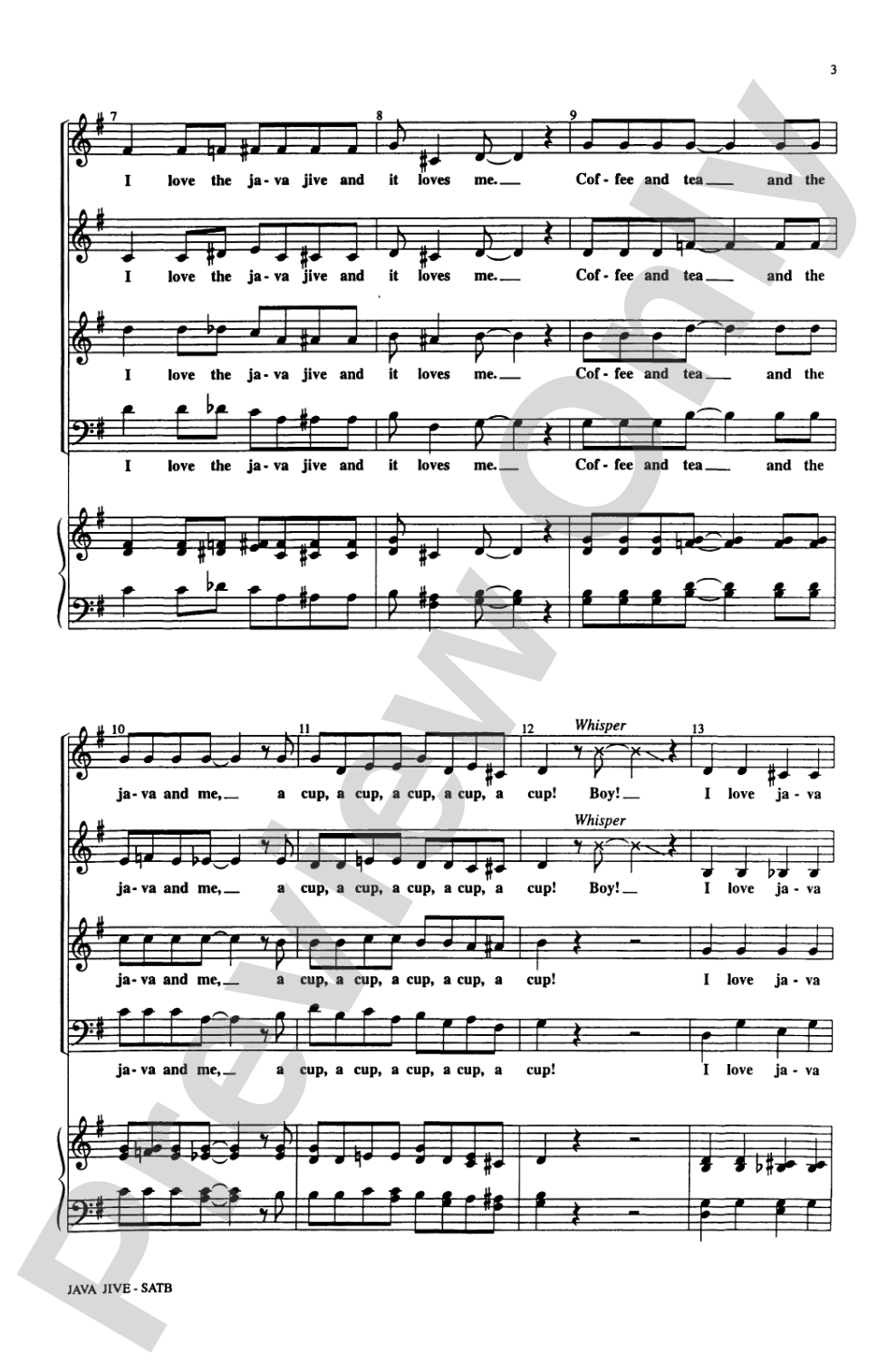
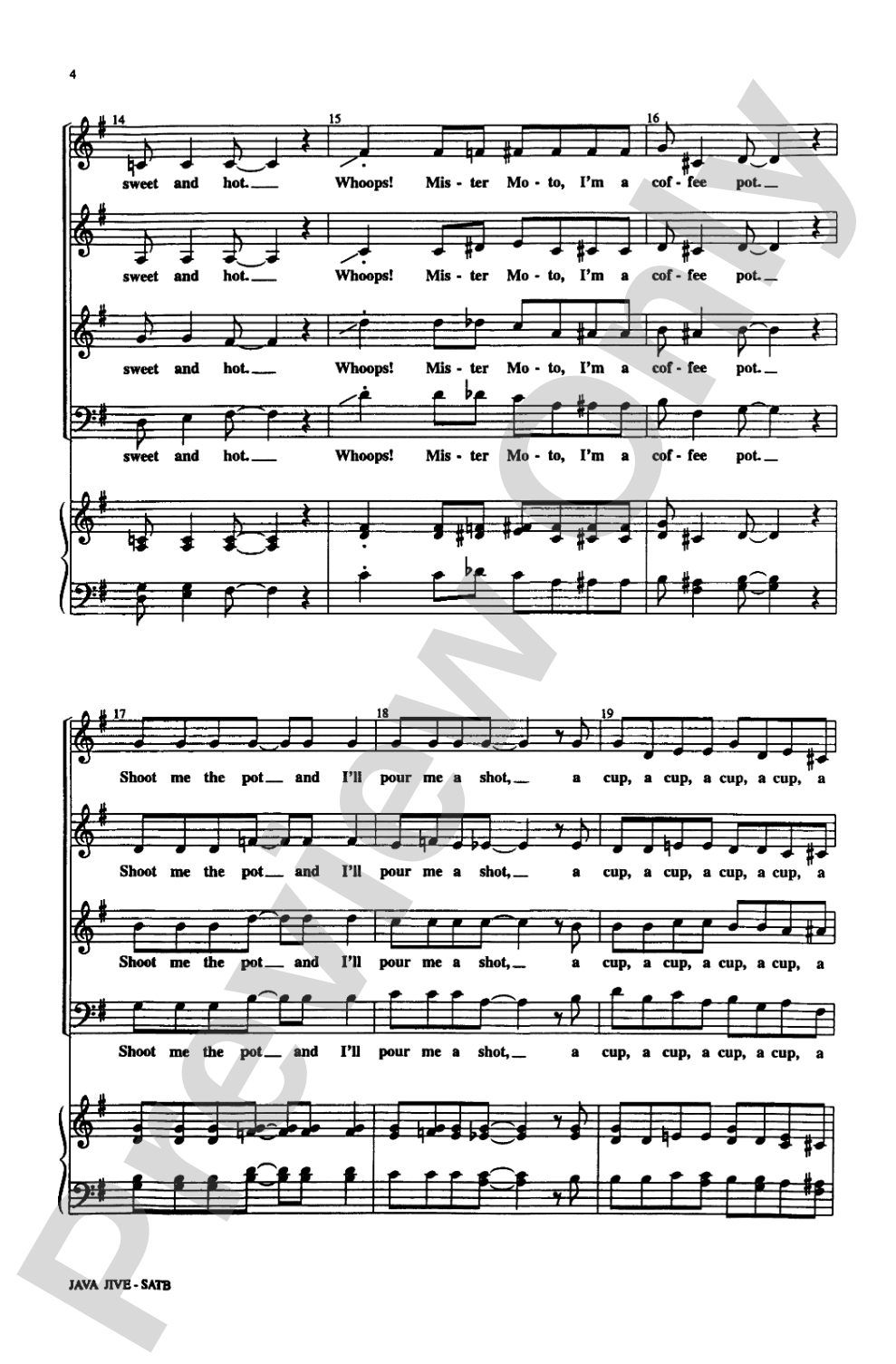

Java Jive: SATB, a cappella Choral Octavo
Arr. Kirby Shaw
Item: 00-PO-0002828
$2.25
Minimum order quantity: 20 copies
One moment…
Description


Java Jive: SATB, a cappella Choral Octavo isn't in MakeMusic Cloud just yet...but it could be. Let us know you'd like to see it, and you'll help shape what comes next. In the meantime, start a free trial and dive into thousands of interactive titles your students can play along with today.
Request This Title
Tell us you want it.
Start Your Free Trial
Explore everything that's ready to play right now.
Sample Audio
No sample audio found.
Sample Video
No sample videos found.
Additional Details
Series:
Alfred Archive Edition: Alfred Pop Choral Series
Publisher:
Alfred Music
Page Count:
12
SKU:
00-PO-0002828
More about this title
About the Arranger: Kirby Shaw
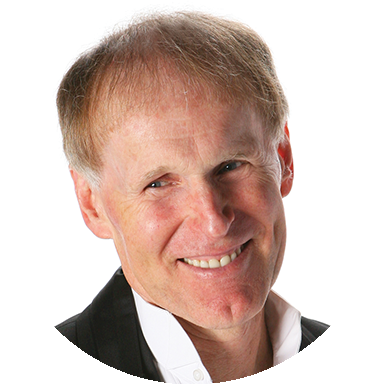
Kirby Shaw brings decades of choral leadership across North America and Europe, earning recognition as one of the most prolific arrangers in modern choral music. With formal training in music education, choral composition, and conducting from San Jose State University and the University of Washington, Shaw has directed award-winning vocal jazz ensembles at multiple universities and founded the celebrated COS Vocal Jazz Ensemble at College of the Siskiyous. His work reflects deep musical mentorship; he has studied jazz vocalization directly with artists including Bobby McFerrin, Mark Murphy, and Al Jarreau.
Shaw's compositional output spans over 2,500 arrangements and original works that have sold nearly 20 million copies worldwide and earned multiple ASCAP awards. Beyond choral music, he co-authored the musical Scroogical with his wife Markita and performs as a member of Just 4 Kicks, a four-man a cappella jazz ensemble. His teaching philosophy combines technical rigor with infectious humor, and his arrangements are known for their accessibility, musical sophistication, and ability to engage both performers and audiences.
Why we love this
Shaw's arrangement captures the playful swing and rhythmic snap of this classic without relying on instrumental accompaniment, which means your choir owns the sound entirely. The voicing sits well for mixed ensembles while maintaining enough sophistication to keep musicians engaged; this isn't simplistic. It's the kind of piece that builds ensemble confidence and gets audiences genuinely smiling.
What to expect
Lighthearted and swinging, with the warmth of voices blending in close harmony and the rhythmic vitality that makes this era's pop standards so enduring. The piece carries playful energy throughout while maintaining the musical coherence that comes from Shaw's skilled arranging.
Who it's for
Mixed choirs at intermediate to advanced levels who want accessible repertoire with genuine musicality and personality. Directors seeking a cappella material that entertains both singers and audiences without sacrificing arranging craft will find this a reliable choice for concerts, competitions, or casual performances.
How to get the most out of it
- Lock the rhythmic pocket early in rehearsals by having sections tap their parts while listening to each other, particularly the syncopated passages where the a cappella texture demands tight coordination.
- Shape the phrasing around the lyrical content rather than bar lines; let the text drive the musical line, especially in the opening sections where legato singing contrasts with the rhythm section's lighter approach.
- Balance the four voices so that no single line dominates, even when one part carries the melody; in a cappella writing, every voice contributes to the harmonic and rhythmic foundation.
- Work the swing feel separately from the notation itself; sing through sections at a relaxed tempo to internalize the lift and space that makes this arrangement swing rather than sit.
How to use it
This works beautifully as an opening number to set an upbeat, engaging tone for a concert, or as a palate cleanser between heavier classical selections. It pairs well with other swing-era standards or contemporary pop arrangements in a program celebrating American vocal music.
Skills your students will build
- Singing sustained a cappella blend and balance without instrumental reference
- Executing swing rhythms and syncopation in choral context
- Maintaining independent vocal lines within four-part harmony
- Shaping phrasing from text and lyrical content rather than purely musical notation
- Building rhythmic precision in ensemble coordination without accompaniment support