
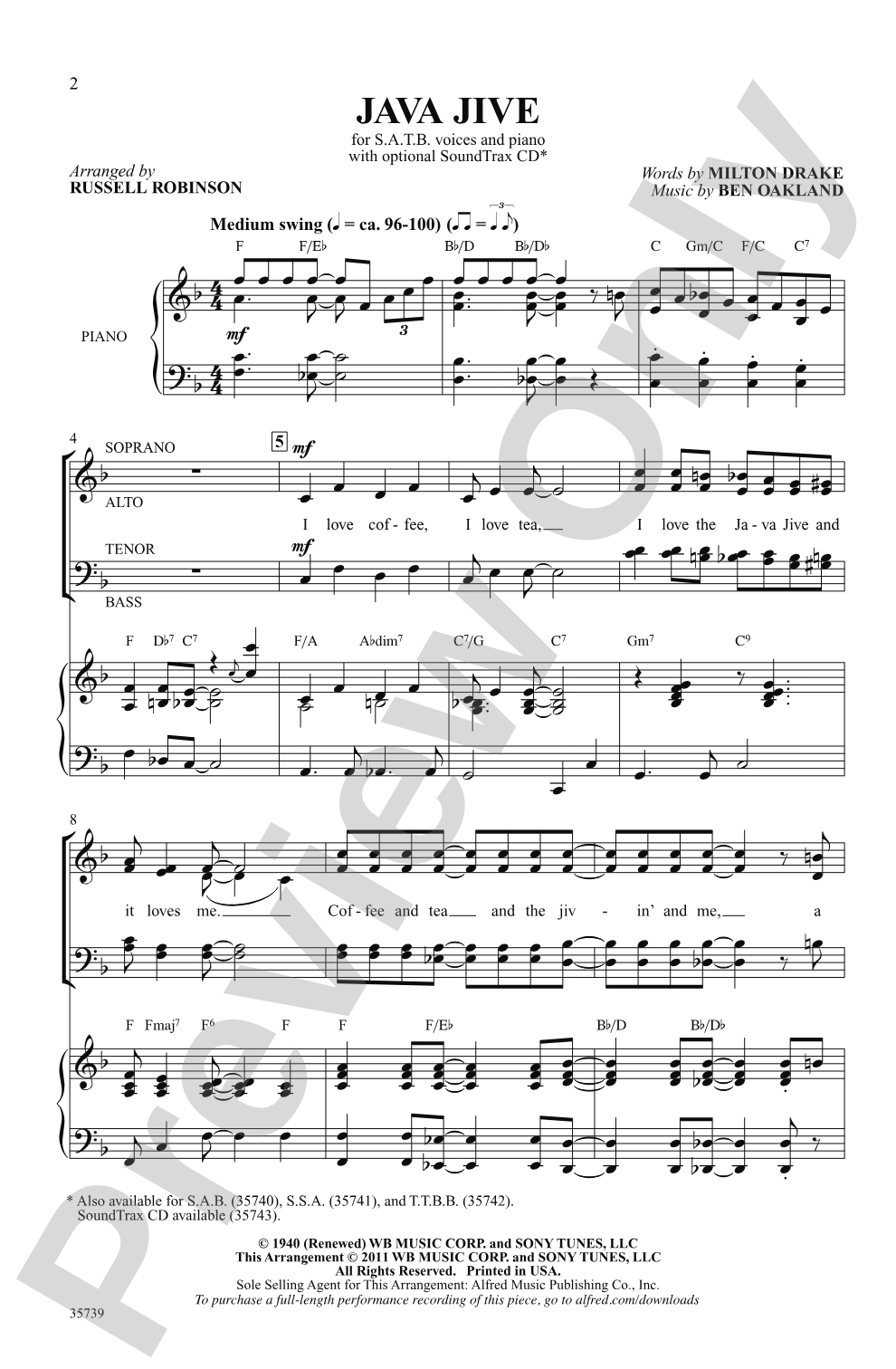
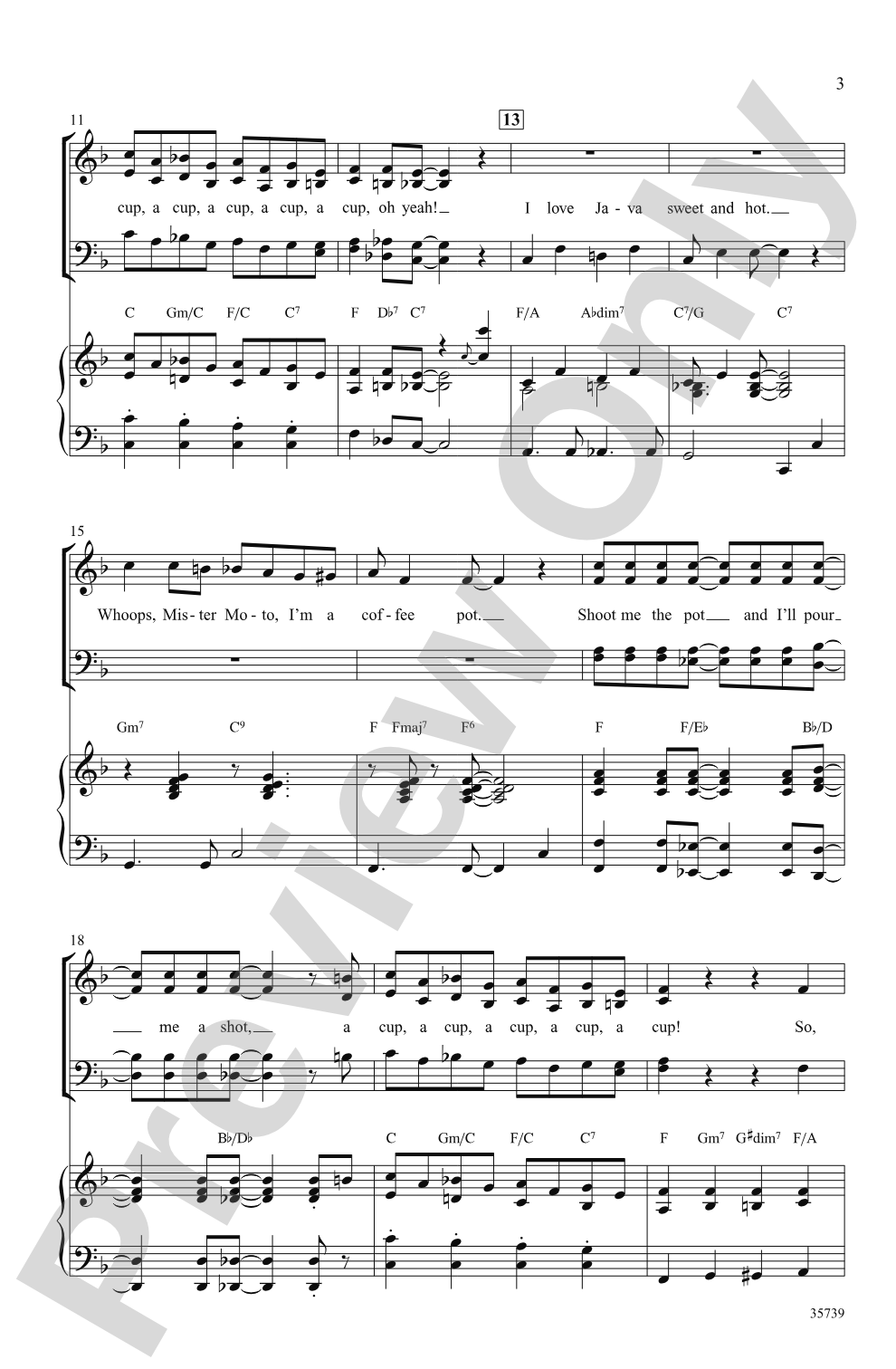

Java Jive: SATB Choral Octavo
Words by Milton Drake, music by Ben Oakland / arr. Russell Robinson
Item: 00-PO-0001065
$1.90
Minimum order quantity: 20 copies
One moment…
Related Items
Java Jive: SoundTrax Digital Audio Download |
$26.99
|
View | |
Java Jive: SAB Choral Octavo |
$1.90
|
View | |
Java Jive: SSA Choral Octavo |
$1.90
|
View | |
Java Jive: TTBB Choral Octavo |
$1.90
|
View | |
Java Jive: SATB Choral Octavo |
$1.90
|
View | |
Java Jive: SAB Choral Octavo |
$1.90
|
View | |
Java Jive: SSA Choral Octavo |
$1.90
|
View | |
Java Jive: TTBB Choral Octavo |
$1.90
|
View | |
Java Jive: Choral Octavo SoundTrax CD |
$26.99
|
View |
Description
"I love coffee, I love tea . . ." Originally made popular by The Ink Spots in 1940 and later by The Manhattan Transfer, this jazz standard still swings today! "I love the java jive, and it loves me."


Java Jive: SATB Choral Octavo isn't in MakeMusic Cloud just yet...but it could be. Let us know you'd like to see it, and you'll help shape what comes next. In the meantime, start a free trial and dive into thousands of interactive titles your students can play along with today.
Request This Title
Tell us you want it.
Start Your Free Trial
Explore everything that's ready to play right now.
Sample Audio
1
Audio File
--:--
0:00
0:00
Sample Video
No sample videos found.
Additional Details
Series:
Alfred Pop Choral Series
Publisher:
Alfred Music
Page Count:
8
SKU:
00-PO-0001065
More about this title
About the Composer: Ben Oakland
Ben Oakland (1907-1980) composed for theater, film, and popular music during the golden age of American songwriting. His catalog spans Broadway pit orchestras, Hollywood scores, and the jazz standards that became fixtures of the American songbook. Oakland had a gift for crafting melodies that were both sophisticated and immediately singable, which is why his work remains accessible to student choirs today.
Why we love this
This arrangement captures the irreverent charm of a mid-century novelty number without leaning on gimmicks. Robinson's voicing sits comfortably in student ranges while preserving the swagger of the original, and the swing rhythm gives young singers a chance to feel the difference between straight and swung eighth notes in a piece that's genuinely fun to perform.
What to expect
Playful and sophisticated at once. The melody has that breezy, conversational quality of early jazz vocals, and the chord changes swing with an easy confidence. There's a wink in every phrase, but the musicianship required to execute it well keeps singers engaged in real work.
Who it's for
High school and select middle school choirs with solid rhythmic foundation and comfort in jazz idioms. The piece works equally well for treble-voice, tenor-bass, or mixed ensembles that want to perform something with personality and historical resonance. Directors seeking a novelty number that doesn't feel cheap will find this both entertaining and musically legitimate.
How to get the most out of it
- Lock the rhythm section (bass and drums from the accompaniment) early in rehearsals so singers can trust the groove and stop rushing or dragging the swing feel.
- Emphasize the articulation on repeated eighth notes in the verse sections; that snappy, conversational rhythm is what makes the lyrics land with humor.
- Balance the soloists in the feature sections carefully so they cut through the harmony parts without overwhelming the blend.
- Record a rehearsal run-through and listen back as a group; hearing themselves swing will do more than any explanation of the style.
How to use it
Program this early in a concert alongside other standards or jazz pieces to set an upbeat tone. It works as a palate cleanser between serious classical selections or as part of a themed set celebrating American popular song. The recorded accompaniment makes it viable for smaller groups that lack a full jazz ensemble.
Skills your students will build
- Singing swung eighth notes and triplet-feel rhythms accurately
- Sustaining blend and intonation through syncopated harmonic movement
- Stylistic interpretation of jazz phrasing and articulation
- Rhythmic independence while following a groove-based accompaniment