
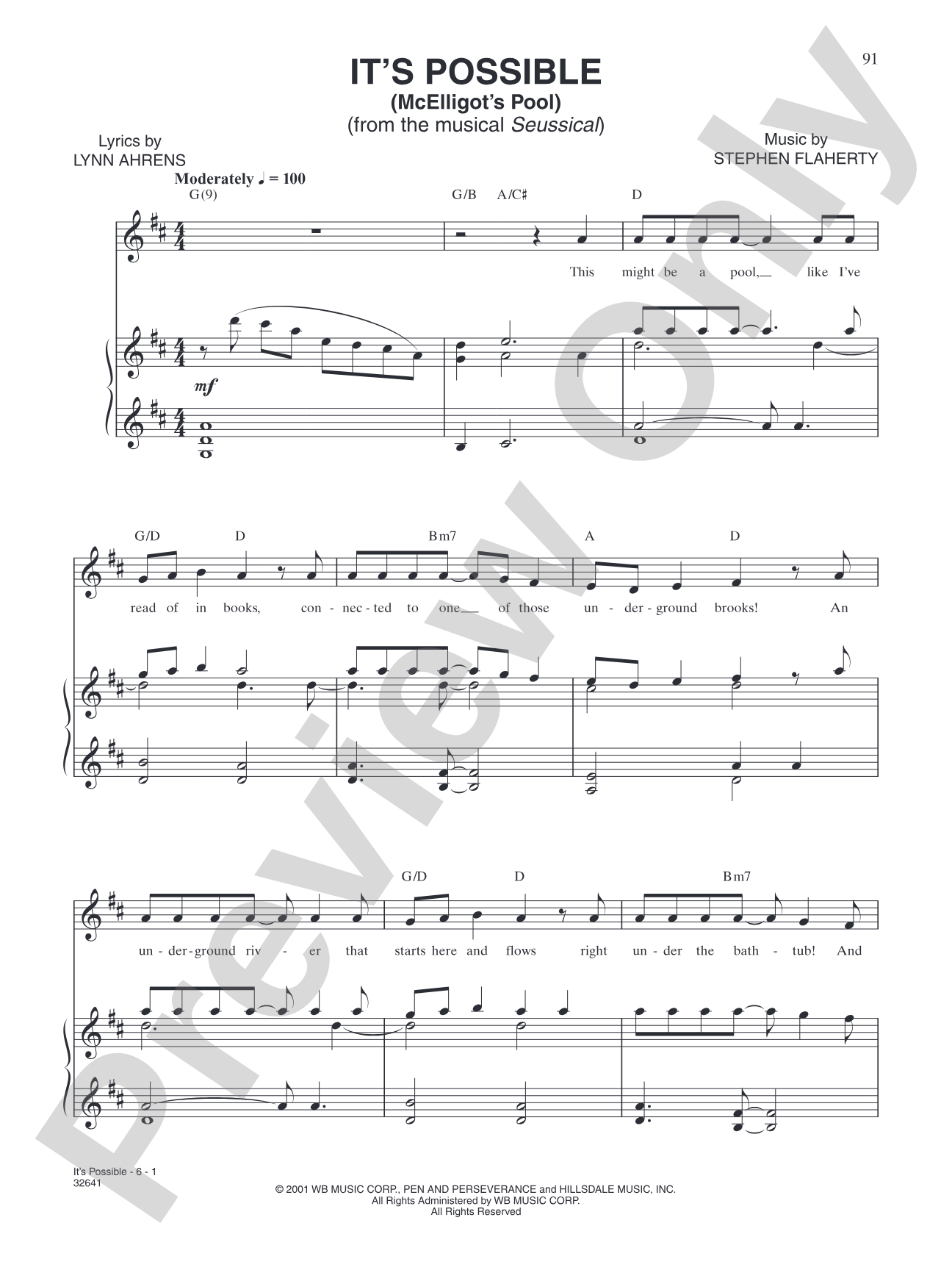
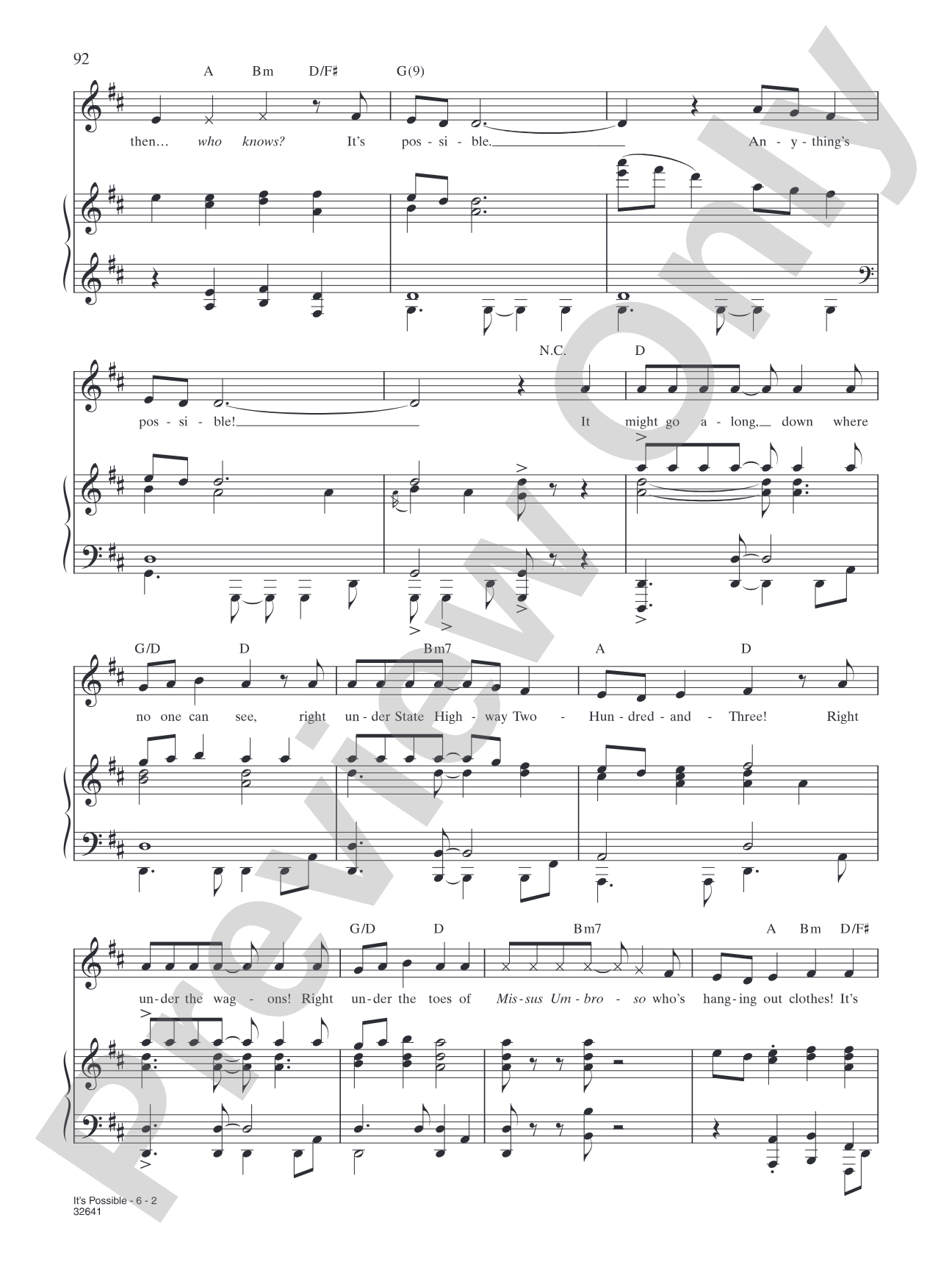

It's Possible (McElligot's Pool): Piano/Vocal/Chords
Lyrics by Lynn Ahrens, music by Stephen Flaherty
Item: 00-PS-0011024
$5.99
One moment…
Related Items
I Was Here (from "The Glorious Ones"): Piano/Vocal/Chords |
$9.99
|
View | |
Ragtime (From "Ragtime"): Piano/Vocal/Chords |
$5.99
|
View | |
My Body Wasn't Why (from "The Glorious Ones"): Piano/Vocal/Chords |
$5.99
|
View | |
Something Beautiful: Piano/Vocal/Chords |
$5.99
|
View | |
After the Storm: Piano/Vocal/Chords |
$5.99
|
View | |
Close (but No Cigar): Piano/Vocal/Chords |
$5.99
|
View |
Description
A collection of highlights from the career of one of the most honored Broadway songwriting teams of our time: Lynn Ahrens and Stephen Flaherty. This songbook contains songs that are a joy to perform, no matter what your age from their Tony Award®-winning musical Ragtime to acclaimed shows like Seussical: The Musical and Once On This Island. Titles: After the Storm * All Those Christmas Cliches * Alone in the Universe * At the Beginning * Back to Before * Close But No Cigar * Come Down from the Tree * How Lucky You Are * The Human Heart * I Was Here * If the World Were Like the Movies * It's Possible * Journey to the Past * Larger than Life * Love Who You Love * Make Them Hear You * Mama Will Provide * My Body Wasn't Why * Oh, the Thinks You Can Think * Once Upon a December * Our Children * Ragtime * Something Beautiful * Streets of Dublin * Times Like This * Waiting for Life * Wheels of a Dream.


It's Possible (McElligot's Pool): Piano/Vocal/Chords isn't in MakeMusic Cloud just yet...but it could be. Let us know you'd like to see it, and you'll help shape what comes next. In the meantime, start a free trial and dive into thousands of interactive titles your students can play along with today.
Request This Title
Tell us you want it.
Start Your Free Trial
Explore everything that's ready to play right now.
Sample Audio
No sample audio found.
Sample Video
No sample videos found.
Additional Details
Publisher:
Alfred Music
Page Count:
208
SKU:
00-PS-0011024
More about this title
About the Composer: Stephen Flaherty
Stephen Flaherty has composed the music for some of Broadway's most inventive and emotionally direct musicals. His collaborations with lyricist Lynn Ahrens have produced multiple Tony Award winners and works that span wildly different theatrical worlds, from the historical sweep of Ragtime to the whimsical storytelling of Seussical. His gift for melody is immediate and memorable, and his orchestrations range from intimate and reflective to grandly theatrical.
Flaherty's work appears regularly in music education settings because his songs sit naturally in the voice, support strong character moments, and reward performers who dig into the emotional stakes. Whether writing for children, young adults, or mature audiences, he maintains a compositional integrity that refuses to condescend.
Why we love this
This collection gathers the most singable, character-rich moments from Flaherty's catalog in one resource. A singer or pianist can move fluidly between styles, tonalities, and dramatic contexts, which means you're not locked into programming similar material back to back. The harmonic language rewards pianists who understand voice leading without becoming needlessly complex.
What to expect
These songs feel expansive yet intimate. Some moments swell with hope and theatrical grandeur; others settle into quiet reflection or wry humor. Throughout, there's a sense that the characters and their stories matter, that music and lyrics are working together to illuminate something true about the human experience.
Who it's for
This collection works for intermediate to advanced pianists accompanying singers at auditions, recitals, or showcases, as well as solo singers preparing audition material or thematic recitals. It's equally useful for teachers building a library of contemporary musical theater material that spans different character types and emotional ranges.
How to get the most out of it
- Study the lyrical phrases before diving into the harmonic accompaniment. Flaherty's melodies often sit high in the range and benefit from breath planning that honors the text rather than just the bar line.
- Balance dynamics carefully in the quieter pieces. Songs like 'Once Upon a December' and 'Alone in the Universe' rely on restraint and vulnerability; resist the urge to push the volume.
- Use the provided chord symbols as a foundation, not a ceiling. Many arrangements can support tasteful reharmonization or simplified voicings depending on your skill level and setting.
- Lock tempos early. Several of these songs sit in tricky rhythmic spaces where the accompaniment and vocal line can easily drift apart without a clear pulse agreement.
How to use it
Feature individual songs in themed recitals exploring character archetypes, coming-of-age moments, or resilience. Alternatively, program several selections in sequence to showcase the range and flexibility of a singer's instrument and interpretive skills. The breadth of this collection makes it especially valuable for audition prep and for music theater-focused studio or school showcases.
Skills your students will build
- Reading rhythm in mixed meters and syncopated figures
- Sustaining legit vocal tone in a contemporary musical theater context
- Interpreting character and emotional subtext from song lyrics and harmonic choices
- Accompanying singers with dynamic and harmonic control
- Navigating key changes and modulations within a single song
- Building expressive musical phrasing across large intervals and wide ranges