
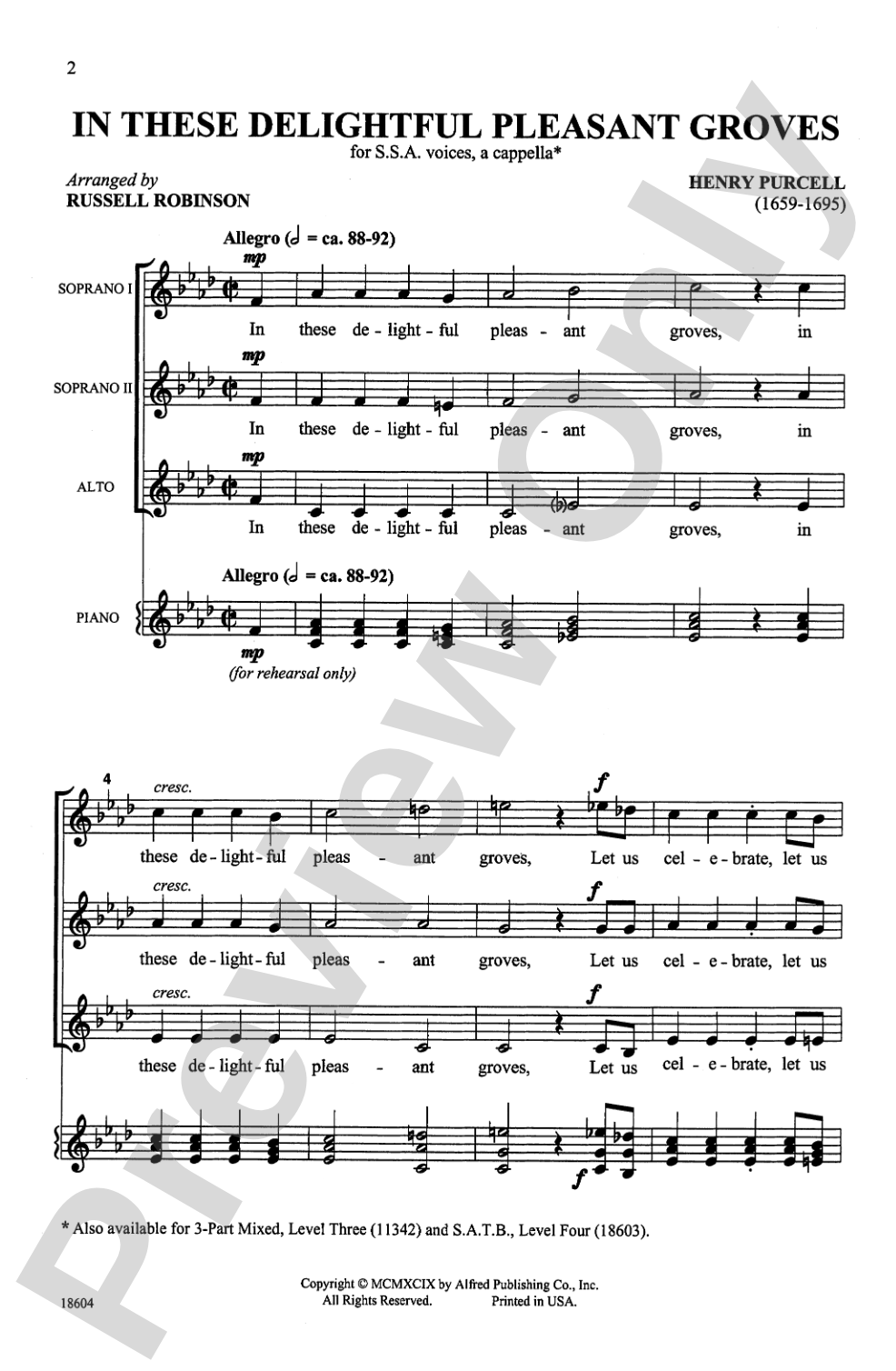
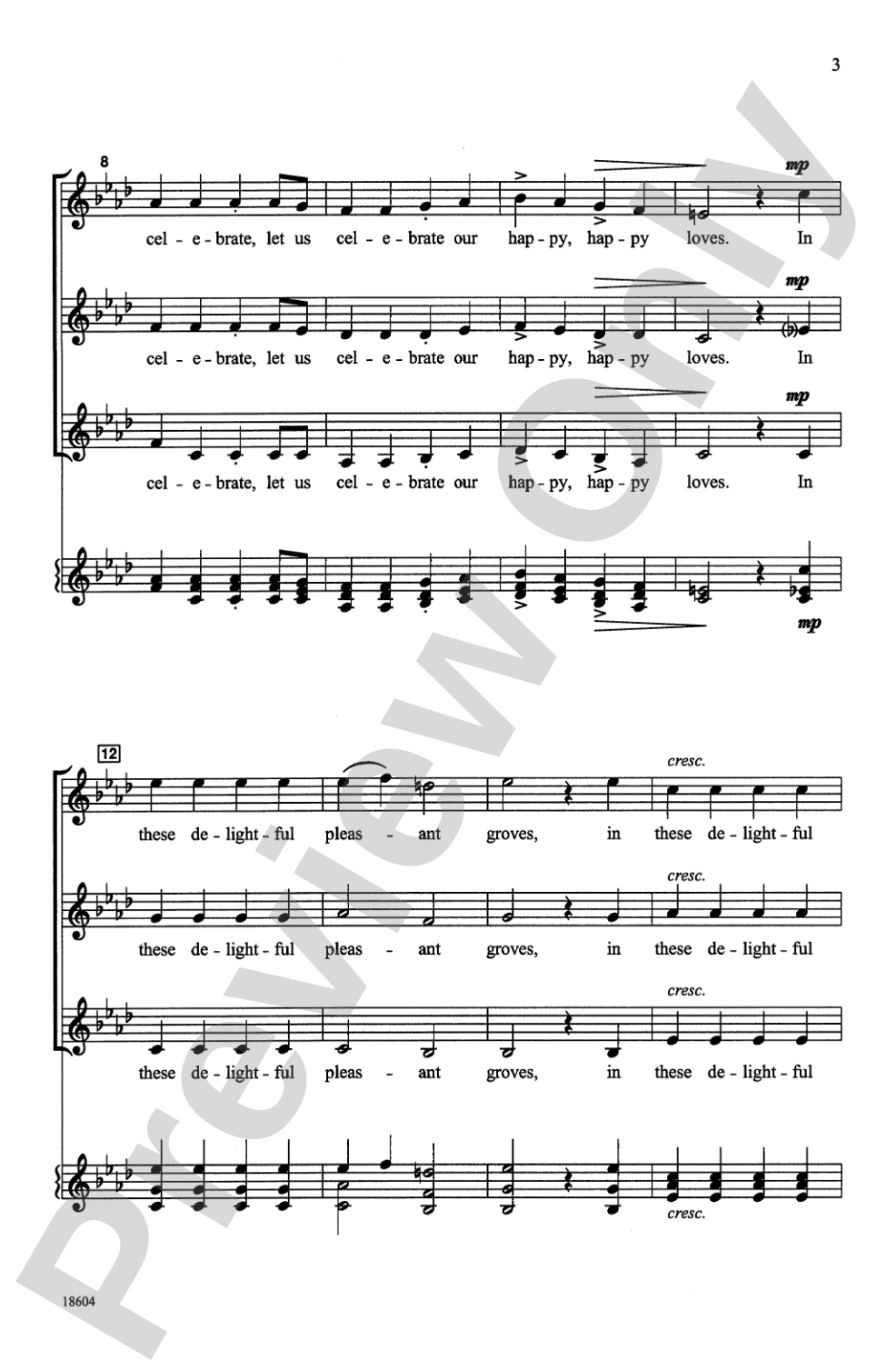

In These Delightful Pleasant Groves: SSA, a cappella Choral Octavo
Music by Henry Purcell / arr. Russell Robinson
Item: 00-PO-0004065
$2.25
Minimum order quantity: 20 copies
Pickup currently not available
Related Items
In These Delightful Pleasant Groves: SATB, a cappella Choral Octavo |
$2.25
|
View | |
In These Delightful Pleasant Groves: 3-Part Mixed, a cappella Choral Octavo |
$2.25
|
View | |
In These Delightful Pleasant Groves: SATB, a cappella Choral Octavo |
$2.25
|
View | |
In These Delightful Pleasant Groves: 3-Part Mixed, a cappella Choral Octavo |
$2.25
|
View | |
In These Delightful Pleasant Groves: SSA, a cappella Choral Octavo |
$2.25
|
View |
Description
A finely crafted edition of the classic English madrigal. The editing and easy-to-read open score are right on target for today's choirs. Fluid contrapuntal sections contrast with full-sounding homophonic sections.


In These Delightful Pleasant Groves: SSA, a cappella Choral Octavo isn't in MakeMusic Cloud just yet...but it could be. Let us know you'd like to see it, and you'll help shape what comes next. In the meantime, start a free trial and dive into thousands of interactive titles your students can play along with today.
Request This Title
Tell us you want it.
Start Your Free Trial
Explore everything that's ready to play right now.
Sample Audio
1
Audio File
--:--
0:00
0:00
Sample Video
No sample videos found.
Additional Details
Series:
Alfred Archive Edition: Alfred Choral Designs
Publisher:
Alfred Music
Page Count:
8
SKU:
00-PO-0004065
More about this title
About the Composer: Henry Purcell
Henry Purcell (1659-1695) was England's greatest Baroque composer and a master of vocal music across every genre from sacred anthems to secular songs and dramatic works. His gift for melody, harmonic innovation, and text-setting made him a towering figure in English musical life, and his influence extended well beyond his lifetime. Purcell's madrigals and part songs remain essential to the choral repertoire, showcasing his ability to balance structural sophistication with immediate emotional appeal.
Why we love this
Russell Robinson's edition captures what makes this madrigal so teachable: the counterpoint is genuinely musical rather than academic, the homophonic moments breathe naturally, and the open score layout removes barriers for singers learning their parts. Directors return to this piece because it delivers authentic Baroque choral writing without demanding extensive rehearsal time, and audiences recognize it as a genuine masterwork, not a simplified version.
What to expect
This madrigal unfolds with the grace and courtesy of English garden verse, weaving individual melodic lines into moments of radiant fullness. The interplay between flowing counterpoint and warm harmonic blocks creates a sense of conversation and community, with the text painting the subject of delightful groves with both wit and genuine affection.
Who it's for
SSA choirs with solid part-reading skills and some experience with Baroque style will find this piece accessible and rewarding. The a cappella format and eight-page length make it manageable for community choirs, school choirs, and collegiate ensembles preparing for festivals or concerts. Singers appreciate the melodic writing and the blend of technical challenge with musical immediacy.
How to get the most out of it
- Shape phrases through text rather than breath marks; let the English words guide your natural phrasing and keep the line moving between the contrasting sections.
- In the contrapuntal passages, highlight the independence of each voice line by maintaining clear articulation and allowing each part to resonate without blending into homogeneity.
- Balance the lighter, more delicate textures with the fuller homophonic sections by adjusting dynamics subtly; the shift in texture creates its own sense of contrast without exaggeration.
- Pay attention to Purcell's harmonic language, which occasionally uses unexpected resolutions; these moments reward a slight emphasis that lets listeners hear the sophistication beneath the surface.
How to use it
Position this as the centerpiece of a Baroque choral set, pairing it with other English madrigals or Continental works from the period to build a cohesive program. Its moderate length and straightforward a cappella setup make it ideal for concert programming in the middle of a set, where it can anchor an audience's attention with familiar elegance.
Skills your students will build
- Reading and sustaining independent voice lines in contrapuntal writing
- Distinguishing texture changes and adjusting blend between homophonic and polyphonic sections
- Interpreting Baroque harmonic language and text-driven phrasing
- Developing intonation awareness in a cappella singing across SSA voicing
- Balancing period-appropriate articulation with modern choral sound