

In These Delightful Pleasant Groves: 3-Part Mixed, a cappella Choral Octavo
Music by Henry Purcell / arr. Russell Robinson
Item: 00-PO-0002052
$2.25
Minimum order quantity: 20 copies
Pickup currently not available
Related Items
In These Delightful Pleasant Groves: SATB, a cappella Choral Octavo |
$2.25
|
View | |
In These Delightful Pleasant Groves: SSA, a cappella Choral Octavo |
$2.25
|
View | |
In These Delightful Pleasant Groves: SATB, a cappella Choral Octavo |
$2.25
|
View | |
In These Delightful Pleasant Groves: 3-Part Mixed, a cappella Choral Octavo |
$2.25
|
View | |
In These Delightful Pleasant Groves: SSA, a cappella Choral Octavo |
$2.25
|
View |
Description
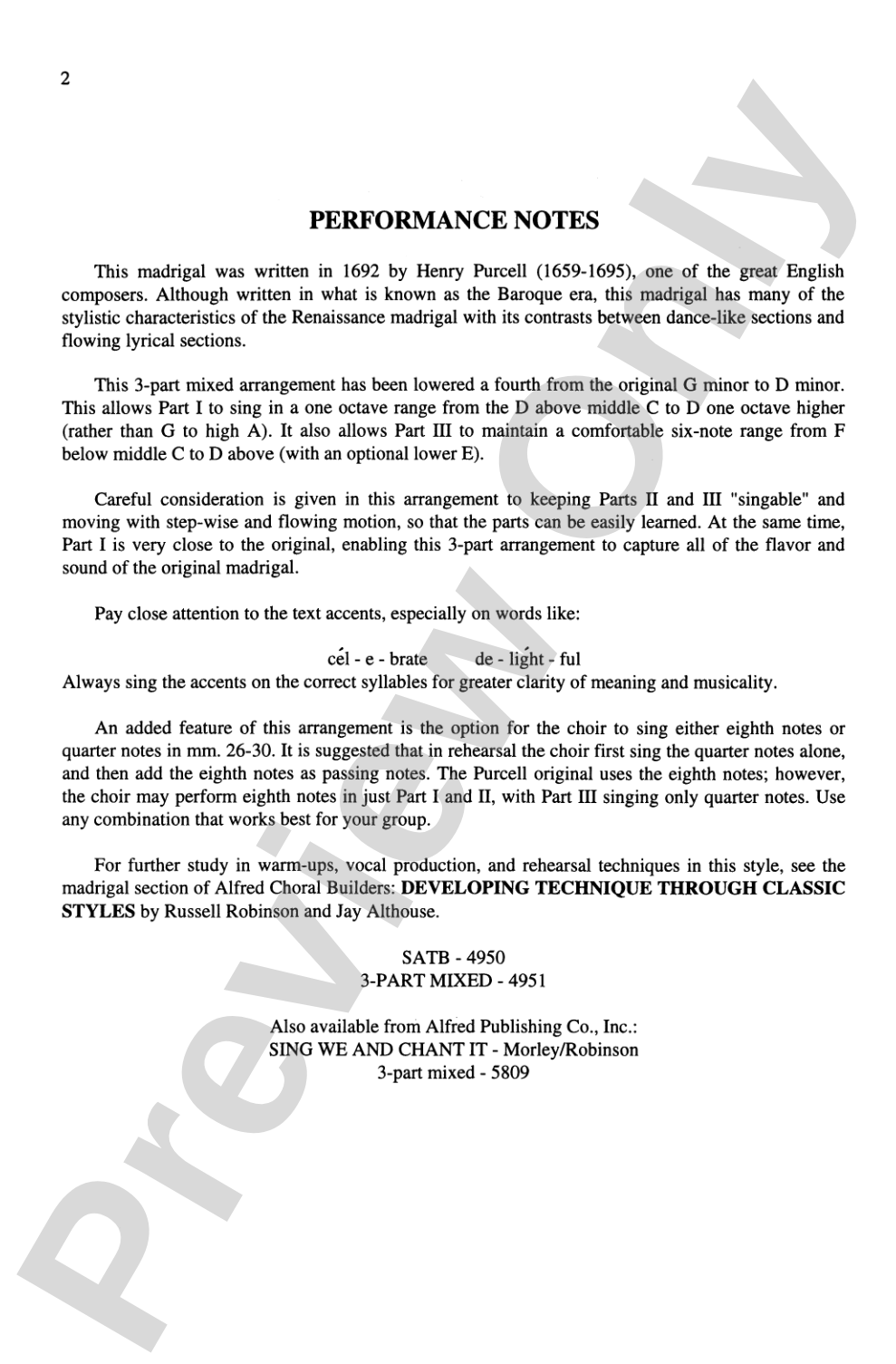
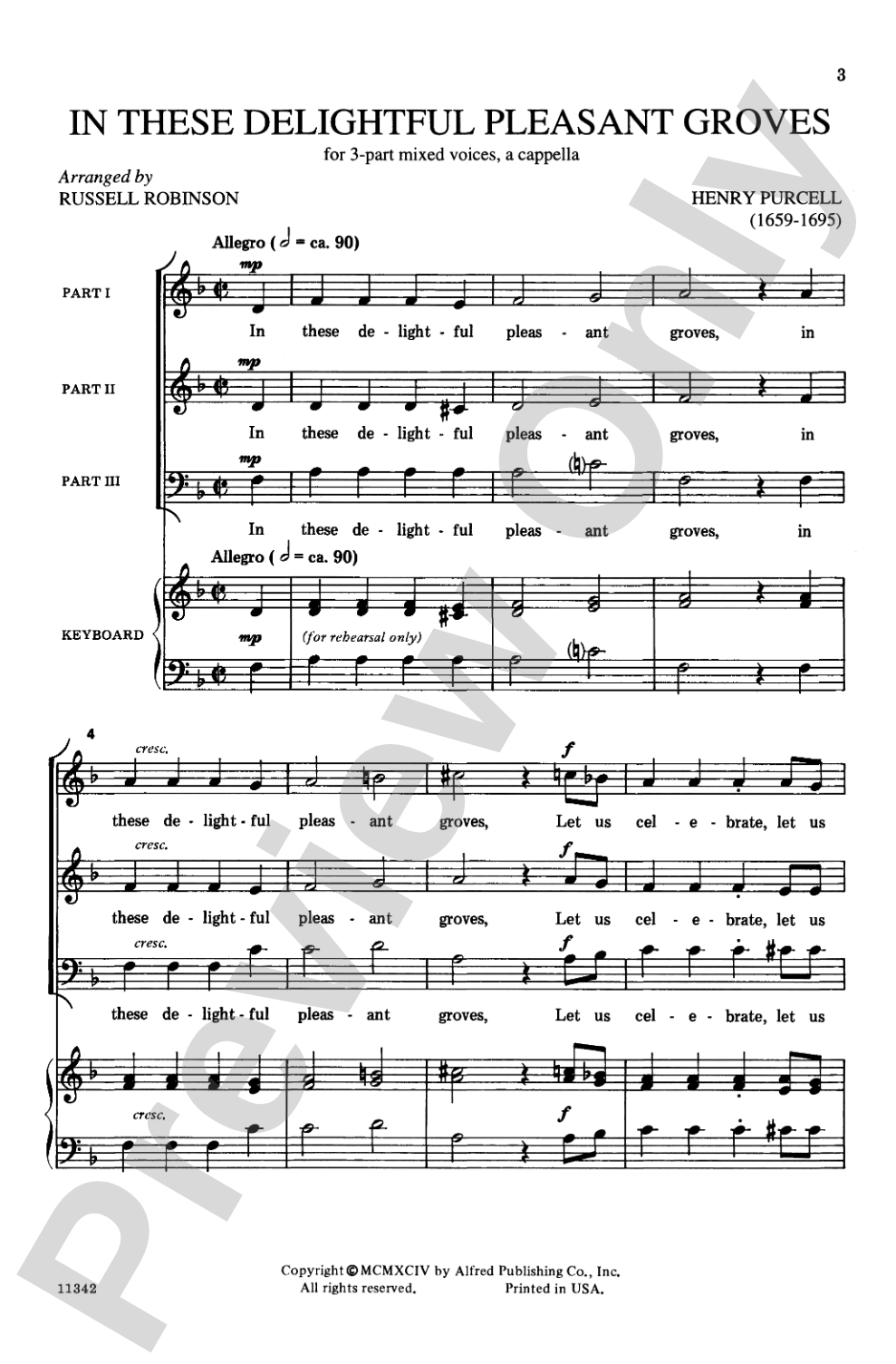
Russell Robinson has carefully edited this 17th Century madrigal for today's 3-part choirs. The key has been lowered a fourth, allowing part I to sing in a comfortable, one-octave (D-D) range. It also provides part III (the changed or changing boys' voices) with a limited 6-note range. Open score means easy reading for young choirs. Includes historical and performance notes. Introduce your middle school or junior high choir to madrigal singing with this well arranged work.


In These Delightful Pleasant Groves: 3-Part Mixed, a cappella Choral Octavo isn't in MakeMusic Cloud just yet...but it could be. Let us know you'd like to see it, and you'll help shape what comes next. In the meantime, start a free trial and dive into thousands of interactive titles your students can play along with today.
Request This Title
Tell us you want it.
Start Your Free Trial
Explore everything that's ready to play right now.
Sample Audio
1
Audio File
--:--
0:00
0:00
Sample Video
No sample videos found.
Additional Details
Series:
Alfred Archive Edition: Alfred Choral Designs
Publisher:
Alfred Music
Page Count:
8
SKU:
00-PO-0002052
More about this title
About the Composer: Henry Purcell
Henry Purcell (1659-1695) was England's greatest Baroque composer and a defining voice in 17th-century music. He served as organist at Westminster Abbey and composed across genres including operas, sacred anthems, and secular vocal works, earning recognition as a master of text setting and harmonic invention. His madrigals and part songs remain staples of the choral repertoire for their lyrical beauty and sophisticated use of imitative counterpoint.
Why we love this
Robinson's edition brings a canonical Baroque madrigal within reach of younger singers without sacrificing the music's sophistication. The transposition and part writing make this genuinely playable for middle school choirs while preserving Purcell's craftsmanship, and the open score format removes a significant barrier to sight-reading early music.
What to expect
Elegant and intimate, with the conversational quality of Renaissance gardens and courtly life. The interweaving melodic lines create moments of genuine beauty, and the a cappella setting draws singers and listeners into close attention to the text and harmony.
Who it's for
Middle school and junior high choirs ready to engage with early music in accessible but authentic arrangements. This edition works well for ensembles with limited changing-voice resources, since the restricted ranges in parts I and III accommodate typical voice development at this level.
How to get the most out of it
- Shape each phrase by thinking horizontally rather than vertically; resist the urge to stop at bar lines and let the text drive the phrasing across the full arc of each melodic statement.
- Balance the three parts so that no single voice dominates; in madrigals, the interplay of voices matters as much as the individual lines, and transparent texture allows the harmonic language to speak clearly.
- Approach the text with natural speech rhythms first, then layer in the musical meter; this prevents the a cappella texture from sounding detached or metronomic.
- Use the historical and performance notes provided to ground your interpretation in period practice; even small adjustments to articulation and vowel consistency can unlock the character of the piece.
How to use it
Pair this with other madrigals or Renaissance secular works to build a thematic concert segment, or program it as a bridge between familiar pop repertoire and longer-form art music study. It also serves as an excellent introduction to contest or festival participation, since madrigal singing builds sight-reading and intonation skills that transfer across genres.
Skills your students will build
- Reading open score format and identifying individual voice lines
- Singing unaccompanied (a cappella) with rhythmic and harmonic independence
- Interpreting historical text underlay and performing with period-appropriate phrasing
- Balancing three part lines with equal weight and transparency
- Recognizing imitative counterpoint and tracking voice entrances across sections