
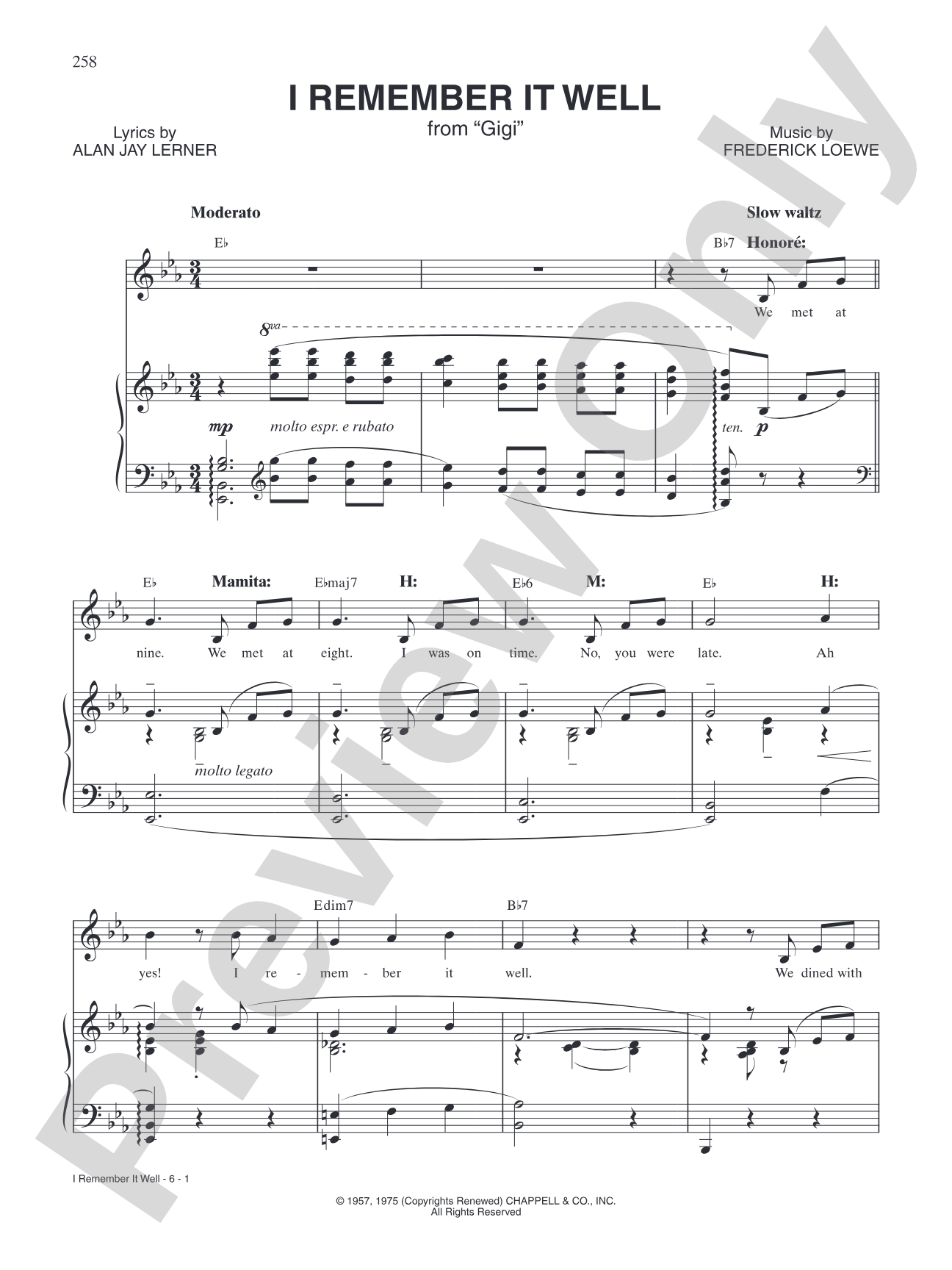
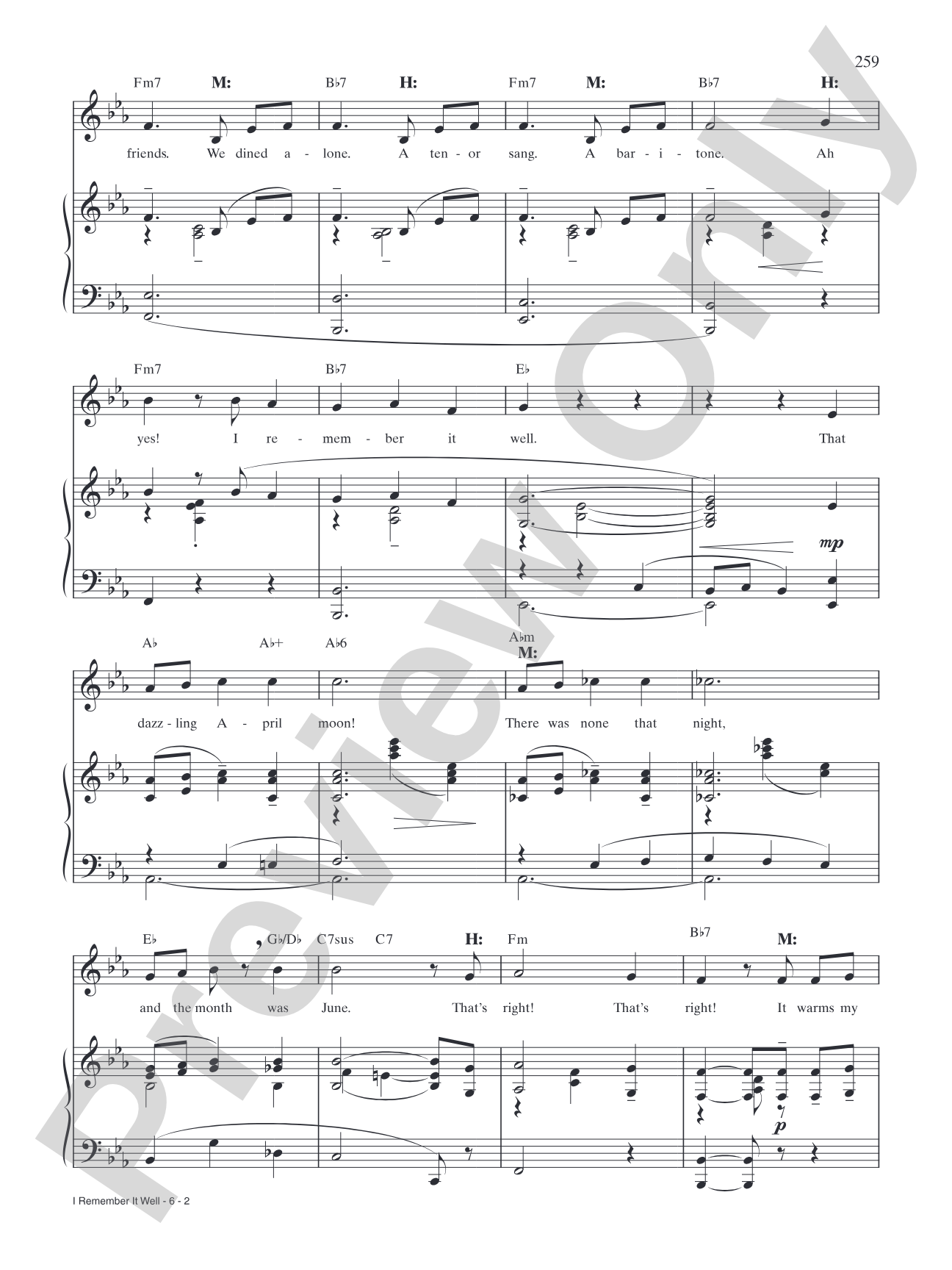

I Remember it Well (from "Gigi"): Piano/Vocal/Chords
60 Songs from M-G-M's Greatest Movie Musicals
Item: 00-PS-0010825
$5.99
One moment…
Related Items
Hi-Lili Hi-Lo (from "Lili"): Piano/Vocal/Chords |
$4.99
|
View | |
The Trolley Song (from "Meet Me in St. Louis"): Piano/Vocal/Chords |
$5.99
|
View | |
Babes In Arms: Piano/Vocal/Chords |
$4.99
|
View | |
The Lady is a Tramp (from "Babes In Arms"): Piano/Vocal/Chords |
$4.99
|
View | |
A Pretty Girl is Like a Melody (from "The Great Ziegfeld"): Piano/Vocal/Chords |
$4.99
|
View | |
I Wanna Be Loved By You (from "Three Little Words"): Piano/Vocal/Chords |
$4.99
|
View | |
Ten Cents a Dance (from "Love Me or Leave Me"): Piano/Vocal/Chords |
$5.99
|
View | |
Get Happy (from "Summer Stock"): Piano/Vocal/Chords |
$4.99
|
View | |
For Me and My Gal (from "For Me and My Gal"): Piano/Vocal/Chords |
$4.99
|
View | |
You're Sensational (from "High Society"): Piano/Vocal/Chords |
$4.99
|
View | |
I Like Myself (from "It's Always Fair Weather"): Piano/Vocal/Chords |
$4.99
|
View | |
Dear Mr. Gable/You Made Me Love You (from "Broadway Melody of 1938"): Piano/Vocal/Chords |
$4.99
|
View |
Description
Enjoy 60 songs total from MGM's greatest movie musicals of all time! Play and sing along to classics such as "There's No Business Like Show Business," "Singin' in the Rain," "Steppin' Out with My Baby," "New York, New York," "That's Entertainment!" and many more. This fun-filled book includes over 250 pages of music, with all songs are formatted for Piano/Vocal/Chords.
Titles: Broadway Melody * Singin' in the Rain * Temptation * I've Got a Feelin' You're Foolin' * Easy to Love * My Man * A Pretty Girl is Like a Melody * Dear Mr. Gable/You Made Me Love You * Some of These Days * Zing! Went the Strings of My Heart * Babes in Arms * Good Morning * Puttin' on the Ritz * Over the Rainbow * Begin the Beguine * Lover, Come Back to Me * Fascinating Rhythm * You Stepped Out of a Dream * For Me and My Gal * Just One of Those Things * Taking a Chance on Love * But Not for Me * Honeysuckle Rose * The Trolley Song * I Fall in Love Too Easily * On the Atchison, Topeka & the Santa Fe * The Last Time I Saw Paris * Steppin' Out with My Baby * I Wish I Were in Love Again * The Lady Is a Tramp * Manhattan * Thou Swell * They Can't Take That Away from Me * New York, New York * There's No Business Like Show Business * Get Happy * I Wanna Be Loved by You * I Got Rhythm * I'll Build a Stairway to Paradise * Love Is Here to Stay * Can't Help Lovin' Dat Man * Ol' Man River * Smoke Gets in Your Eyes * Make 'Em Laugh * You Are My Lucky Star * Dancing in the Dark * I Guess I'll Have to Change My Plan * That's Entertainment! * From This Moment On * Hi-Lili, Hi-Lo * Bless Yore Beautiful Hide * Ten Cents a Dance * I Like Myself * True Love * Well, Did You Evah? * You're Sensational * All of You * Stereophonic Sound * Gigi * I Remember It Well.


Titles: Broadway Melody * Singin' in the Rain * Temptation * I've Got a Feelin' You're Foolin' * Easy to Love * My Man * A Pretty Girl is Like a Melody * Dear Mr. Gable/You Made Me Love You * Some of These Days * Zing! Went the Strings of My Heart * Babes in Arms * Good Morning * Puttin' on the Ritz * Over the Rainbow * Begin the Beguine * Lover, Come Back to Me * Fascinating Rhythm * You Stepped Out of a Dream * For Me and My Gal * Just One of Those Things * Taking a Chance on Love * But Not for Me * Honeysuckle Rose * The Trolley Song * I Fall in Love Too Easily * On the Atchison, Topeka & the Santa Fe * The Last Time I Saw Paris * Steppin' Out with My Baby * I Wish I Were in Love Again * The Lady Is a Tramp * Manhattan * Thou Swell * They Can't Take That Away from Me * New York, New York * There's No Business Like Show Business * Get Happy * I Wanna Be Loved by You * I Got Rhythm * I'll Build a Stairway to Paradise * Love Is Here to Stay * Can't Help Lovin' Dat Man * Ol' Man River * Smoke Gets in Your Eyes * Make 'Em Laugh * You Are My Lucky Star * Dancing in the Dark * I Guess I'll Have to Change My Plan * That's Entertainment! * From This Moment On * Hi-Lili, Hi-Lo * Bless Yore Beautiful Hide * Ten Cents a Dance * I Like Myself * True Love * Well, Did You Evah? * You're Sensational * All of You * Stereophonic Sound * Gigi * I Remember It Well.
I Remember it Well (from "Gigi"): Piano/Vocal/Chords isn't in MakeMusic Cloud just yet...but it could be. Let us know you'd like to see it, and you'll help shape what comes next. In the meantime, start a free trial and dive into thousands of interactive titles your students can play along with today.
Request This Title
Tell us you want it.
Start Your Free Trial
Explore everything that's ready to play right now.
Sample Audio
No sample audio found.
Sample Video
No sample videos found.
Additional Details
Publisher:
Alfred Music
Page Count:
264
SKU:
00-PS-0010825
More about this title
About the Composer: Frederick Loewe
Frederick Loewe (1901-1988) was an Austrian-American composer whose gift for melody and theatrical sophistication shaped the golden age of musical theater. Best known for his collaborations with lyricist Alan Jay Lerner, including "My Fair Lady" and "Gigi," Loewe brought European classical training to Broadway, creating scores that balanced popular appeal with genuine compositional craft.
Loewe's influence on music education extends beyond his famous works; his approach to orchestration, harmonic progression, and singable melodies provides singers and pianists with repertoire that rewards both technical study and interpretive depth. His music remains central to standards-based vocal curricula and recital programming.
Why we love this
This collection draws from the finest MGM film musicals, meaning every song has been proven across decades of performance. The piano-vocal-chords format serves both singers preparing auditions and pianists building a repertoire of standards that never leave the stage. With 60 songs spanning multiple shows and decades, it's a single source for the theatrical material your students actually need to know.
What to expect
Opening this collection feels like stepping into a theater lobby circa 1950, where elegance, charm, and wit coexist on every page. The songs range from intimate character moments to showstopping production numbers, all carrying the hallmark sophistication of MGM's golden age. Whether you're singing a wistful reflection or belting a comic number, the music carries inherent theatricality that lifts the performer and listener alike.
Who it's for
Singers preparing auditions, musical theater students, and pianists who accompany or perform in cabaret and recital contexts will find essential repertoire here. Singing teachers and voice studios can use this collection to introduce students to standards-based repertoire with immediate melodic appeal. Community theater music directors benefit from having multiple theater songs at hand for supplementary rehearsals or staging options.
How to get the most out of it
- Treat the chord symbols as a guide rather than gospel. These standards were originally orchestrated for full ensembles, so voice leading and voicing choices in your left hand should serve the melody and lyrical intention, not just fill in the harmony.
- Pay attention to where the melody sits rhythmically against the accompaniment. Many of these pieces place the vocal line slightly behind or ahead of the beat for style; your piano part sets the reference point, so lock the pulse clearly without rushing.
- Adjust your tempo based on the lyrical content and dramatic arc of each song. A ballad like "The Last Time I Saw Paris" needs space to breathe, while uptempo pieces like "There's No Business Like Show Business" demand rhythmic precision and lift.
- Use the key signatures and modulations as emotional markers. Loewe often shifts keys mid-song to heighten the emotional weight; highlight these moments rather than playing through them smoothly.
How to use it
Use this book to stock your studio with audition material that works across multiple musical theater styles and eras. For vocal programs or showcase performances, select contrasting numbers that highlight different facets of a singer's range and interpretation. In an educational setting, assign songs from this collection as part of a unit on standards-based repertoire, allowing students to study compositional technique through music that remains actively performed.
Skills your students will build
- Reading chord symbols and building appropriate voicings for piano accompaniment
- Connecting lyrical content to melodic phrasing and emotional interpretation
- Managing keys and key changes within theatrical contexts
- Balancing vocal line with piano texture in the piano-vocal-chords format
- Performing standards from multiple theatrical sources with stylistic consistency