
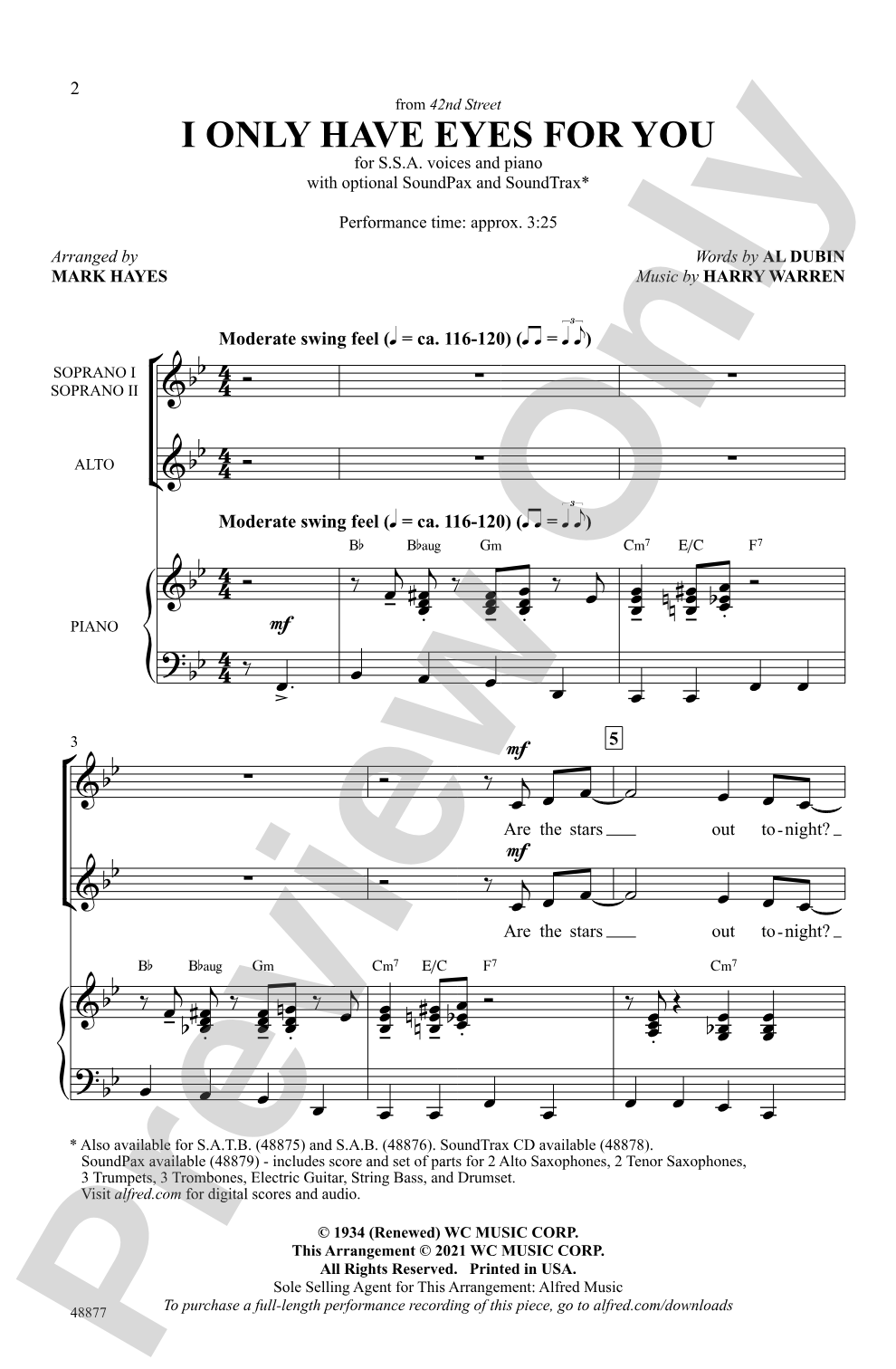
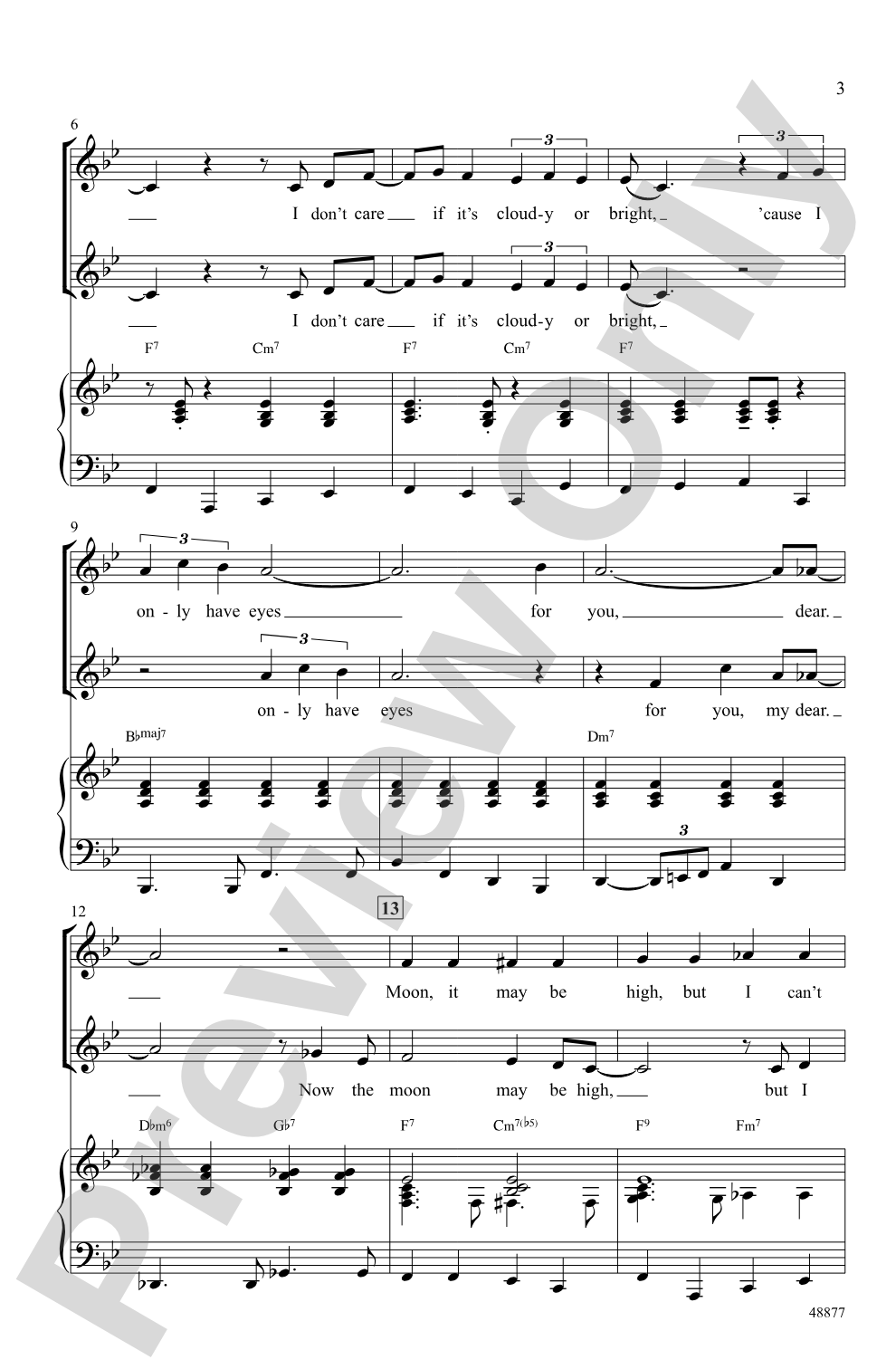
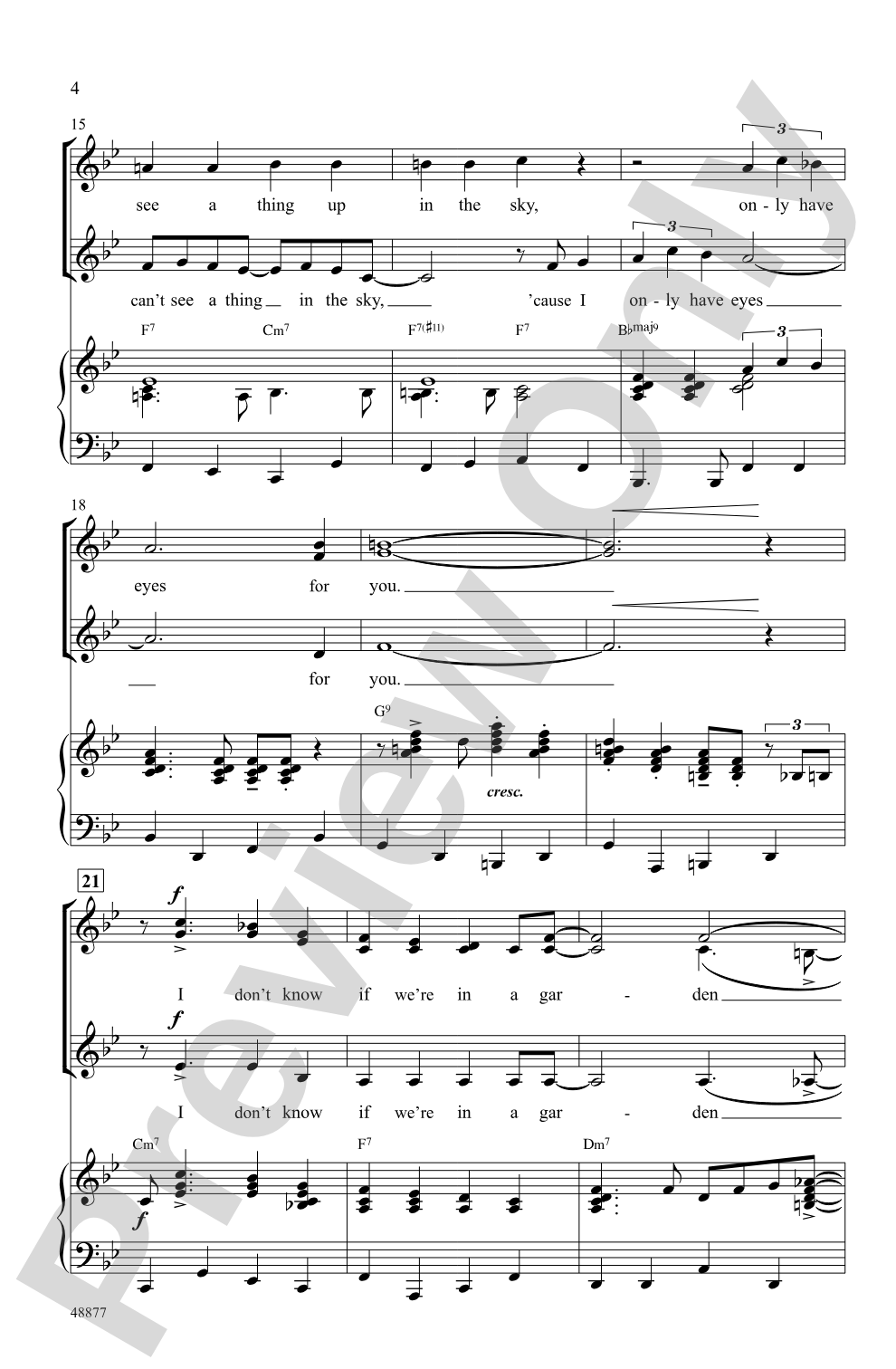

I Only Have Eyes for You: SSA Choral Octavo
Words by Al Dubin, music by Harry Warren / arr. Mark Hayes
Item: 00-PO-0006667
$2.25
Minimum order quantity: 20 copies
One moment…
Related Items
I Only Have Eyes for You: SoundTrax Digital Audio Download |
$29.99
|
View | |
I Only Have Eyes for You: SATB Choral Octavo |
$2.25
|
View | |
I Only Have Eyes for You: SAB Choral Octavo |
$2.25
|
View | |
I Only Have Eyes for You: Choral SoundPax |
$50.00
|
View | |
I Only Have Eyes for You: SATB Choral Octavo |
$2.25
|
View | |
I Only Have Eyes for You: SAB Choral Octavo |
$2.25
|
View | |
I Only Have Eyes for You: SSA Choral Octavo |
$2.25
|
View | |
I Only Have Eyes for You: Choral Octavo SoundTrax CD |
$29.99
|
View | |
I Only Have Eyes for You: Choral SoundPax |
$50.00
|
View |
Description
This swingin' standard made Rolling Stones' "500 Greatest Songs of All Time" list and has been recorded by various artists from The Flamingos and Art Garfunkel to Michael Bublé. This big-band style arrangement includes a dash of scat singing toward the end and plenty of jazzy syncopations along the way. Besides the obvious meaning of the title, a current-day twist hints at smizing over a face mask (wink, wink).


Discover MakeMusic Cloud: thousands of interactive titles your students can play along with today.
Sample Audio
1
Audio File
--:--
0:00
0:00
Sample Video
Additional Details
Series:
Alfred Pop Choral Series
Publisher:
Alfred Music
Page Count:
16
SKU:
00-PO-0006667
More about this title
About the Composer: Harry Warren
Harry Warren (1893-1981) composed some of the most enduring standards of the American songbook, with a catalog spanning from silent film scores through the golden age of Hollywood musicals. His melodies combined memorable hooks with sophisticated harmonic movement, making his work instantly recognizable yet complex enough to reward serious interpretation. Warren's prolific output includes "Lullaby of Broadway," "You're Getting to Be a Habit with Me," and "I Only Have Eyes for You," songs that have sustained decades of reinterpretation across jazz, pop, and theatrical contexts.
Why we love this
Mark Hayes' arrangement captures the essence of big-band swing while keeping the voicing accessible for SSA choirs. The scat singing section and syncopated jazz figures give singers genuine stylistic vocabulary to work with rather than simply singing a standard straight, and the contemporary twist referenced in the title adds a playful dimension that connects with modern singers without undermining the song's timeless appeal.
What to expect
Sophisticated and playful in equal measure. The arrangement swings hard with snappy syncopations and a conversational scat section that feels conversational rather than overly arranged, yet beneath it sits the elegant harmonic foundation of a song that has survived nearly a century for good reason. There's room for personality and interpretation throughout.
Who it's for
SSA choirs at the intermediate to advanced level who want to perform a standard with genuine jazz vocabulary and contemporary wit. Singers need comfort with swing interpretation and syncopated rhythms, plus the confidence to handle the scat section's rhythmic specificity.
How to get the most out of it
- Establish a clear swing feel early in sectional rehearsals by having singers listen to the recorded accompaniment while marking the backbeat; the groove needs to feel relaxed rather than metrically rigid.
- Shape the scat section as genuine improvisation over the form, not as recitation. Let singers breathe naturally and lean into the playfulness rather than treating it as technically demanding passage work.
- Balance the melody prominently when homophonic passages occur, but allow the upper harmony parts to breathe independently during the syncopated sections so the rhythmic independence reads clearly.
- Keep the tempo flexible through the bridge if needed; this standard benefits from slight rubato that emphasizes the harmonic shifts without losing the underlying swing pulse.
How to use it
Pair this with other standards from the Alfred Pop Choral Series to build a full jazz-inflected concert set, or feature it as a standalone showstopper that demonstrates your choir's range beyond classical repertoire. The contemporary humor also makes it ideal for a spring pops concert or a program celebrating American songwriting.
Skills your students will build
- Swing feel and jazz articulation
- Syncopated rhythm reading and independence between parts
- Scat singing technique and rhythmic freedom within structure
- Harmonic sophistication in a contemporary performance context
- Stylistic interpretation of a standard-era composition