
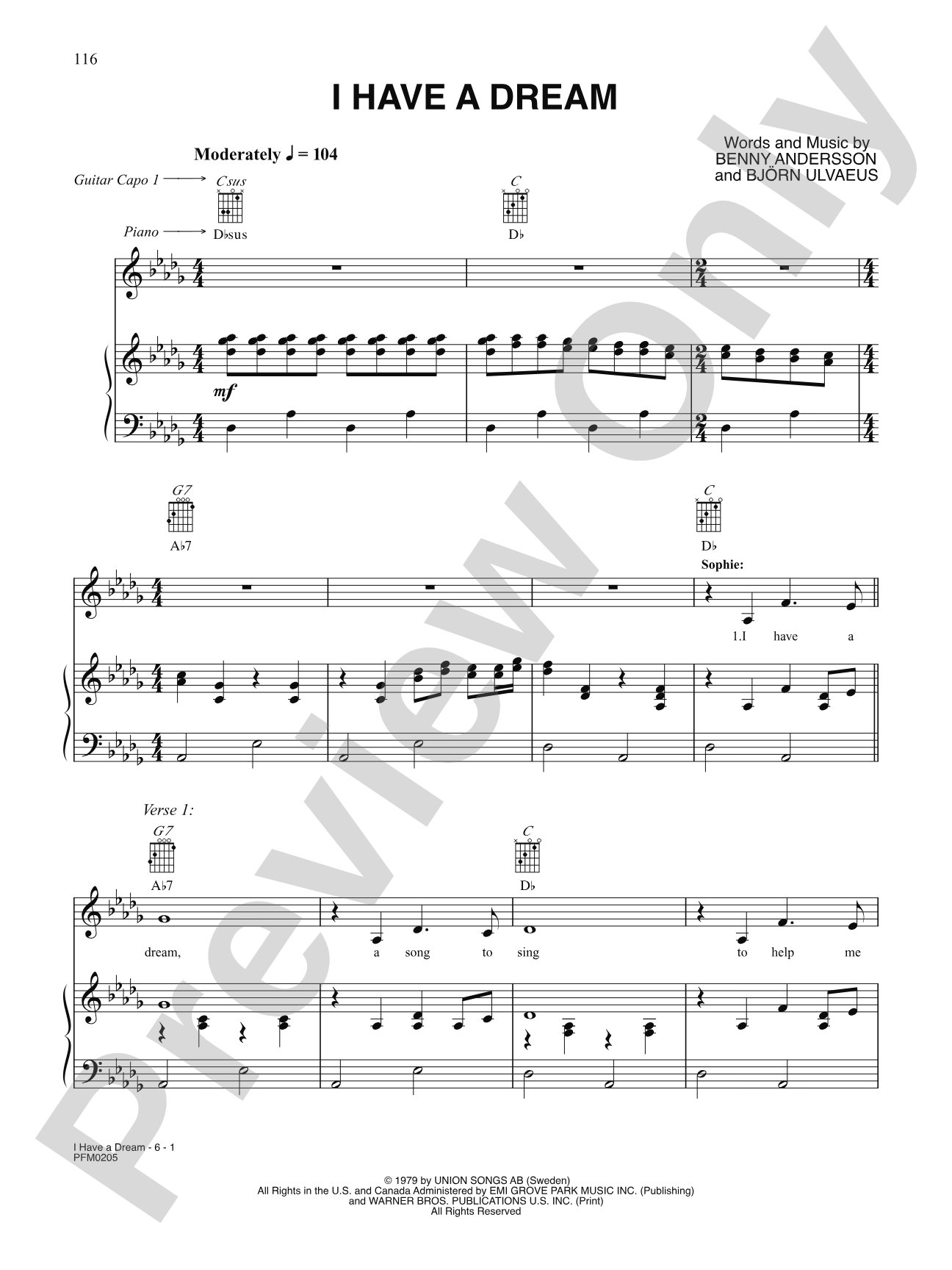
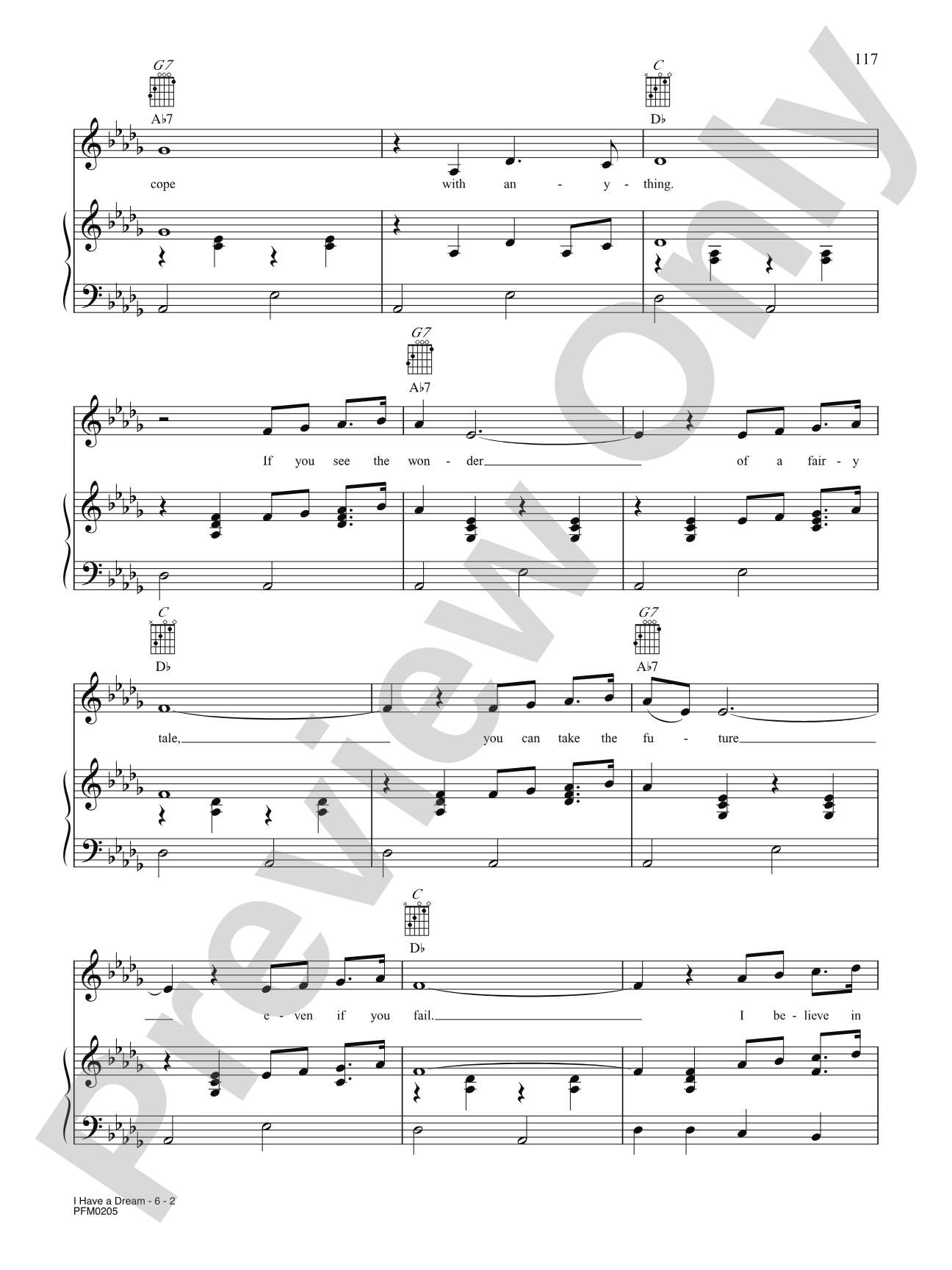

I Have a Dream: Piano/Vocal/Chords
Music and lyrics by Benny Andersson and Björn Ulvaeus
Item: 00-PS-0000067
$5.99
One moment…
Description
Based on the music from the ever-popular Swedish pop group ABBA, this show tells three wonderful love stories of family and friends on a mythical Greek island. Our folio features eight pages of color photos. Titles: Dancing Queen * Gimme! Gimme! Gimme! * Mamma Mia * Honey, Honey * Money, Money, Money * The Name of the Game * Super Trouper * Thank You for the Music * I Have a Dream * S.O.S. * Under Attack * The Winner Takes It All * and many more.


I Have a Dream: Piano/Vocal/Chords isn't in MakeMusic Cloud just yet...but it could be. Let us know you'd like to see it, and you'll help shape what comes next. In the meantime, start a free trial and dive into thousands of interactive titles your students can play along with today.
Request This Title
Tell us you want it.
Start Your Free Trial
Explore everything that's ready to play right now.
Sample Audio
No sample audio found.
Sample Video
No sample videos found.
Additional Details
Publisher:
Alfred Music
Page Count:
144
SKU:
00-PS-0000067
More about this title
About the Composer: Benny Andersson
Benny Andersson is a Swedish composer, keyboardist, and one half of the songwriting partnership that defined ABBA's sound. His melodic gift and sophisticated harmonic sensibilities shaped some of the most recognizable pop songs of the 1970s and 1980s. As both a composer and performer, Andersson understands how to write music that serves singers while maintaining strong musical integrity across multiple ensemble configurations.
Beyond ABBA, Andersson has composed for theater, film, and orchestral contexts, demonstrating his range across genres. His work with lyricist Björn Ulvaeus on the *Mamma Mia!* musical extended their catalog into a new medium, proving that pop songwriting of genuine quality can anchor theatrical storytelling. For music educators, his compositions offer accessible yet musically substantial material that engages singers and pianists alike.
Why we love this
This folio captures the full emotional and melodic richness of *Mamma Mia!* in a format that works for classroom singers, student pianists, and community performance groups. The collection spans the show's most beloved moments, and the vocal lines sit naturally in comfortable ranges while the piano parts maintain enough harmonic sophistication to keep pianists engaged. Thirteen complete songs give you genuine programming flexibility, whether you're building a full concert or spotlighting individual numbers in a revue.
What to expect
Warm, energetic, and joyful. These songs carry the unmistakable sparkle of 1970s pop craft: bright major keys, infectious grooves, and melodies that lodge immediately in memory. Yet underneath the pop sheen lies genuine harmonic sophistication and emotional depth, particularly in ballads like *The Winner Takes It All* and *I Have a Dream*. Performing this music feels both celebratory and emotionally honest.
Who it's for
This folio serves pianists and singers preparing *Mamma Mia!* musical theater productions, as well as vocalists and accompanists in school settings who want accessible, recognizable pop songs with genuine musical substance. It also works for voice studio instruction, where the variety of vocal styles and emotional content across the thirteen songs provides excellent material for song interpretation and performance.
How to get the most out of it
- Anchor the rhythmic pocket with steady left-hand accompaniment; ABBA's grooves depend on consistent pulse rather than rubato.
- Balance the vocal melody against the harmonic color in the piano part. The chords often carry as much character as the melody itself.
- Reference the recorded versions to understand the original groove and orchestration, then adapt the piano arrangement to suggest those textures through chord voicing and rhythmic feel.
- Shape phrases by varying dynamics subtly within the piano part; these pop songs reward expressive playing even at moderate volumes.
How to use it
Program selections from this folio in a pop or musical theater concert, pairing upbeat numbers like *Dancing Queen* and *Super Trouper* with contrasting ballads to showcase the breadth of Andersson and Ulvaeus's songwriting. The collection also works as a complete song cycle if you're mounting the *Mamma Mia!* musical itself or creating a themed revue centered on ABBA's catalog. Individual songs can anchor voice lessons or serve as audition material for singers of various levels.
Skills your students will build
- Interpreting pop song phrasing and emotional intent across multiple vocal styles
- Reading and realizing chord symbols and lead-sheet notation
- Accompanying vocalists with stylistically appropriate piano grooves and voicings
- Managing the tension between rhythmic precision and expressive vocal phrasing in pop contexts