
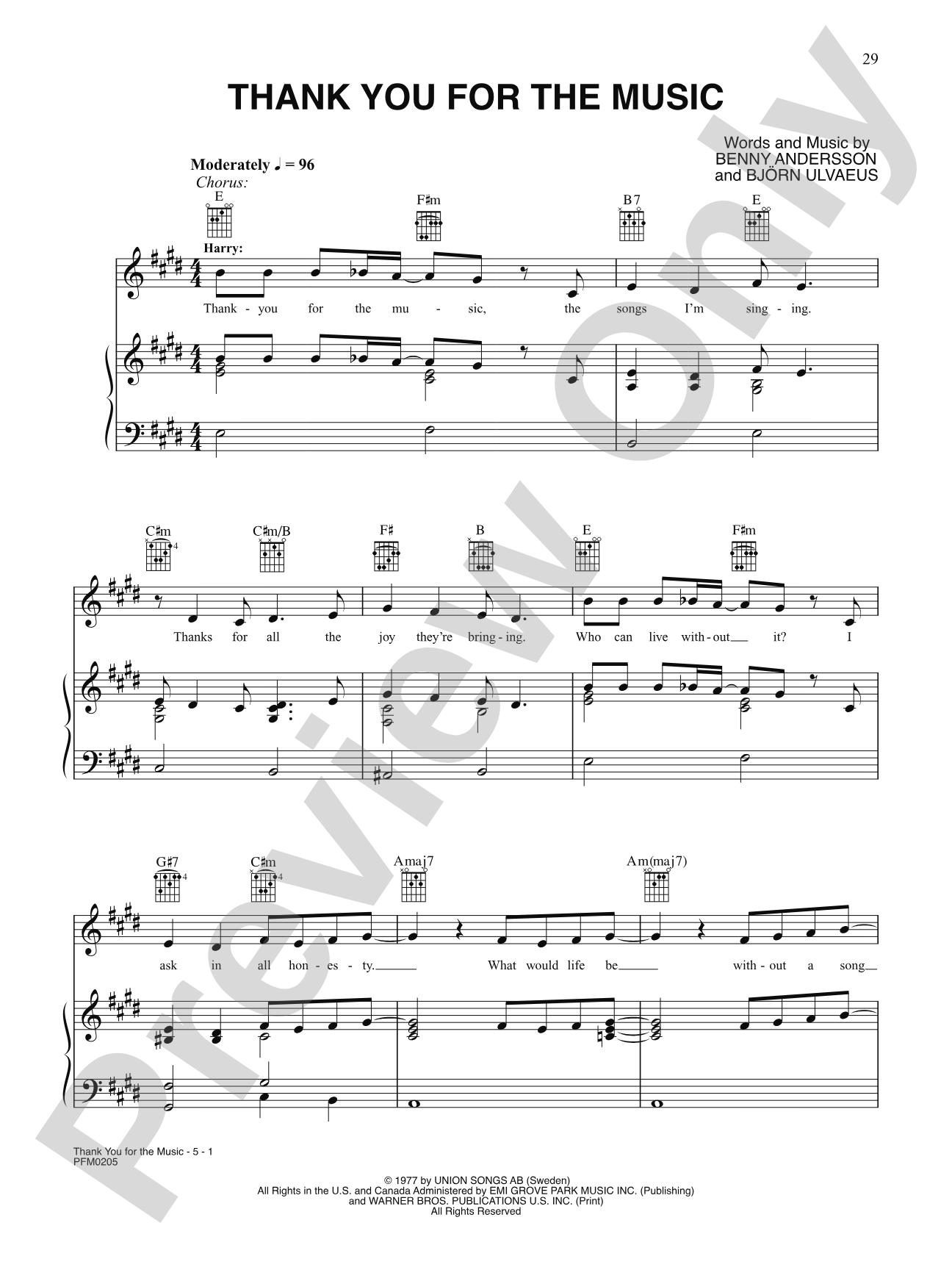

Thank You for the Music: Piano/Vocal/Chords
Music and lyrics by Benny Andersson and Björn Ulvaeus
Item: 00-PS-0000075
$4.99
One moment…
Description
Based on the music from the ever-popular Swedish pop group ABBA, this show tells three wonderful love stories of family and friends on a mythical Greek island. Our folio features eight pages of color photos. Titles: Dancing Queen * Gimme! Gimme! Gimme! * Mamma Mia * Honey, Honey * Money, Money, Money * The Name of the Game * Super Trouper * Thank You for the Music * I Have a Dream * S.O.S. * Under Attack * The Winner Takes It All * and many more.


Thank You for the Music: Piano/Vocal/Chords isn't in MakeMusic Cloud just yet...but it could be. Let us know you'd like to see it, and you'll help shape what comes next. In the meantime, start a free trial and dive into thousands of interactive titles your students can play along with today.
Request This Title
Tell us you want it.
Start Your Free Trial
Explore everything that's ready to play right now.
Sample Audio
No sample audio found.
Sample Video
No sample videos found.
Additional Details
Publisher:
Alfred Music
Page Count:
144
SKU:
00-PS-0000075
More about this title
About the Composer: Benny Andersson
Benny Andersson is a Swedish composer, pianist, and founding member of ABBA, one of the most commercially successful pop groups in history. His melodic gift and harmonic sophistication shaped some of the most enduring pop songs of the 1970s and beyond, demonstrating that accessible popular music can also possess genuine compositional craft. Since ABBA's peak years, Andersson has continued writing for theater and film, including the global phenomenon *Mamma Mia!*, which introduced his catalog to new generations of performers and audiences.
Why we love this
This folio gives singers and pianists direct access to the *Mamma Mia!* score in a single, beautifully illustrated collection. The songs span an ideal range of vocal difficulty and emotional texture, making them equally suitable for beginning performers building confidence and experienced singers exploring character work. ABBA's melodic clarity and rhythmic vitality make these arrangements genuinely fun to rehearse and perform, not just nostalgic.
What to expect
These songs radiate warmth and energy. Even the ballads carry an optimistic lyricism characteristic of ABBA's style, while the uptempo numbers pulse with infectious rhythm and joyful spirit. The production feels both intimate and grand, with enough harmonic color to remain musically interesting across multiple performances.
Who it's for
This collection serves singers preparing for auditions, recitals, or ensemble performances, as well as pianists looking for accessible pop literature with genuine harmonic interest. It works equally well for music theater students, high school ensemble singers seeking contemporary material, and adult community performers seeking familiar, audience-friendly repertoire.
How to get the most out of it
- Balance the vocal line clearly over the accompaniment; ABBA's strength lies in transparent melody, so resist the urge to bury the voice in thick chords.
- Use the chord symbols to inform your harmonic interpretation at the piano. The specific voicings Andersson favored—particularly his use of seventh chords and sus structures—are central to the songs' character.
- Pay attention to rhythmic precision in the piano part, especially in uptempo numbers like 'Dancing Queen' and 'Super Trouper.' The groove drives the arrangement.
- Explore dynamics within individual phrases rather than treating entire sections at one volume level. These songs benefit from subtle shaping that highlights lyrical content.
How to use it
Feature individual selections as showcase solos or duets within a larger concert, or program several songs back-to-back as a medley celebrating the *Mamma Mia!* story. This folio also pairs naturally with a full theatrical production or with summer recital programs where contemporary pop selections complement classical and musical theater repertoire.
Skills your students will build
- Reading chord symbols and realizing them at the piano with appropriate voicings
- Maintaining rhythmic precision and groove in pop idiom while singing
- Phrasing pop lyrics with emotional authenticity and character connection
- Balancing legibility of melody with harmonic accompaniment in an ensemble setting
- Interpreting rhythmic notation in popular music conventions (swing eighths, syncopation)