
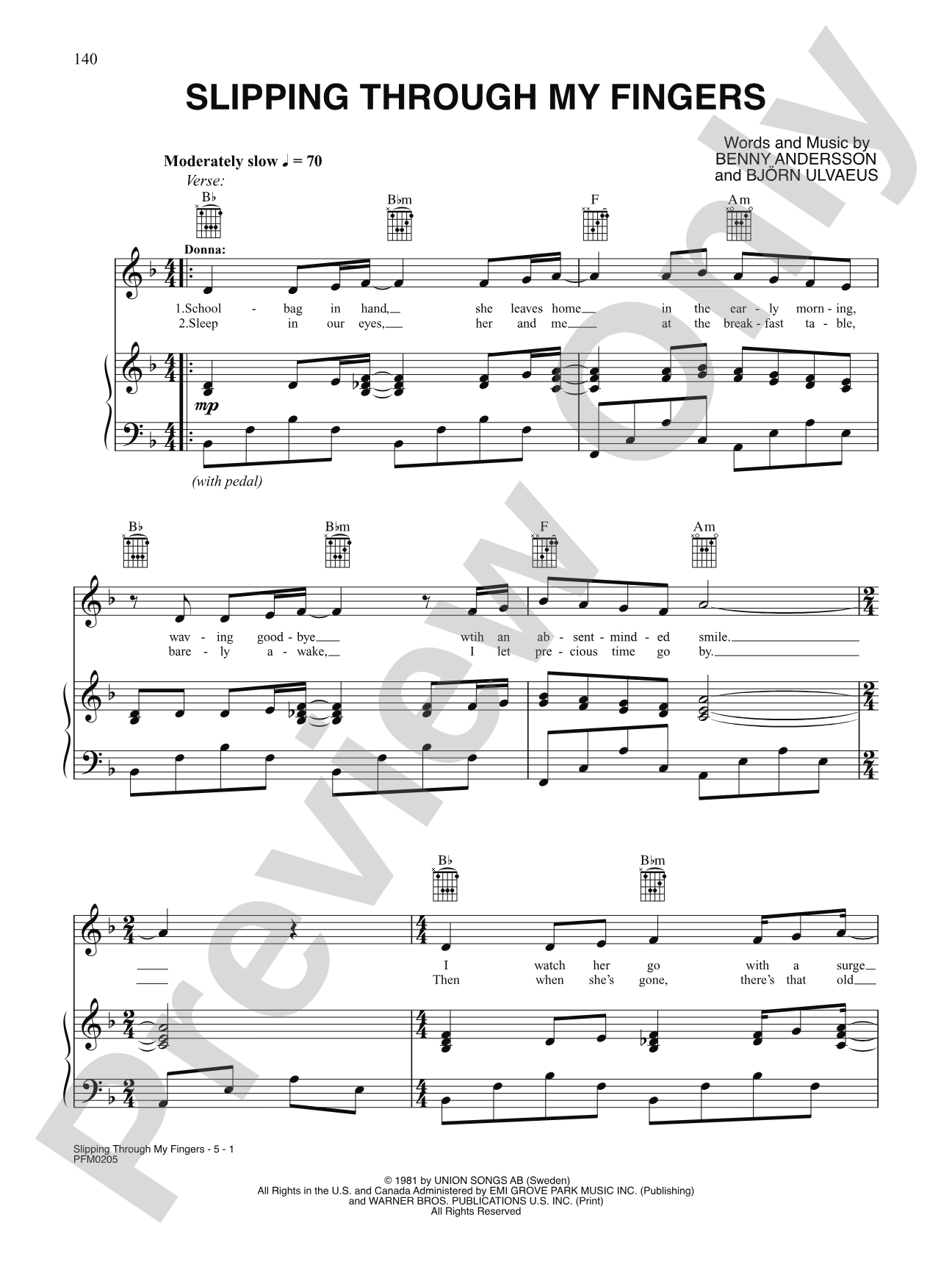

Slipping Through My Fingers: Piano/Vocal/Chords
Music and lyrics by Benny Andersson and Björn Ulvaeus
Item: 00-PS-0000079
$4.99
One moment…
Description
Based on the music from the ever-popular Swedish pop group ABBA, this show tells three wonderful love stories of family and friends on a mythical Greek island. Our folio features eight pages of color photos. Titles: Dancing Queen * Gimme! Gimme! Gimme! * Mamma Mia * Honey, Honey * Money, Money, Money * The Name of the Game * Super Trouper * Thank You for the Music * I Have a Dream * S.O.S. * Under Attack * The Winner Takes It All * and many more.


Discover MakeMusic Cloud: thousands of interactive titles your students can play along with today.
Sample Audio
No sample audio found.
Sample Video
No sample videos found.
Additional Details
Publisher:
Alfred Music
Page Count:
144
SKU:
00-PS-0000079
More about this title
About the Composer: Benny Andersson
Benny Andersson is one half of ABBA's legendary songwriting partnership with Björn Ulvaeus. As composer and keyboardist, Andersson shaped the sonic identity of one of the best-selling music acts in history, crafting melodies and arrangements that became global standards. His work spans five decades and demonstrates an intuitive grasp of what makes a song both commercially resonant and emotionally enduring.
For music educators, Andersson's catalog offers an invaluable resource: songs with strong harmonic movement, memorable vocal lines, and arrangements that work at multiple skill levels. Whether teaching pop music literacy, exploring 1970s production techniques, or building confidence in student performers, his compositions reward close study and engage audiences consistently.
Why we love this
This folio captures the entire emotional and rhythmic range of Mamma Mia in one accessible digital package. Students encounter sophisticated harmonic progressions ("The Winner Takes It All," "The Name of the Game") alongside infectious pop structures ("Dancing Queen," "Super Trouper"), making it ideal for mixed-ability casts and rehearsals where you need songs that work for both strong soloists and ensemble members. The combination of piano/vocal/chord notation gives pianists, singers, and accompanists equal footing in preparation.
What to expect
ABBA's catalog inhabits the space between pure pop sensibility and genuine theatrical storytelling. These songs carry the sparkle and propulsion of 1970s disco while grounding themselves in real human experiences: longing, joy, heartbreak, and resilience. Performing them feels both celebratory and intimate at once.
Who it's for
This folio serves music theater directors, accompanists, and private voice teachers working with students who need accessible yet sophisticated pop repertoire. Singers preparing auditions, rehearsing ensemble roles in Mamma Mia productions, or exploring contemporary musical theater songwriting will find reliable material here with genuine emotional depth.
How to get the most out of it
- Study the chord progressions before focusing on melody. ABBA songs often shift keys and use unexpected harmonic movement; mapping the underlying changes helps singers stay anchored and pianists anticipate transitions.
- Don't rush the tempo relationships between songs. "Slipping Through My Fingers" and "The Winner Takes It All" require space and restraint; pushing them rhythmically will undermine their emotional impact.
- Use the rhythm section clarity that ABBA arrangements demand. Lock the piano accompaniment with precise rhythmic articulation, especially in the disco and upbeat numbers where groove is everything.
- Balance the vocal-piano relationship in intimate songs. In "I Have a Dream" and slower ballads, the accompaniment supports rather than drives; keep dynamic restraint so the singer's vulnerability registers with the audience.
How to use it
This collection works as a complete song source for Mamma Mia productions, but it also serves smaller contexts: a pop music showcase featuring three or four ABBA songs, a voice student's recital that bridges classical technique and contemporary material, or a piano accompanist's audition repertoire. Consider programming it alongside other Broadway pop adaptations to show the continuity between theatrical pop and traditional musical theater song.
Skills your students will build
- Reading piano/vocal/chord notation and translating chord symbols into accompaniment voicings
- Managing key changes and harmonic shifts within pop song structures
- Matching vocal line phrasing to rhythmically sophisticated piano accompaniments
- Building confidence with contemporary, non-classical repertoire while maintaining musical rigor
- Understanding 1970s pop production techniques and how they translate to live performance