
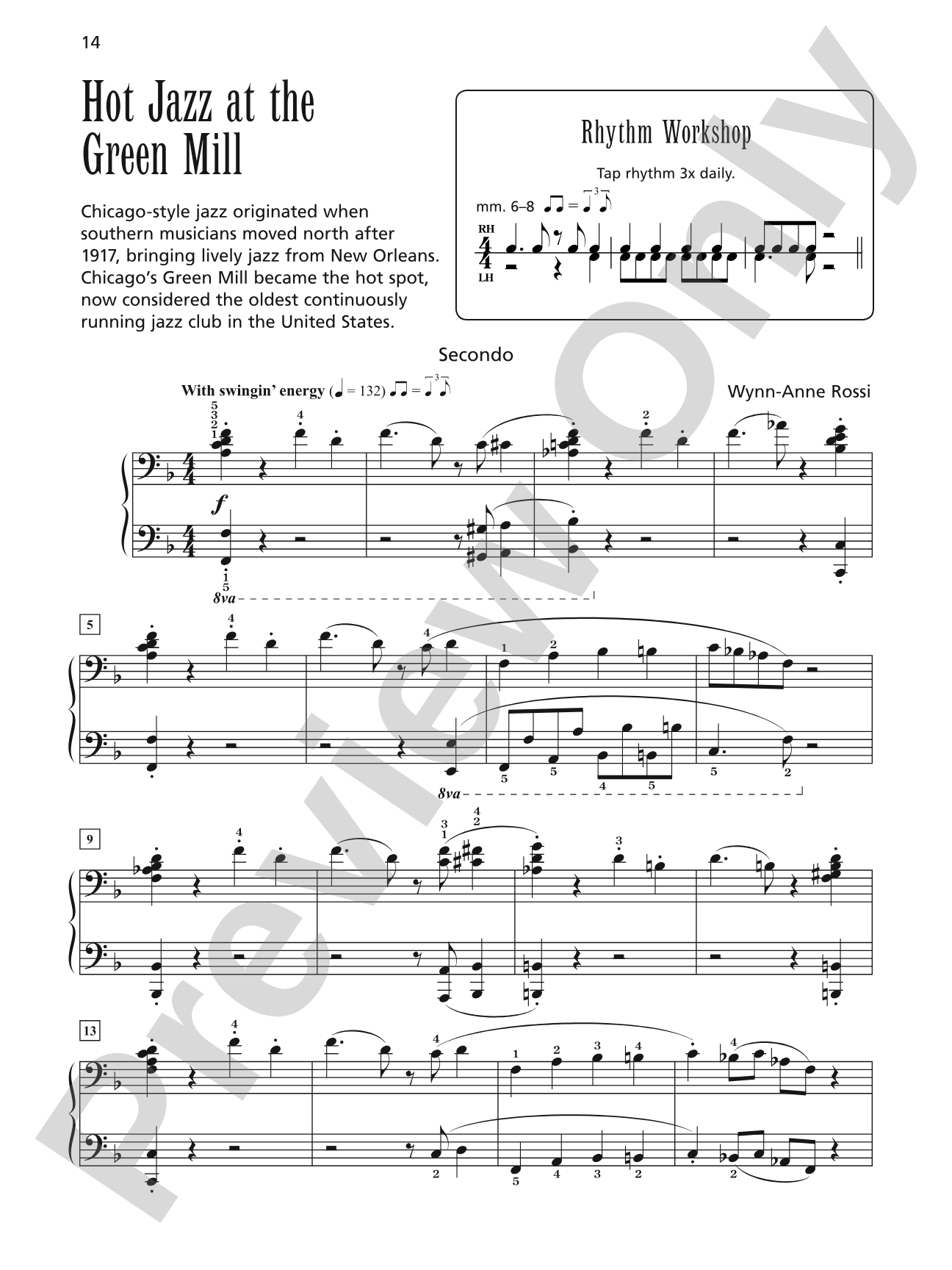

Hot Jazz at the Green Mill - Piano Duet (1 Piano, 4 Hands): Piano Duet (1 Piano, 4 Hands)
5 Late Intermediate to Early Advanced Piano Duets That Celebrate American Jazz
By Wynn-Anne Rossi
Level: Late Intermediate / Early Advanced
Item: 00-PS-0017607
$7.99
Pickup currently not available
Related Items
Fountains of Jazz - Piano Duet (1 Piano, 4 Hands): Piano Duet (1 Piano, 4 Hands) |
$5.99
|
View | |
Fusion Reaction - Piano Duet (1 Piano, 4 Hands): Piano Duet (1 Piano, 4 Hands) |
$4.99
|
View | |
Hymn to Friendship - Piano Duet (1 Piano, 4 Hands): Piano Duet (1 Piano, 4 Hands) |
$5.99
|
View | |
La Belle Seine - Piano Duet (1 Piano, 4 Hands): Piano Duet (1 Piano, 4 Hands) |
$5.99
|
View | |
Jazzin' Americana for Two, Book 4: Piano Duet (1 Piano, 4 Hands) Book |
$7.99
|
View |
Description
Wynn-Anne Rossi's Jazzin' Americana for Two series is a journey through the jazz genre, honoring the history, the diverse styles, and the fabulous musicians who made this music great. Students will become familiar with the names of famous musicians such as George Gershwin, Oscar Peterson, and John Coltrane while learning different jazz styles, from blues and bebop to boogie and rock. Each duet (for one piano, four hands) is enhanced with interesting facts that will awaken curiosity and enhance the musical experience. Titles: Fountains of Jazz * Fusion Reaction * Hot Jazz at the Green Mill * Hymn to Friendship * La Belle Seine. A Federation Festivals 2024-2028 selection.


Discover MakeMusic Cloud: thousands of interactive titles your students can play along with today.
Sample Audio
No sample audio found.
Sample Video
Additional Details
Series:
Jazzin' Americana
Publisher:
Alfred Music
Page Count:
28
SKU:
00-PS-0017607
More about this title
About the Composer: Wynn-Anne Rossi
Wynn-Anne Rossi has built her reputation as a composer and arranger who speaks directly to music educators and their students. Her work consistently bridges the gap between serious musicianship and genuine engagement, creating pieces that students want to play and teachers want to teach.
Rossi's Jazzin' Americana series reflects her commitment to making jazz history accessible and tangible. By pairing repertoire with contextual learning about the musicians and styles that shaped American jazz, she ensures that technical growth and cultural understanding develop together.
Why we love this
Rossi writes duets that actually sound good when four hands share a single keyboard. The writing balances both players fairly, so neither hand feels relegated to accompaniment, and the jazz idioms unfold naturally within the duet texture. Students leave the bench with a real understanding of how the blues, bebop, and other styles work because they've lived inside them musically.
What to expect
Stepping into a jazz club where the music is alive, conversational, and full of personality. Rhythmic syncopation and blue notes sit comfortably alongside moments of lyrical beauty, creating a soundscape that feels both historically grounded and immediately engaging.
Who it's for
Late intermediate and early advanced pianists ready to explore jazz through idiomatic writing that respects their growing musicianship. Duet pairs strengthen each other through equal partnership, making these works ideal for studio teaching, ensemble classes, or piano faculty collaborations.
How to get the most out of it
- Establish the groove between both players before adding dynamics or ornaments. The primo and secondo parts lock together through rhythm first; style comes after.
- Listen actively to recordings of the musicians mentioned in the score notes. Oscar Peterson's touch, George Gershwin's phrasing, John Coltrane's intensity: these become reference points that inform how you voice the piece.
- Treat the score notes as performance material, not just context. Students who know the story behind each duet bring intention to every phrase.
How to use it
Feature a duet from this series as a concert opener to set a sophisticated, accessible tone, or pair it with classical works to show how jazz influences extend across the repertoire. The historical anchors woven through each piece make them natural bridges for interdisciplinary programming with history or literature courses.
Skills your students will build
- Comping rhythms and jazz harmony conventions
- Syncopation and swing feel in ensemble contexts
- Blues tonality and improvisation-informed phrasing
- Balancing independence and interdependence as duet partners
- Recognizing stylistic markers across bebop, fusion, boogie, and blues idioms