
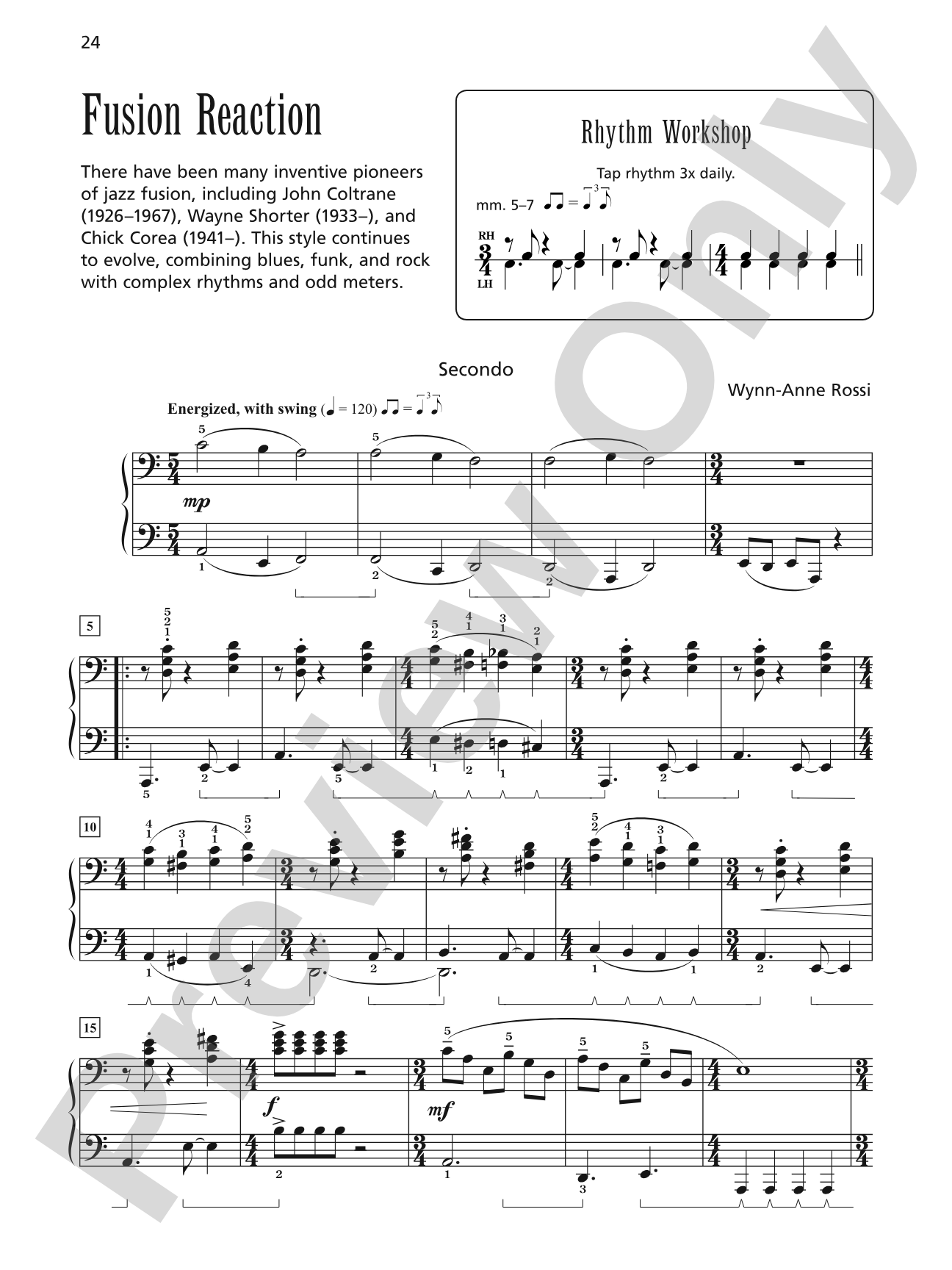

Fusion Reaction - Piano Duet (1 Piano, 4 Hands): Piano Duet (1 Piano, 4 Hands)
5 Late Intermediate to Early Advanced Piano Duets That Celebrate American Jazz
By Wynn-Anne Rossi
Level: Late Intermediate / Early Advanced
Item: 00-PS-0017606
$4.99
Pickup currently not available
Related Items
Fountains of Jazz - Piano Duet (1 Piano, 4 Hands): Piano Duet (1 Piano, 4 Hands) |
$5.99
|
View | |
Hot Jazz at the Green Mill - Piano Duet (1 Piano, 4 Hands): Piano Duet (1 Piano, 4 Hands) |
$7.99
|
View | |
Hymn to Friendship - Piano Duet (1 Piano, 4 Hands): Piano Duet (1 Piano, 4 Hands) |
$5.99
|
View | |
La Belle Seine - Piano Duet (1 Piano, 4 Hands): Piano Duet (1 Piano, 4 Hands) |
$5.99
|
View | |
Jazzin' Americana for Two, Book 4: Piano Duet (1 Piano, 4 Hands) Book |
$7.99
|
View |
Description
Wynn-Anne Rossi's Jazzin' Americana for Two series is a journey through the jazz genre, honoring the history, the diverse styles, and the fabulous musicians who made this music great. Students will become familiar with the names of famous musicians such as George Gershwin, Oscar Peterson, and John Coltrane while learning different jazz styles, from blues and bebop to boogie and rock. Each duet (for one piano, four hands) is enhanced with interesting facts that will awaken curiosity and enhance the musical experience. Titles: Fountains of Jazz * Fusion Reaction * Hot Jazz at the Green Mill * Hymn to Friendship * La Belle Seine. A Federation Festivals 2024-2028 selection.


Discover MakeMusic Cloud: thousands of interactive titles your students can play along with today.
Sample Audio
No sample audio found.
Sample Video
Additional Details
Series:
Jazzin' Americana
Publisher:
Alfred Music
Page Count:
28
SKU:
00-PS-0017606
More about this title
About the Composer: Wynn-Anne Rossi
Wynn-Anne Rossi brings decades of experience as both a performer and educator, with a distinctive voice in contemporary piano pedagogy. Her work prioritizes engagement without sacrificing musical substance, consistently finding ways to deepen students' understanding of genre history and style through accessible yet sophisticated compositions.
Why we love this
Rossi's approach to jazz education sidesteps the typical "simplified jazz" trap by embedding real stylistic content alongside cultural context. Students learn about the musicians who shaped jazz history, not as afterthoughts, but as integral parts of understanding what they're actually playing. The Federation Festivals recognition underscores that this series holds up musically while serving a genuine pedagogical purpose.
What to expect
Fusion Reaction captures the energy of musicians crossing stylistic boundaries, blending harmonic language and rhythmic vocabulary in ways that feel spontaneous yet carefully structured. The two-piano conversation has real momentum, with enough textural variety to keep both players intellectually engaged throughout.
Who it's for
Late intermediate to early advanced pianists ready to engage with jazz as a serious musical language rather than a novelty. Duet partnerships in studio and group settings will deepen their understanding of how jazz functions harmonically and rhythmically while building collaborative listening skills.
How to get the most out of it
- Study the fascinating facts provided with each piece before rehearsals begin. When students understand the historical context and which musicians inspired the writing, their interpretive choices become more intentional.
- Balance the duet lines so neither hand dominates. Late intermediate and early advanced pianists sometimes favor the primo part; remind both players that conversation happens when both voices remain audible.
- Use the style-specific vocabulary embedded in each piece as a rehearsal touchstone. Reference the bebop, blues, or rock elements by name so students develop stronger genre literacy alongside technical fluency.
How to use it
Feature this as part of a jazz-focused studio recital or chamber concert where students can introduce the historical figures and musical styles they've learned. Pairing it with other titles from the Jazzin' Americana series gives audiences a guided tour through different jazz idioms without feeling academic.
Skills your students will build
- Jazz comping rhythms and syncopated articulation
- Listening and balancing in a two-voice ensemble texture
- Reading swing eighth notes and jazz phrasing conventions
- Understanding bebop, fusion, and contemporary jazz harmonic language
- Collaborative communication and stylistic interpretation