
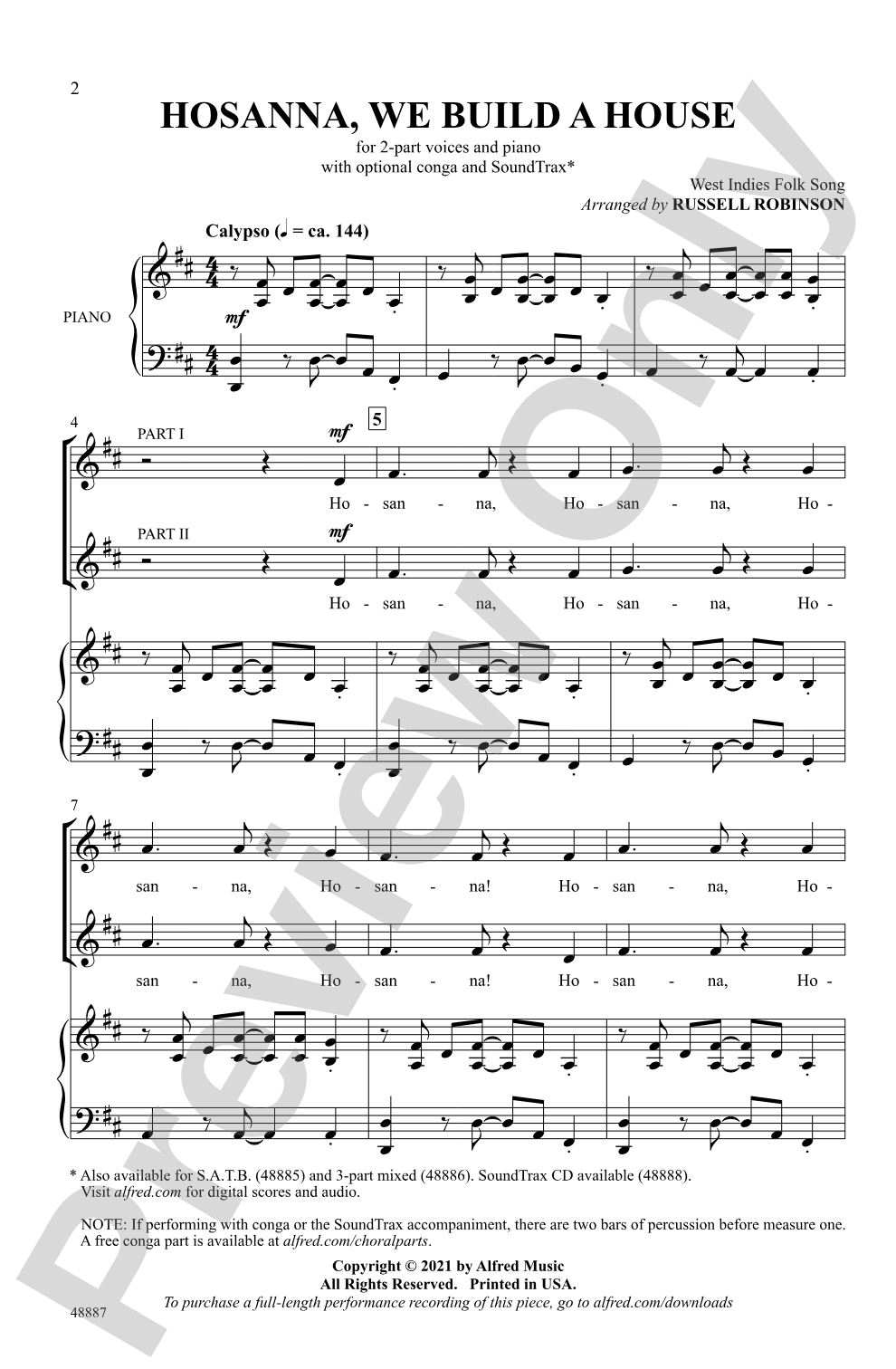
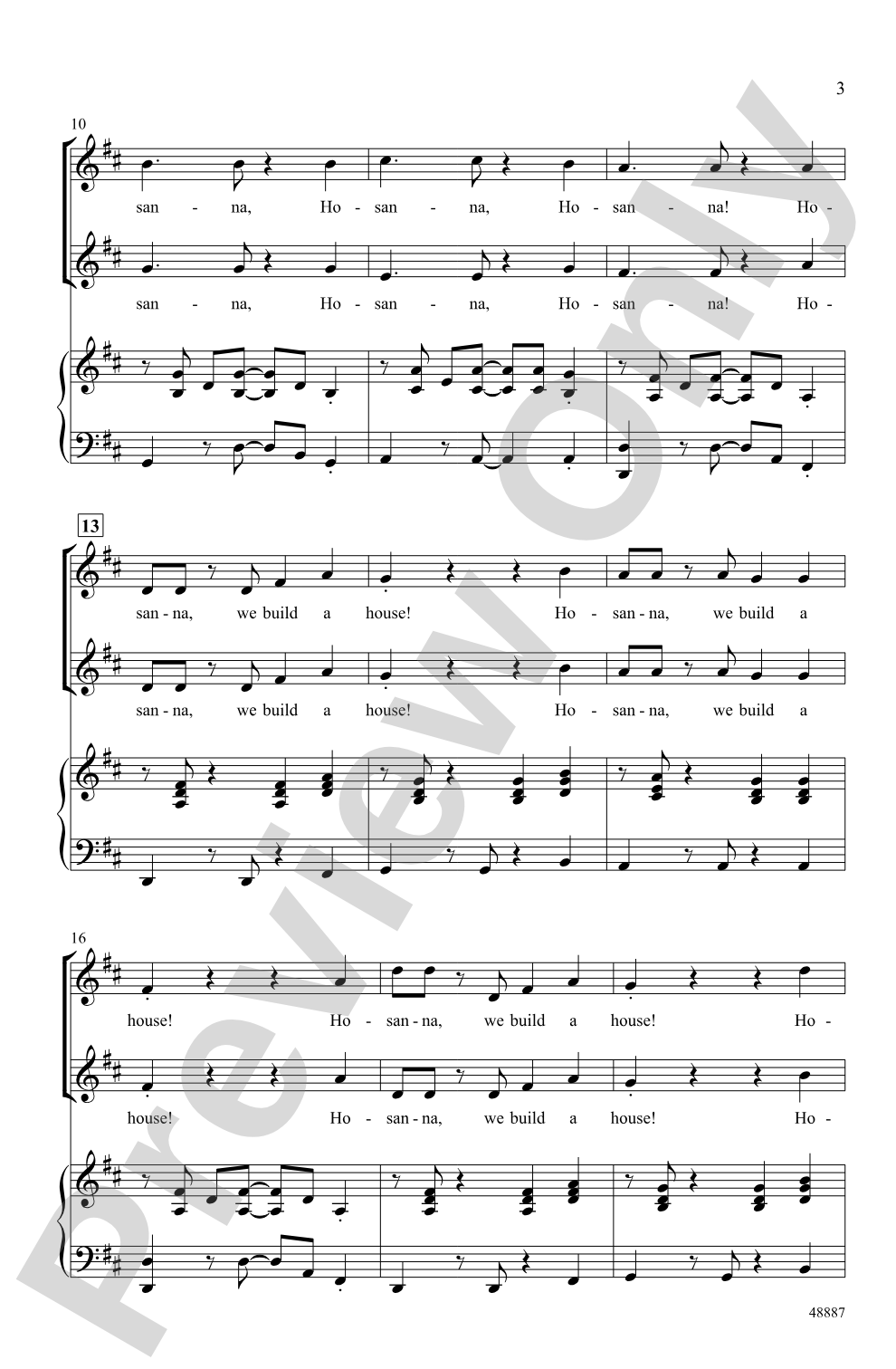
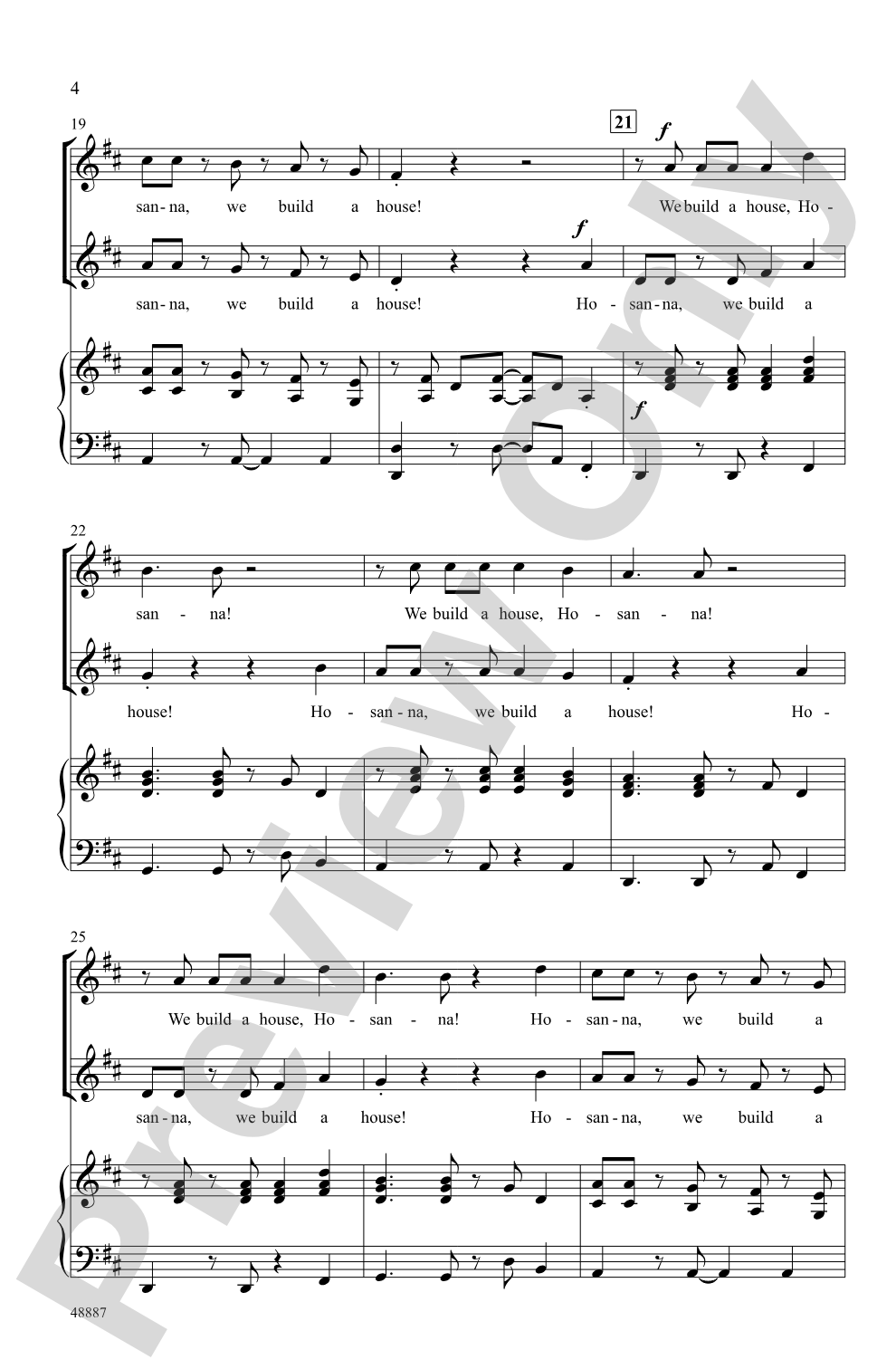

Hosanna, We Build a House: 2-Part Choral Octavo
West Indies Folk Song / arr. Russell Robinson
Item: 00-PO-0006673
$2.05
Minimum order quantity: 20 copies
Pickup currently not available
Related Items
Hosanna, We Build a House: SoundTrax Digital Audio Download |
$29.99
|
View | |
Hosanna, We Build a House: SATB Choral Octavo |
$2.05
|
View | |
Hosanna, We Build a House: 3-Part Mixed Choral Octavo |
$2.05
|
View | |
Hosanna, We Build a House: SATB Choral Octavo |
$2.05
|
View | |
Hosanna, We Build a House: 3-Part Mixed Choral Octavo |
$2.05
|
View | |
Hosanna, We Build a House: 2-Part Choral Octavo |
$2.05
|
View | |
Hosanna, We Build a House: Choral SoundTrax CD |
$29.99
|
View |
Description
A great fit for choirs of any age or ability! Harry Belafonte sang this joyful West Indies song on his 1956 album Calypso. Dr. Robinson's arrangement has just the right amount of repetition versus development, and will come together quickly with intuitive voice leading and some stylistic syncopation. One a cappella refrain just after the key change features the conga to keep the groove going, and a final descant adds a rhythmic counterline above. Build up the Jamaican vibe with our light SoundTrax accompaniment or the notated percussion part (available free online). The theme: build your house on solid ground.


Hosanna, We Build a House: 2-Part Choral Octavo isn't in MakeMusic Cloud just yet...but it could be. Let us know you'd like to see it, and you'll help shape what comes next. In the meantime, start a free trial and dive into thousands of interactive titles your students can play along with today.
Request This Title
Tell us you want it.
Start Your Free Trial
Explore everything that's ready to play right now.
Sample Audio
1
Audio File
--:--
0:00
0:00
Sample Video
Additional Details
Series:
Alfred Choral Designs
Publisher:
Alfred Music
Page Count:
12
SKU:
00-PO-0006673
More about this title
About the Arranger: Russell Robinson
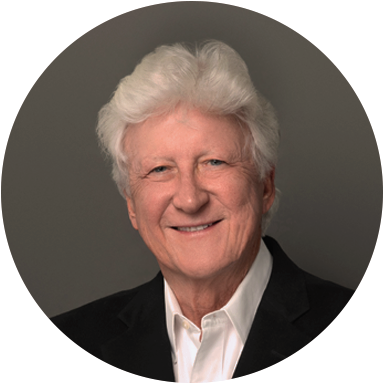
Russell Robinson has spent his career shaping choral music education across the globe. As Emeritus Professor of Music Education at the University of Florida, he has conducted and consulted at major venues including Carnegie Hall, Lincoln Center, and the Kennedy Center, while also presenting at festivals and conferences across six continents. He served as Associate Dean of the UF College of the Arts and held leadership roles with the Florida Music Educators Association and the National Association for Music Education.
With over 500 published works to his name, Robinson balances his conducting and administrative legacy with prolific output as a composer and arranger. His published materials span choral compositions, arrangements, instructional texts, and videos, all grounded in his direct experience leading singers at every level.
Why we love this
Robinson's touch is evident in how economically this arrangement builds its energy. The intuitive voice leading means singers can focus on style rather than wrestling with difficult harmony, while the strategic placement of repetition and development keeps the piece moving without feeling static. The a cappella refrain with conga texture and the closing descant give you memorable moments to rehearse and perform, making this one that feels substantial even at twelve pages.
What to expect
You're in a warm, open space where joy isn't performed but felt. The West Indies vibe moves with an easy lilt, buoyed by the rhythmic conga texture and the unfussy syncopation that lets singers smile while they sing. That final descant catches the light just as you think the piece has landed, adding one more breath of brightness before the close.
Who it's for
This arrangement works for mixed-age choirs because the voice leading and repeating sections allow younger or less experienced singers to participate fully while older singers engage with the stylistic nuance. Whether you're building a concert around Caribbean repertoire or programming an ecumenical service with the theme of building on solid ground, this piece accommodates both contexts without strain.
How to get the most out of it
- Layer the accompaniment gradually across rehearsals. Start without it to establish the voice parts and groove, then add the SoundTrax to hear how the parts sit within the full texture.
- The syncopation in the melody sits naturally once singers internalize the calypso feel. Mark the backbeat gently in early rehearsals, then trust the ear to carry the rhythm.
- The a cappella refrain depends on locked rhythm and breath control. Treat it as a moment of ensemble intimacy; the conga reference means precision without tension.
- Balance the final descant so it colors the top line without overpowering the melody. It should feel like an added shimmer, not a competing voice.
How to use it
Pair this with other world or multicultural repertoire to build a concert identity, or use it as an opener that immediately sets an uplifting tone for a mixed program. The spiritual theme and accessible two-part voicing also make it ideal for youth choirs, community choirs, or service music settings where building congregation engagement matters as much as musical polish.
Skills your students will build
- Reading and performing syncopated rhythms in a calypso style
- Maintaining rhythmic independence in an a cappella texture
- Balancing and blending a descant with the primary melody
- Intonation and ensemble accuracy in unfamiliar harmonic contexts
- Stylistic interpretation of Caribbean musical idiom