
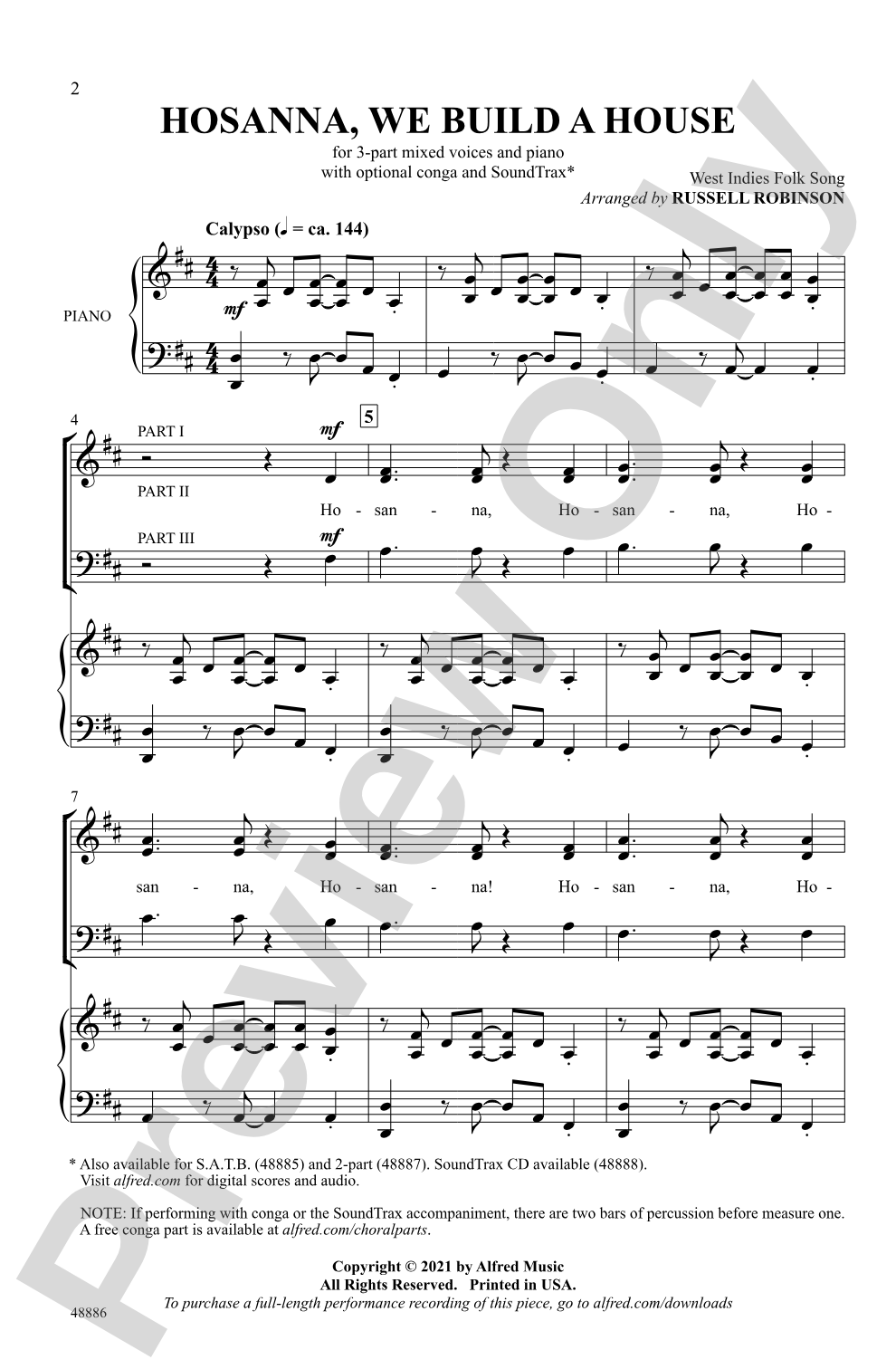
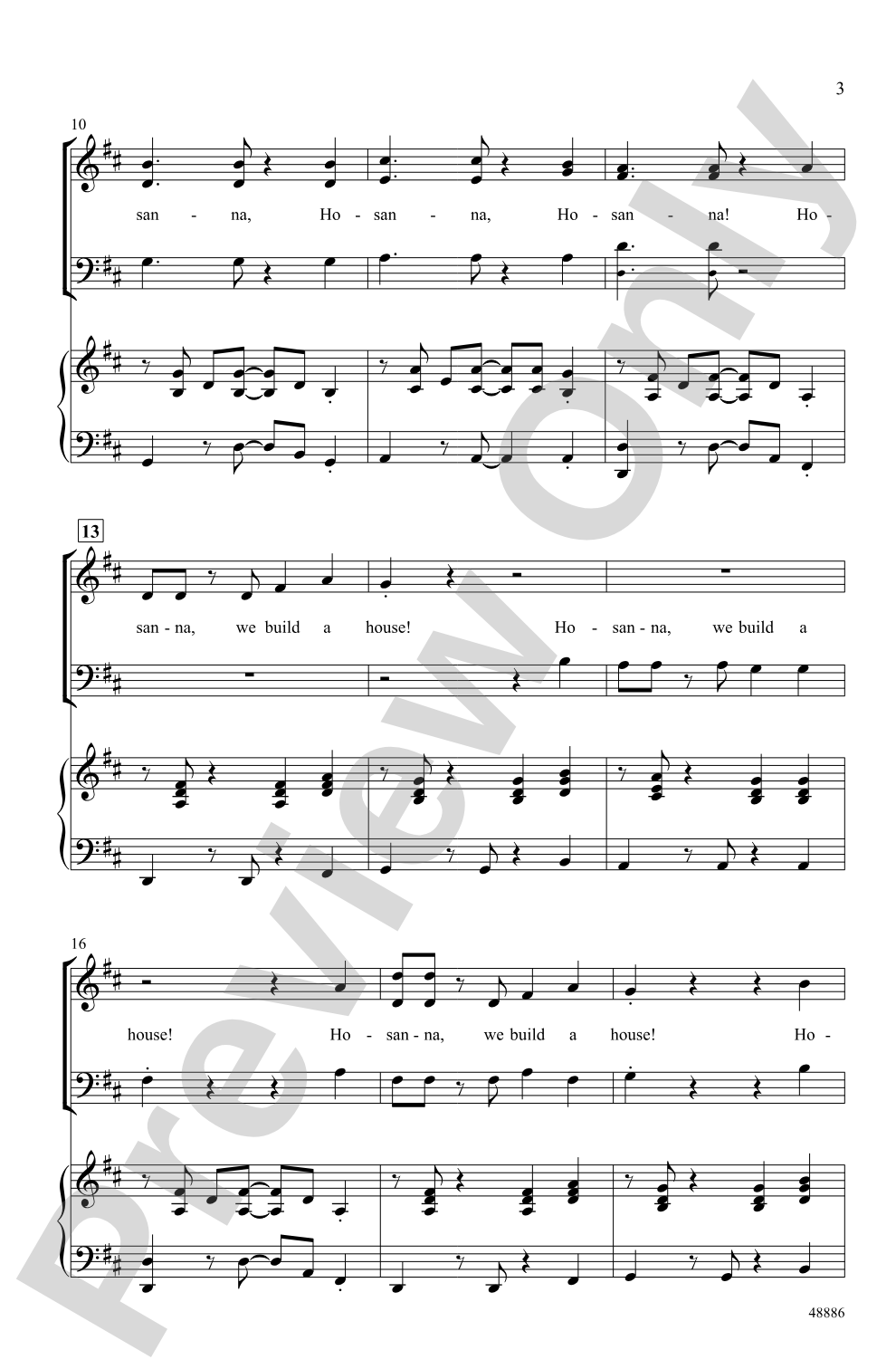
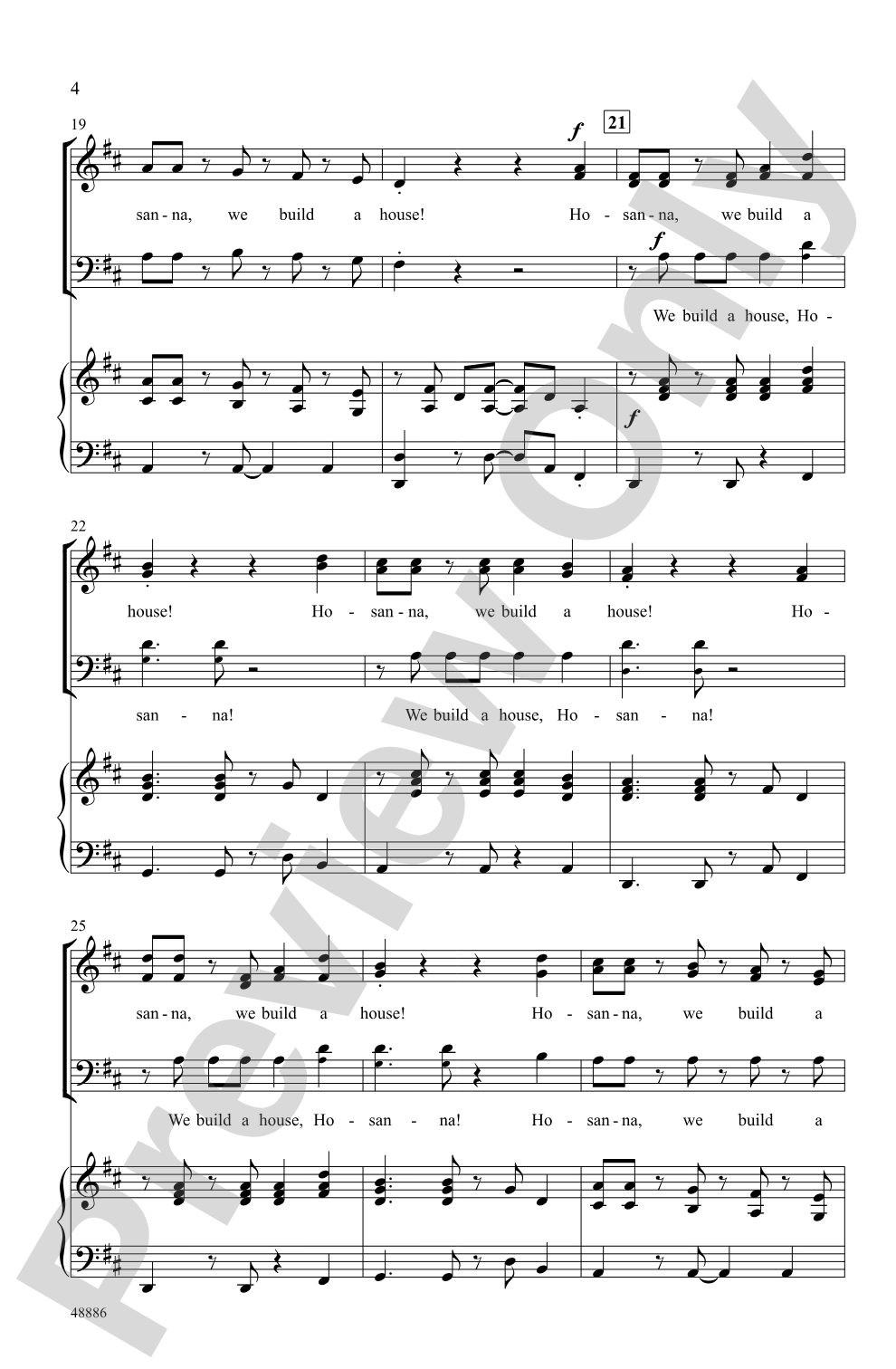

Hosanna, We Build a House: 3-Part Mixed Choral Octavo
West Indies Folk Song / arr. Russell Robinson
Item: 00-PO-0006672
$2.05
Minimum order quantity: 20 copies
Pickup currently not available
Related Items
Hosanna, We Build a House: SoundTrax Digital Audio Download |
$29.99
|
View | |
Hosanna, We Build a House: SATB Choral Octavo |
$2.05
|
View | |
Hosanna, We Build a House: 2-Part Choral Octavo |
$2.05
|
View | |
Hosanna, We Build a House: SATB Choral Octavo |
$2.05
|
View | |
Hosanna, We Build a House: 3-Part Mixed Choral Octavo |
$2.05
|
View | |
Hosanna, We Build a House: 2-Part Choral Octavo |
$2.05
|
View | |
Hosanna, We Build a House: Choral SoundTrax CD |
$29.99
|
View |
Description
A great fit for choirs of any age or ability! Harry Belafonte sang this joyful West Indies song on his 1956 album Calypso. Dr. Robinson's arrangement has just the right amount of repetition versus development, and will come together quickly with intuitive voice leading and some stylistic syncopation. One a cappella refrain just after the key change features the conga to keep the groove going, and a final descant adds a rhythmic counterline above. Build up the Jamaican vibe with our light SoundTrax accompaniment or the notated percussion part (available free online). The theme: build your house on solid ground.


Discover MakeMusic Cloud: thousands of interactive titles your students can play along with today.
Sample Audio
1
Audio File
--:--
0:00
0:00
Sample Video
Additional Details
Series:
Alfred Choral Designs
Publisher:
Alfred Music
Page Count:
12
SKU:
00-PO-0006672
More about this title
About the Arranger: Russell Robinson

Russell Robinson has shaped music education across six continents through conducting, consultation, and pedagogy at the highest levels. His appearances span Carnegie Hall, Lincoln Center, the Kennedy Center, and the White House, as well as honor choirs, all-state festivals, and conferences worldwide. He served as Associate Dean of the University of Florida College of the Arts and held leadership roles in the National Association for Music Education.
As a prolific arranger and composer, Robinson has published over 500 works in print, ranging from choral compositions and arrangements to instructional materials and scholarly writing. His contributions to music education earned him induction into the Florida Music Educators Association Hall of Fame in 2016.
Why we love this
Robinson's touch on this Belafonte classic strikes the balance every director seeks: the arrangement feels authentic to the West Indies roots while remaining accessible for mixed choirs at any level. The strategic use of repetition paired with subtle development means your singers will own the material quickly, leaving rehearsal time for the real payoff: bringing out that relaxed, groovy Jamaican character that makes this piece genuinely fun to perform.
What to expect
Warm, buoyant, and infused with the easy confidence of a song sung countless times in its native setting. The harmonic movement opens like a door to the Caribbean, while the rhythmic syncopation invites your singers into a groove that feels natural rather than imposed. By the final descant, the whole room vibrates with a shared sense of joy and purpose that justifies the piece's theme of building on solid ground.
Who it's for
Any choir seeking a piece that teaches cultural awareness through joyful music making. Whether you're working with middle school singers, high school singers, or community choristers, the intuitive voice leading and repetition-based structure ensure success without sacrificing musical authenticity or engagement.
How to get the most out of it
- Let the a cappella refrain after the key change breathe naturally; the conga rhythm cited in the score keeps the groove intact even without accompaniment, so trust that pulse and don't rush the syncopation.
- The descant in the final section works best when it floats above rather than competes with the main line; think counterpoint, not doubling, and adjust blend accordingly during sectional rehearsals.
- Pair the SoundTrax accompaniment with the notated percussion part (available free online) to layer in authentic texture without overwhelming the voices; test both options and choose what fits your rehearsal room acoustics.
- Lock in the stylistic syncopation early by isolating just the rhythmic cells in measures where the syncopation first appears; once that sits in the body, the full harmonic context clicks into place.
How to use it
Program this as a concert opener or closer to set a bright, welcoming tone that audiences remember. It also pairs beautifully with other world music selections to build a thematic program around cultural heritage, or stands alone as a spiritual anchor in a set focused on sacred themes and community building.
Skills your students will build
- Singing with stylistic syncopation and rhythmic independence
- Blending three-part mixed voicing with intuitive harmonic awareness
- Maintaining pulse and groove in a cappella sections
- Layering independent melodic lines (main parts plus descant) without losing ensemble cohesion
- Interpreting cultural context and musical authenticity in World music repertoire