
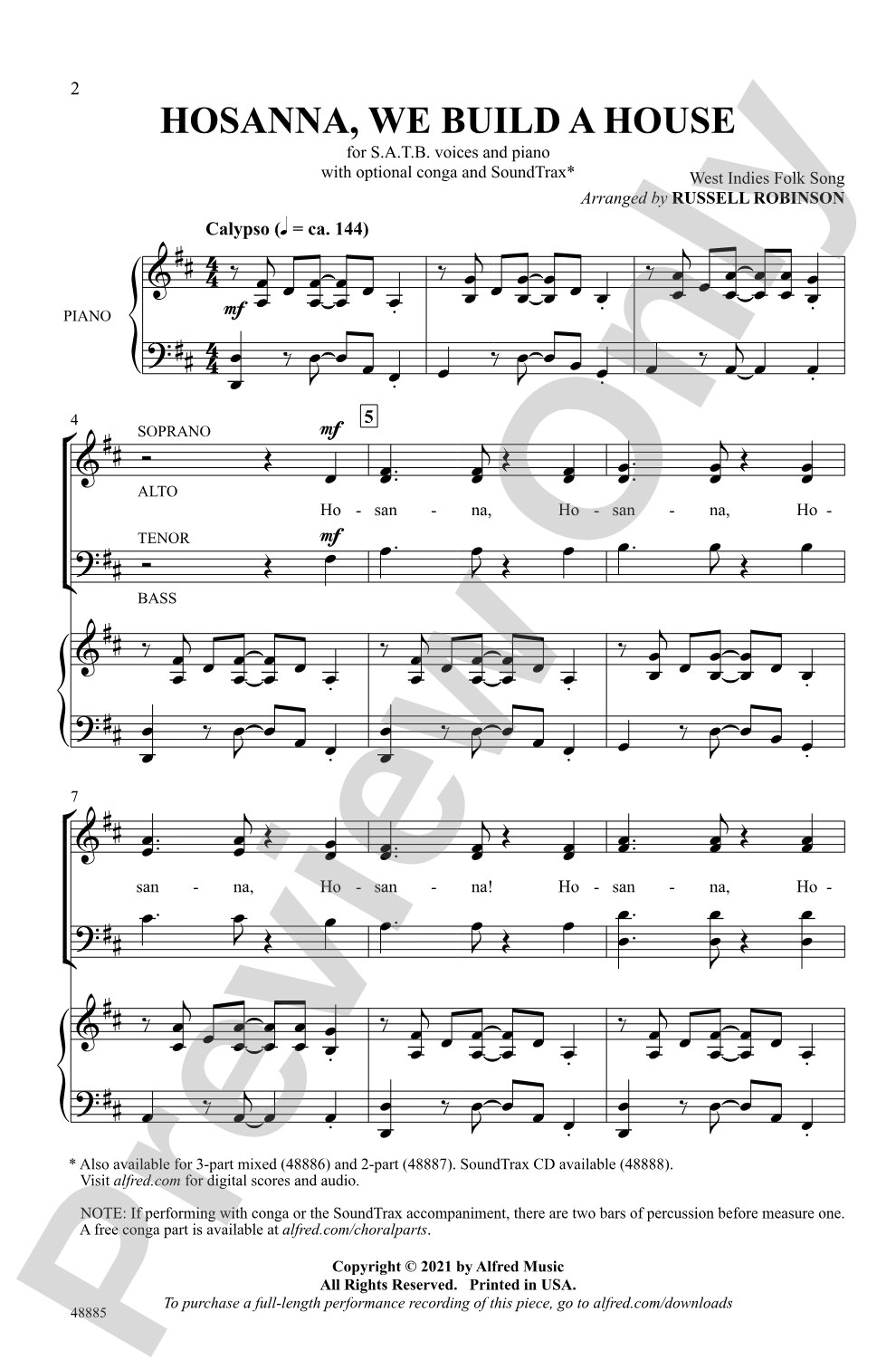
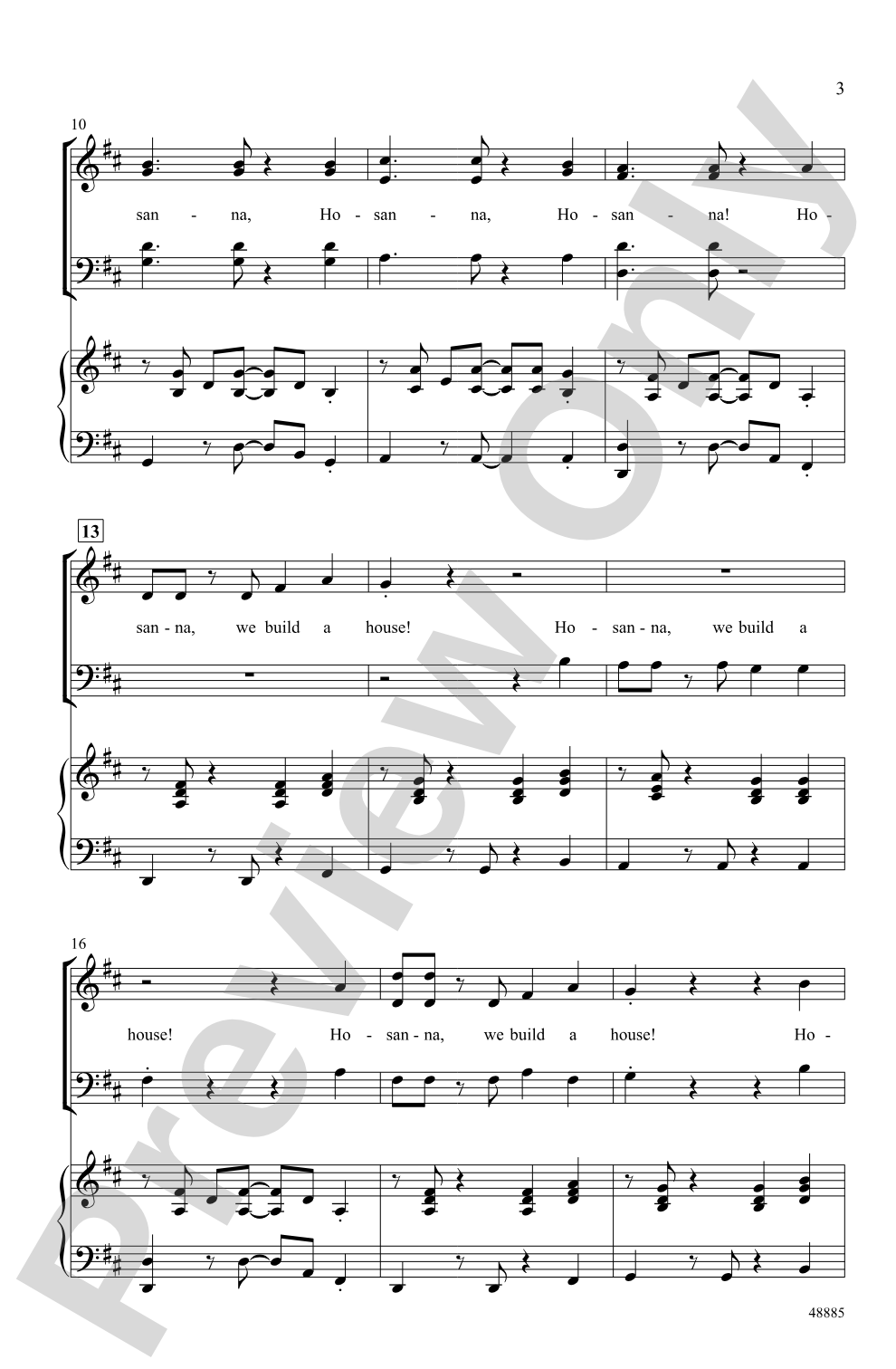
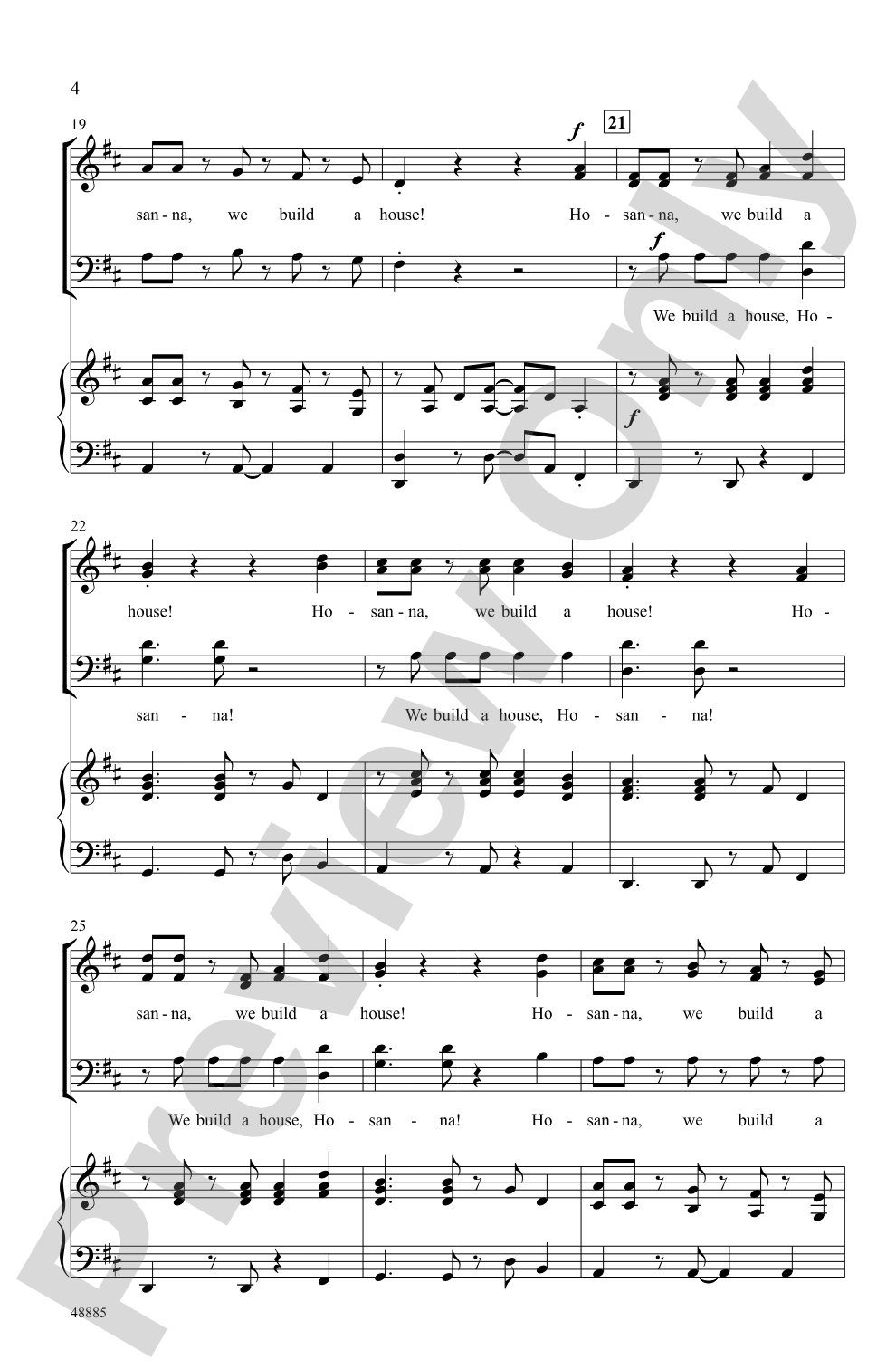

Hosanna, We Build a House: SATB Choral Octavo
West Indies Folk Song / arr. Russell Robinson
Item: 00-PO-0006671
$2.05
Minimum order quantity: 20 copies
Pickup currently not available
Related Items
Hosanna, We Build a House: SoundTrax Digital Audio Download |
$29.99
|
View | |
Hosanna, We Build a House: 3-Part Mixed Choral Octavo |
$2.05
|
View | |
Hosanna, We Build a House: 2-Part Choral Octavo |
$2.05
|
View | |
Hosanna, We Build a House: SATB Choral Octavo |
$2.05
|
View | |
Hosanna, We Build a House: 3-Part Mixed Choral Octavo |
$2.05
|
View | |
Hosanna, We Build a House: 2-Part Choral Octavo |
$2.05
|
View | |
Hosanna, We Build a House: Choral SoundTrax CD |
$29.99
|
View |
Description
A great fit for choirs of any age or ability! Harry Belafonte sang this joyful West Indies song on his 1956 album Calypso. Dr. Robinson's arrangement has just the right amount of repetition versus development, and will come together quickly with intuitive voice leading and some stylistic syncopation. One a cappella refrain just after the key change features the conga to keep the groove going, and a final descant adds a rhythmic counterline above. Build up the Jamaican vibe with our light SoundTrax accompaniment or the notated percussion part (available free online). The theme: build your house on solid ground.


Hosanna, We Build a House: SATB Choral Octavo isn't in MakeMusic Cloud just yet...but it could be. Let us know you'd like to see it, and you'll help shape what comes next. In the meantime, start a free trial and dive into thousands of interactive titles your students can play along with today.
Request This Title
Tell us you want it.
Start Your Free Trial
Explore everything that's ready to play right now.
Sample Audio
1
Audio File
--:--
0:00
0:00
Sample Video
1 / 2
Additional Details
Series:
Alfred Choral Designs
Publisher:
Alfred Music
Page Count:
12
SKU:
00-PO-0006671
More about this title
About the Arranger: Russell Robinson
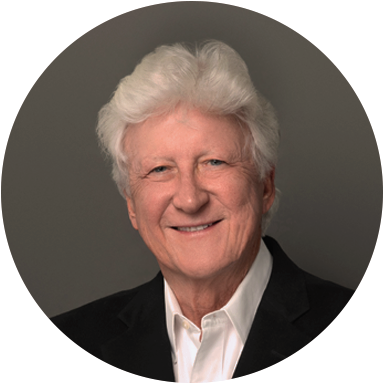
Dr. Russell Robinson served as Emeritus Professor of Music Education at the University of Florida and has established himself as a widely sought conductor and clinician, appearing over 300 times at festivals, workshops, honor choirs, and conferences across six continents. His work has taken him to prestigious venues including Carnegie Hall, Lincoln Center, the Kennedy Center, and the White House, while his leadership roles have included President of the Florida Music Educators Association, Associate Dean of the UF College of the Arts, and National Collegiate Chair for the National Association for Music Education.
As a prolific published composer and arranger, Robinson maintains an extensive catalog of over 500 works in print spanning choral compositions, arrangements, instructional materials, and books. His contributions to music education have earned him induction into the FMEA Hall of Fame in 2016.
Why we love this
Robinson's ear for what makes choral music singable shines here. The voice leading feels inevitable rather than tricky, the rhythmic syncopation sits naturally in the voice parts, and the structural design (repetition balanced with development) means your choir will grasp the piece quickly and spend rehearsal time on musicianship rather than untangling notes.
What to expect
Sunlit and propulsive. The piece radiates the joy of the original Belafonte recording while the Jamaican rhythmic language gives it swing and lift. The harmonic movement feels generous and warm, and moments of silence punctuate the texture like breath.
Who it's for
This arrangement welcomes choirs of all ages and ability levels. Whether you're working with high school singers encountering world music for the first time or an experienced community ensemble seeking fresh repertoire with infectious energy, the intuitive voice leading and stylistic clarity make it accessible without sacrificing musical substance.
How to get the most out of it
- Establish the conga groove early. Even in rehearsal, having one person tap the rhythm while the choir locks into the pulse will anchor the syncopation and give singers permission to lean into the calypso feel without overthinking.
- Shape the a cappella refrain with confidence. This moment breaks the texture and draws focus; commit to the silence before it and let the voices float with the imagined conga underneath.
- Balance the descant carefully in the final section. It should add rhythmic life, not weight; consider having fewer singers double the soprano line if the descant overwhelms the main melody.
- Layer in the SoundTrax accompaniment once the voices are secure. Starting without it builds ownership of the harmonic progression and makes the accompaniment a reward rather than a crutch.
How to use it
Program this for a spring concert celebrating world music and folk traditions, or pair it with other works exploring themes of home and community. Its moderate length and energetic character make it an excellent closer before a final serious piece, or a strong opening that establishes an uplifted mood for the entire program.
Skills your students will build
- Singing syncopated rhythms in context
- Maintaining ensemble pulse while navigating calypso-inflected phrasing
- Balancing solo and ensemble textures
- Building cultural awareness through Caribbean folk traditions
- Reading and executing a cappella passages with precision
- Layering independent voice parts in descant writing