
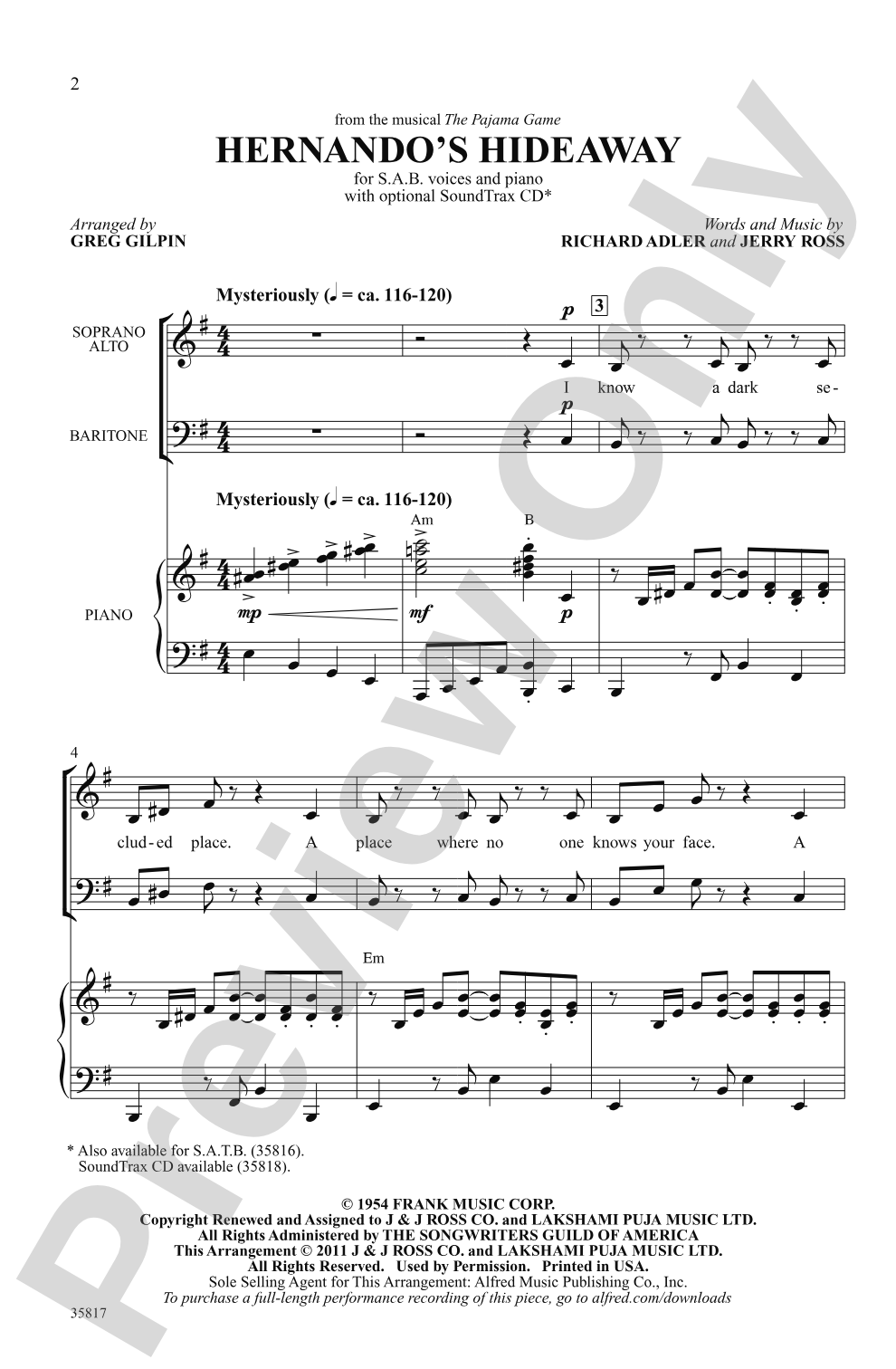
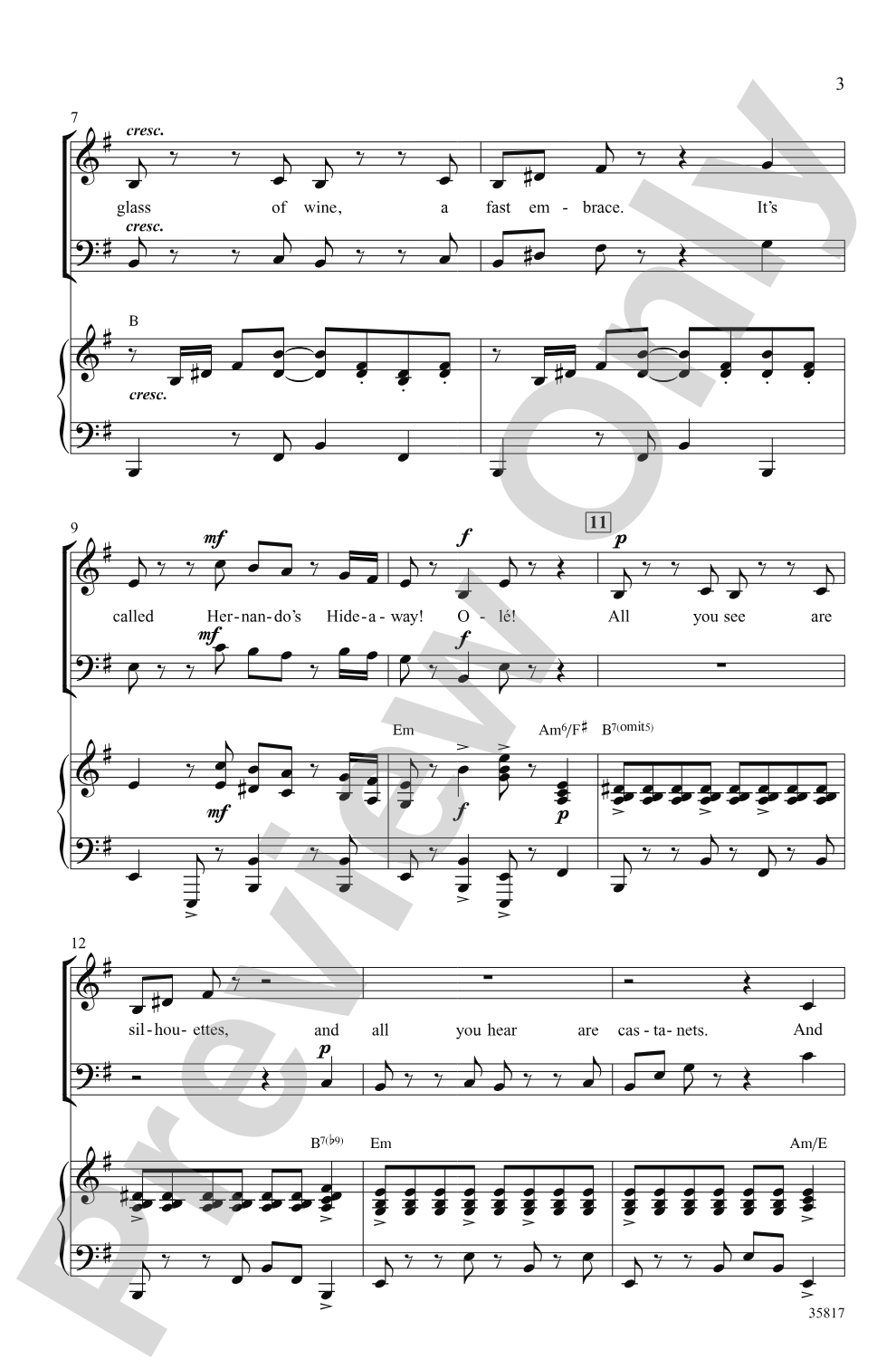

Hernando's Hideaway (from the musical The Pajama Game): SAB Choral Octavo
From the Musical The Pajama Game
Words and music by Richard Adler and Jerry Ross / arr. Greg Gilpin
Item: 00-PO-0001109
$1.90
Minimum order quantity: 20 copies
One moment…
Related Items
Hernando's Hideaway: SoundTrax Digital Audio Download |
$26.99
|
View | |
Hernando's Hideaway (from the musical The Pajama Game): SATB Choral Octavo |
$2.25
|
View | |
Hernando's Hideaway: SATB Choral Octavo |
$2.25
|
View | |
Hernando's Hideaway: SAB Choral Octavo |
$1.90
|
View | |
Hernando's Hideaway: Choral Octavo SoundTrax CD |
$26.99
|
View |
Description
Featured in the Tony-nominated Broadway hit The Pajama Game, this Latin-flavored arrangement will be easily learned by both concert and show groups. Add some choreography for a guaranteed showstopper!


Hernando's Hideaway (from the musical The Pajama Game): SAB Choral Octavo isn't in MakeMusic Cloud just yet...but it could be. Let us know you'd like to see it, and you'll help shape what comes next. In the meantime, start a free trial and dive into thousands of interactive titles your students can play along with today.
Request This Title
Tell us you want it.
Start Your Free Trial
Explore everything that's ready to play right now.
Sample Audio
1
Audio File
--:--
0:00
0:00
Sample Video
No sample videos found.
Additional Details
Series:
Alfred Pop Choral Series
Publisher:
Alfred Music
Page Count:
12
SKU:
00-PO-0001109
More about this title
About the Composer: Richard Adler
Richard Adler composed some of Broadway's most enduring popular musicals during the 1950s, a period when the form was undergoing tremendous creative expansion. Along with lyricist Jerry Ross, Adler created The Pajama Game (1954) and Damn Yankees (1955), both of which earned Tony nominations and produced standards that remain central to the American musical theater repertoire. His gift for crafting accessible yet sophisticated melodies, combined with a keen ear for contemporary idioms like Latin rhythms, made his work immediately engaging to audiences while retaining musical substance.
Why we love this
Greg Gilpin's arrangement strikes the rare balance of being both genuinely singable for developing choirs and genuinely fun to perform. The Latin feel sits naturally in a three-part voicing without sacrificing the song's theatrical charm, and the built-in staging potential transforms this from a concert piece into a memorable moment that audiences will still be talking about after the show.
What to expect
Sultry and playful, with a Spanish guitar sensibility that immediately evokes a romantic speakeasy. The Latin rhythm gives the arrangement an inherent energy and swagger that makes sitting still nearly impossible.
Who it's for
This arrangement works for concert choirs seeking a show-stopping closer and for school musicals looking for a production number that showcases strong singers while remaining accessible to mixed ensembles. Both experienced programs and those new to musical theater staging will find the piece manageable and rewarding.
How to get the most out of it
- Establish the clave rhythm as your foundation; have the rhythm section lock that pattern early in rehearsals so the Latin pocket stays clear even when voices enter with the melody.
- Keep the articulation light and slightly detached on the rhythmic figures in the accompaniment parts to maintain the buoyant Latin character rather than letting it feel heavy.
- Work the choreography incrementally rather than teaching music and movement simultaneously; separate rehearsals for each skill prevent either from suffering, then integrate them once both are secure.
- Balance the middle part carefully; it carries harmonic substance that supports the SAB blend, so it needs enough presence without overwhelming the soprano melody line.
How to use it
Program this as a finale number when you want to send the audience out energized, or use it strategically mid-program to inject theatrical vitality into an otherwise concert-focused set. The combination of recognizable melody, stylistic distinction, and movement-friendly structure makes it equally at home in a Broadway revue or as a statement piece in a spring concert.
Skills your students will build
- Latin rhythm patterns and clave feel in a choral context
- Three-part mixed voicing with independent middle part writing
- Coordination of singing with choreographed movement
- Maintaining rhythmic precision while performing staged action
- Building ensemble cohesion across SAB voicings in up-tempo material