
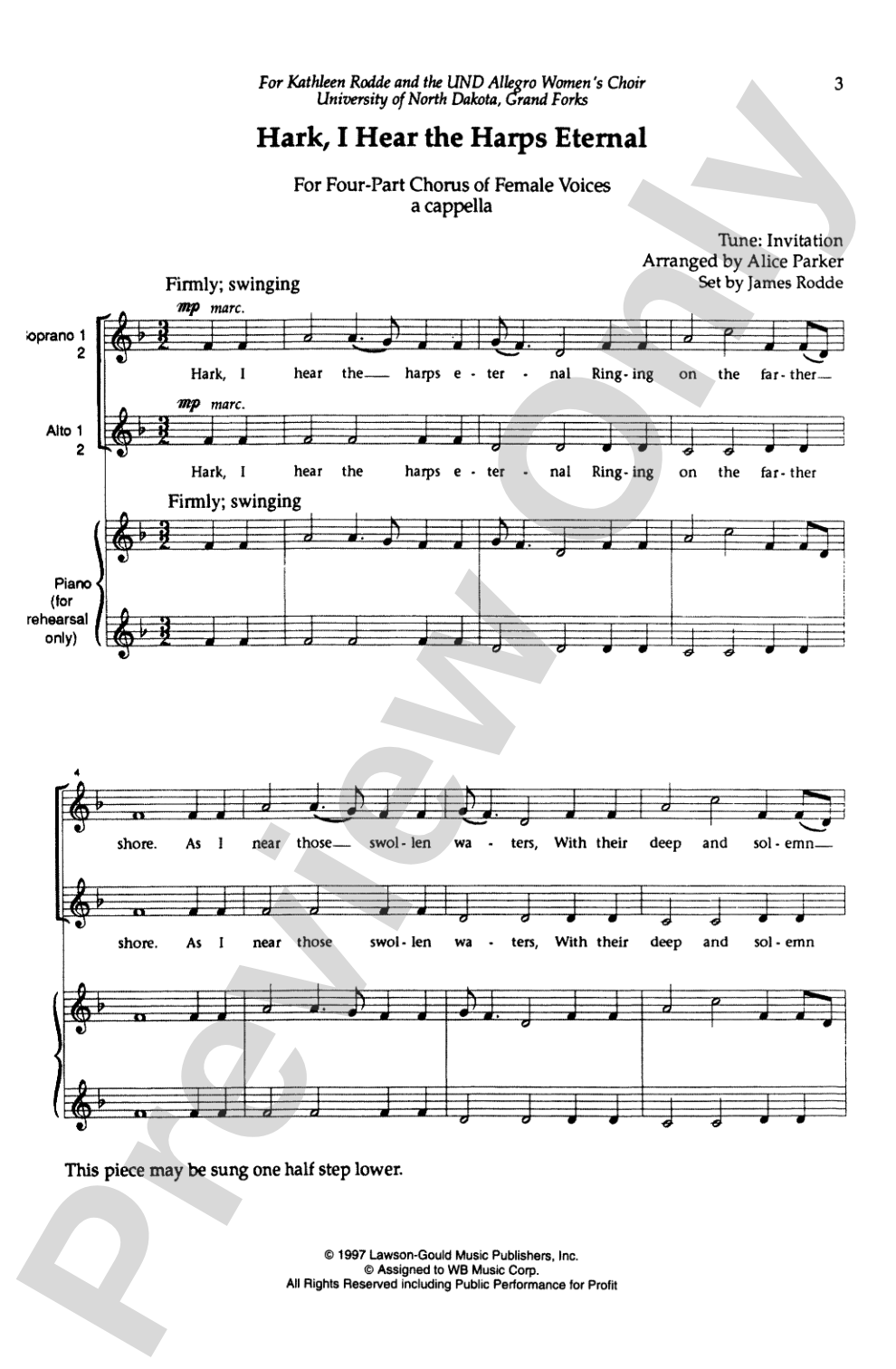
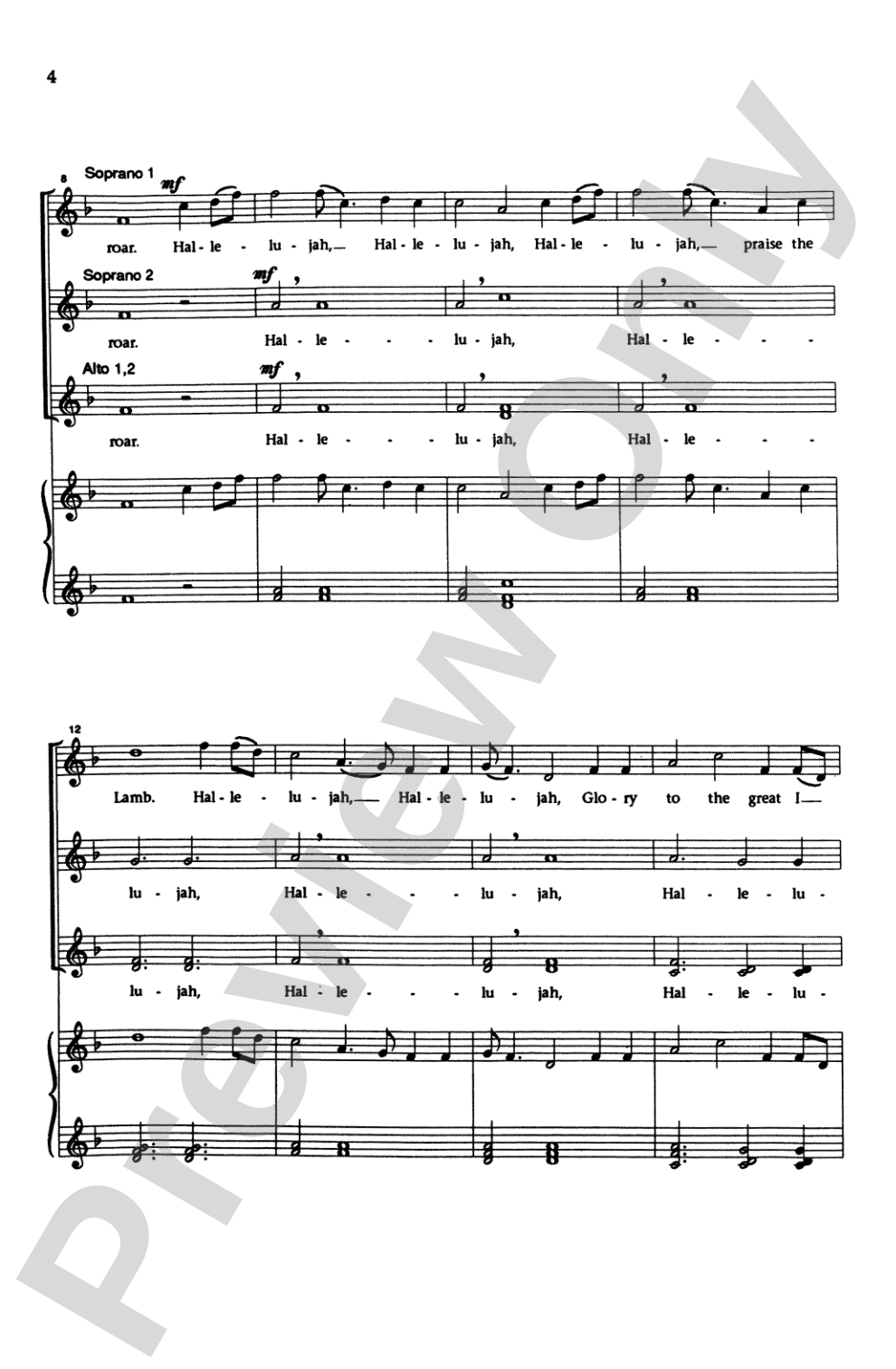

Hark, I Hear the Harps Eternal: SSAA, a cappella Choral Octavo
Traditional Hymn / arr. Alice Parker
Item: 00-PO-0003532
$2.05
Minimum order quantity: 20 copies
Pickup currently not available
Related Items
Hark, I Hear the Harps Eternal: SATB, a cappella Choral Octavo |
$2.05
|
View | |
Hark, I Hear the Harps Eternal: TTBB, a cappella Choral Octavo |
$2.05
|
View | |
Hark, I Hear the Harps Eternal: SATB, a cappella Choral Octavo |
$2.50
|
View | |
Hark, I Hear the Harps Eternal: SSAA, a cappella Choral Octavo |
$2.05
|
View | |
Hark, I Hear the Harps Eternal: TTBB, a cappella Choral Octavo |
$2.05
|
View |
Description
Now women's choirs can enjoy this famous arrangement by Alice Parker, originally written for the Robert Shaw Chorale. The strong walking pulse and juxtaposed motives have made it exceptionally popular for over 40 years.


Hark, I Hear the Harps Eternal: SSAA, a cappella Choral Octavo isn't in MakeMusic Cloud just yet...but it could be. Let us know you'd like to see it, and you'll help shape what comes next. In the meantime, start a free trial and dive into thousands of interactive titles your students can play along with today.
Request This Title
Tell us you want it.
Start Your Free Trial
Explore everything that's ready to play right now.
Sample Audio
1
Audio File
--:--
0:00
0:00
Sample Video
No sample videos found.
Additional Details
Series:
Lawson-Gould
Publisher:
Alfred Music
Page Count:
12
SKU:
00-PO-0003532
More about this title
About the Arranger: Alice Parker

Alice Parker brought together deep training in composition and conducting at Smith College and Juilliard with a lifelong collaboration with Robert Shaw that shaped American choral music. From their partnership emerged hundreds of settings of folk hymns, spirituals, and traditional songs that remain central to choral repertoires everywhere. Her work extended far beyond arranging; she founded MELODIOUS ACCORD, INC. in 1985 to explore the relationship between melody and meaning in vocal music, publishing influential texts on hymn singing, choral improvisation, and song leadership.
Parker's contributions to American musical life earned recognition including the Robert Shaw Award from the American Choral Directors Association, the Harvard Glee Club Foundation Medal, and six honorary doctorates. She served as Director Laureate of Chorus America and was named Distinguished Composer of the Year 2000 by the American Guild of Organists, receiving major grants from ASCAP, the National Endowment for the Arts, and the Aaron Copland Fund for Music.
Why we love this
This arrangement has sustained its popularity for over four decades because Parker's hand is unmistakable: the walking pulse anchors the piece while contrasting melodic ideas weave above it, creating forward momentum without sacrificing clarity. For SSAA ensembles, it offers the rare gift of a sacred standard that feels both dignified and genuinely singable, with writing that respects the voices' natural ranges while giving each section something rewarding to carry.
What to expect
There is an almost meditative quality to the steady forward motion, as if the piece itself is walking toward something with quiet purpose. The interplay of the melodic lines creates moments of surprising warmth and depth, while the a cappella texture keeps everything intimate and direct, never allowing the piece to drift into abstraction.
Who it's for
Women's choirs seeking substantial sacred repertoire beyond hymn collections will find an expertly crafted arrangement that has proven itself in festivals and concert settings. SSAA ensembles at the high school and collegiate level, as well as community and church choirs with strong treble resources, can tackle this piece with confidence that the voice leading and harmonic language will reward careful attention.
How to get the most out of it
- Establish the walking pulse early in rehearsal by conducting the underlying quarter-note motion; this rhythmic foundation allows singers to lock into the piece's propulsive character without overexertion.
- Shape the juxtaposed motives with clear dynamic contrast so that each melodic idea reads distinctly rather than blending into a uniform texture.
- Let the a cappella writing breathe; resist the impulse to rush, especially at phrase endings where the harmonic movement can be allowed space to settle.
- Address intonation challenges in the close four-part writing by rehearsing sections individually before combining them, paying special attention to how the inner voices support the soprano line.
How to use it
This arrangement sits comfortably in a program of American sacred music or works arranged by significant American composers. Its spiritual depth and accessibility make it an effective choice for ecumenical services, choral festivals, and concert programs that need a centerpiece offering both musical substance and emotional resonance without demanding an accompanist.
Skills your students will build
- Balancing independent melodic lines within a four-part harmonic texture
- Maintaining steady pulse and forward momentum in a cappella singing
- Singing with precision in close four-part voicing and tight harmonic writing
- Interpreting contrasting motives and understanding how they relate to overall musical architecture