
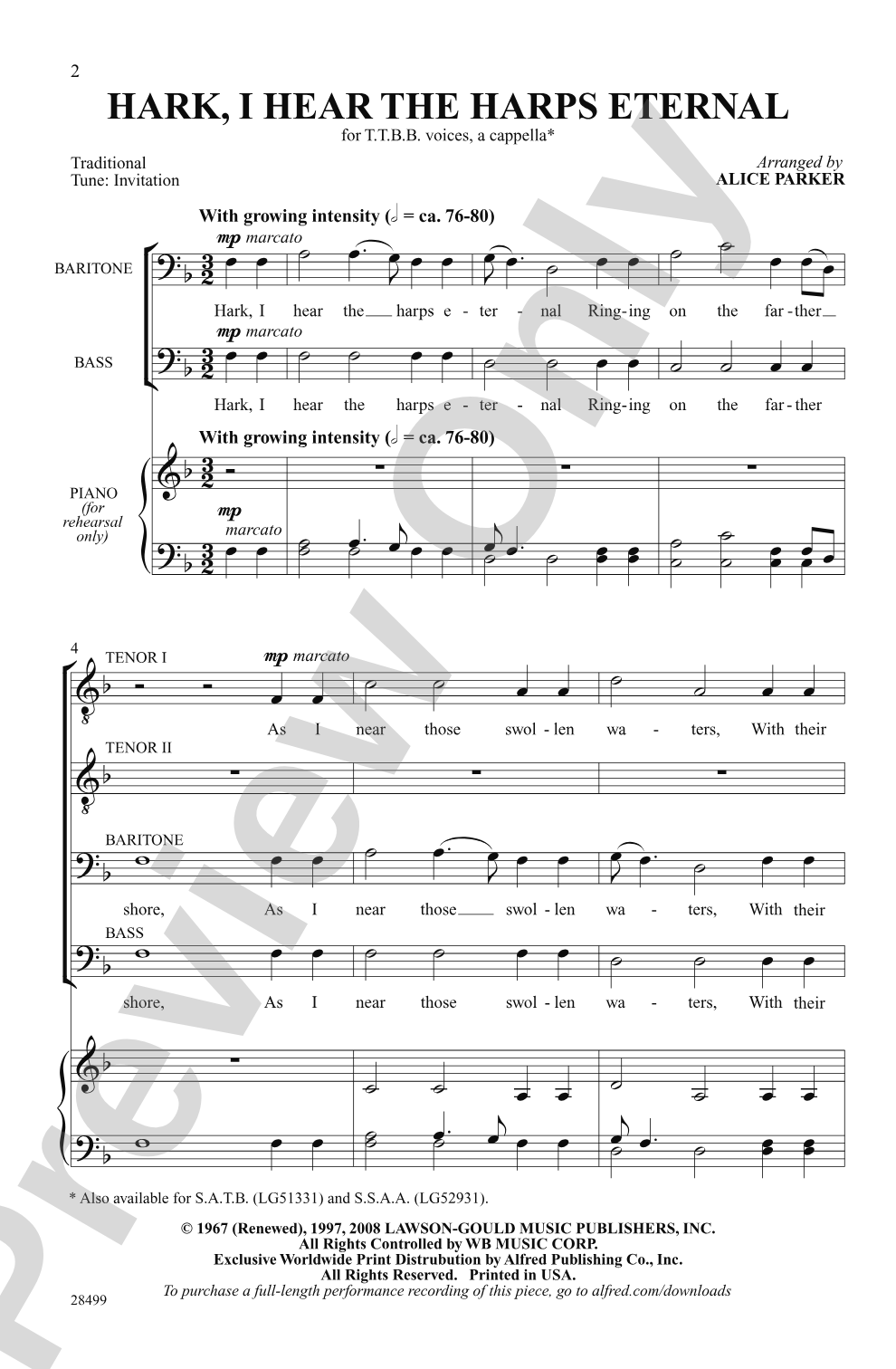
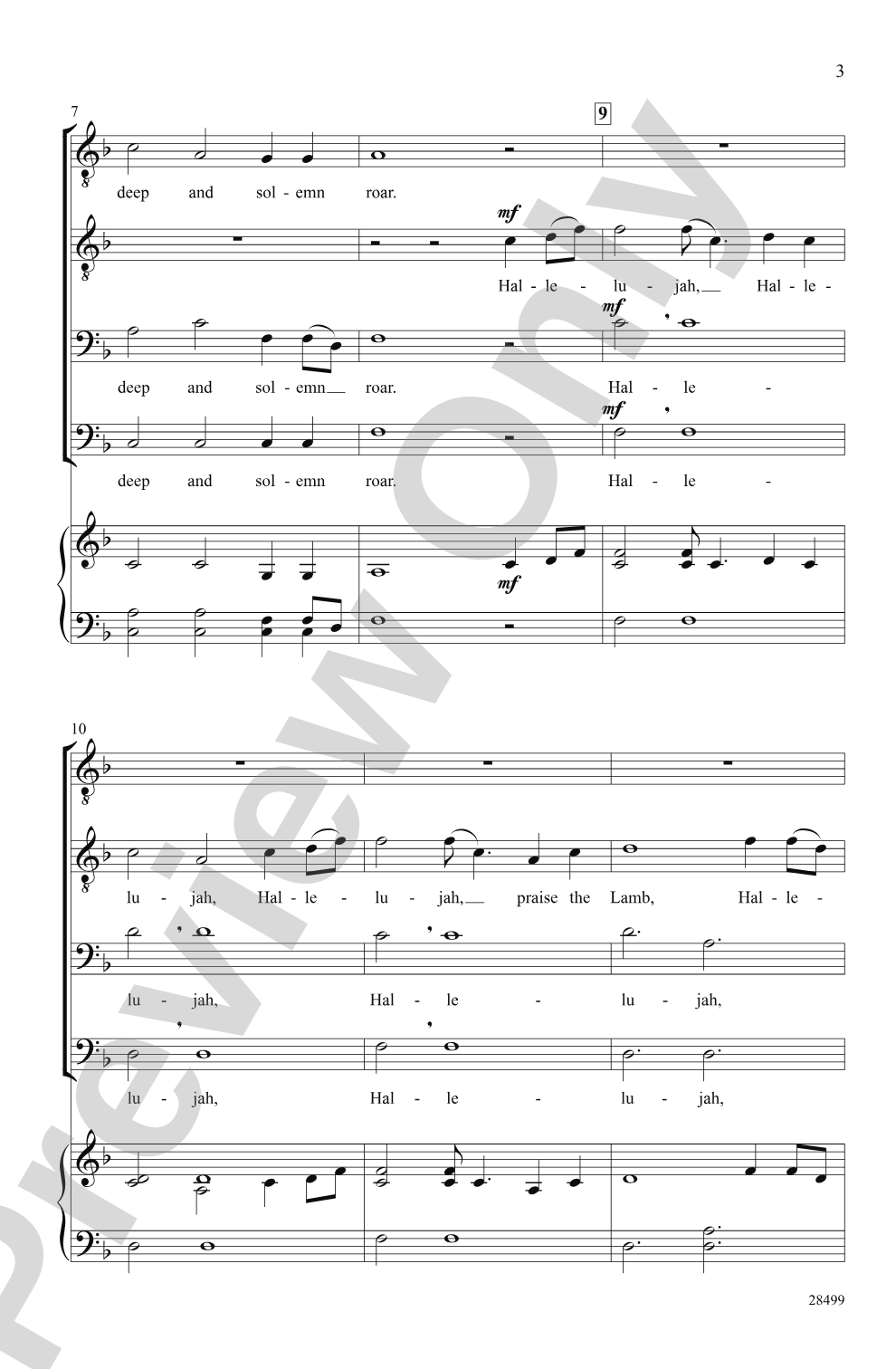

Hark, I Hear the Harps Eternal: TTBB, a cappella Choral Octavo
Traditional Hymn / arr. Alice Parker
Item: 00-PO-0000460

$2.05
Minimum order quantity: 20 copies
Pickup currently not available
Related Items
Hark, I Hear the Harps Eternal: SATB, a cappella Choral Octavo |
$2.05
|
View | |
Hark, I Hear the Harps Eternal: SSAA, a cappella Choral Octavo |
$2.05
|
View | |
Hark, I Hear the Harps Eternal: SATB, a cappella Choral Octavo |
$2.50
|
View | |
Hark, I Hear the Harps Eternal: SSAA, a cappella Choral Octavo |
$2.05
|
View | |
Hark, I Hear the Harps Eternal: TTBB, a cappella Choral Octavo |
$2.05
|
View |
Description
Now men's choirs can enjoy this famous arrangement by Alice Parker, originally written for the Robert Shaw Chorale. The strong walking pulse and juxtaposed motives have made it exceptionally popular for over 40 years.


Don't just read it, hear it, play along with it, and watch your students grow with it. In MakeMusic Cloud, Hark, I Hear the Harps Eternal: TTBB, a cappella Choral Octavo comes alive with professional accompaniment, adjustable tempo, and built-in practice tools that turn solo practice into real progress.
Open in the Player
Jump straight in and assign it today.
Start Your Free Trial
Open this title and explore the full library in minutes.
Sample Audio
1
Audio File
--:--
0:00
0:00
Sample Video
No sample videos found.
Additional Details
Series:
Lawson-Gould
Publisher:
Alfred Music
Page Count:
12
SKU:
00-PO-0000460
More about this title
About the Arranger: Alice Parker

Alice Parker studied composition and conducting at Smith College and the Juilliard School, where she developed a deep working relationship with Robert Shaw that shaped her artistic vision for decades. Their collaborative settings of American folksongs, hymns, and spirituals became core repertoire for choirs across the country and remain widely performed today.
Parker's output spans over five hundred published works, including operas, cantatas, song cycles, and individual anthems. In 1985, she founded MELODIOUS ACCORD, INC., dedicating herself to the study and practice of melody in choral music. Her written works on melodic style, congregational singing, and choral improvisation have influenced how musicians approach text and tune. She served as Director Laureate of Chorus America, received the Robert Shaw Award from the American Choral Directors Association, and earned numerous honors including six honorary doctorates and the Smith College Medal.
Why we love this
Parker's arrangement transforms a beloved hymn into something fresh and rhythmically alive without losing its spiritual core. The walking pulse and overlapping motives create forward momentum while the a cappella texture ensures every voice part stays essential, making this a standout choice for men's choirs seeking substantial, singable music.
What to expect
This setting moves with purpose and dignity, its steady pulse and interlocking phrases creating a sense of forward motion while maintaining the reverent character the text demands. The a cappella voices weave around each other in a warm, full texture that feels both timeless and contemporary.
Who it's for
Men's choirs and TTBB ensembles of intermediate to advanced ability seeking quality sacred repertoire that combines liturgical weight with musical sophistication. Singers comfortable with independent voice-leading and committed to blended, balanced ensemble sound will find this arrangement deeply rewarding.
How to get the most out of it
- Establish the walking pulse in rehearsal before adding text; the steady eighth-note motion in at least one voice part must feel organic, not metronomic.
- Isolate the juxtaposed motives by voice part to hear how they interact; once each section understands its rhythmic shape, the overlapping lines will lock into place naturally.
- Shape phrases across the bar lines rather than stopping at rests, allowing the harmonic motion to breathe while maintaining the piece's inherent momentum.
- Balance the four parts so that no single voice dominates; in a cappella scoring, one dominant tenor or baritone will muddy the texture and obscure Parker's careful voice-leading.
How to use it
Program this as a spiritual centerpiece in a concert featuring American sacred music, or use it to anchor a set of hymn-based choral works alongside spirituals and folk arrangements. Its contest and festival credentials make it ideal for spring competition programs or ecumenical worship events.
Skills your students will build
- Independent voice-leading in four-part a cappella texture
- Maintaining rhythmic integrity while singing overlapping motives
- Blend and balance without instrumental support
- Phrasing across bar lines and rests
- Stylistic interpretation of sacred hymn-based material