
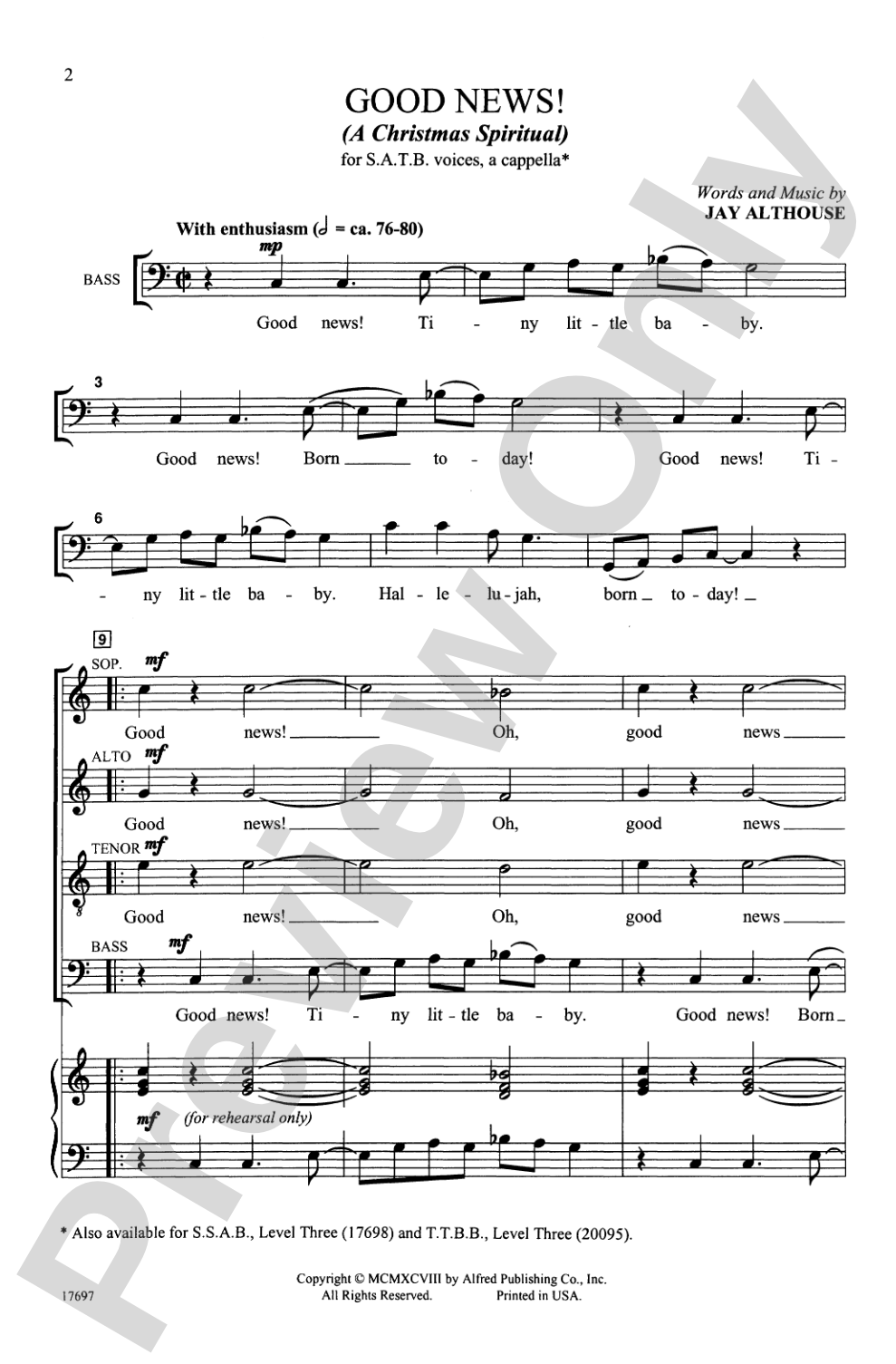
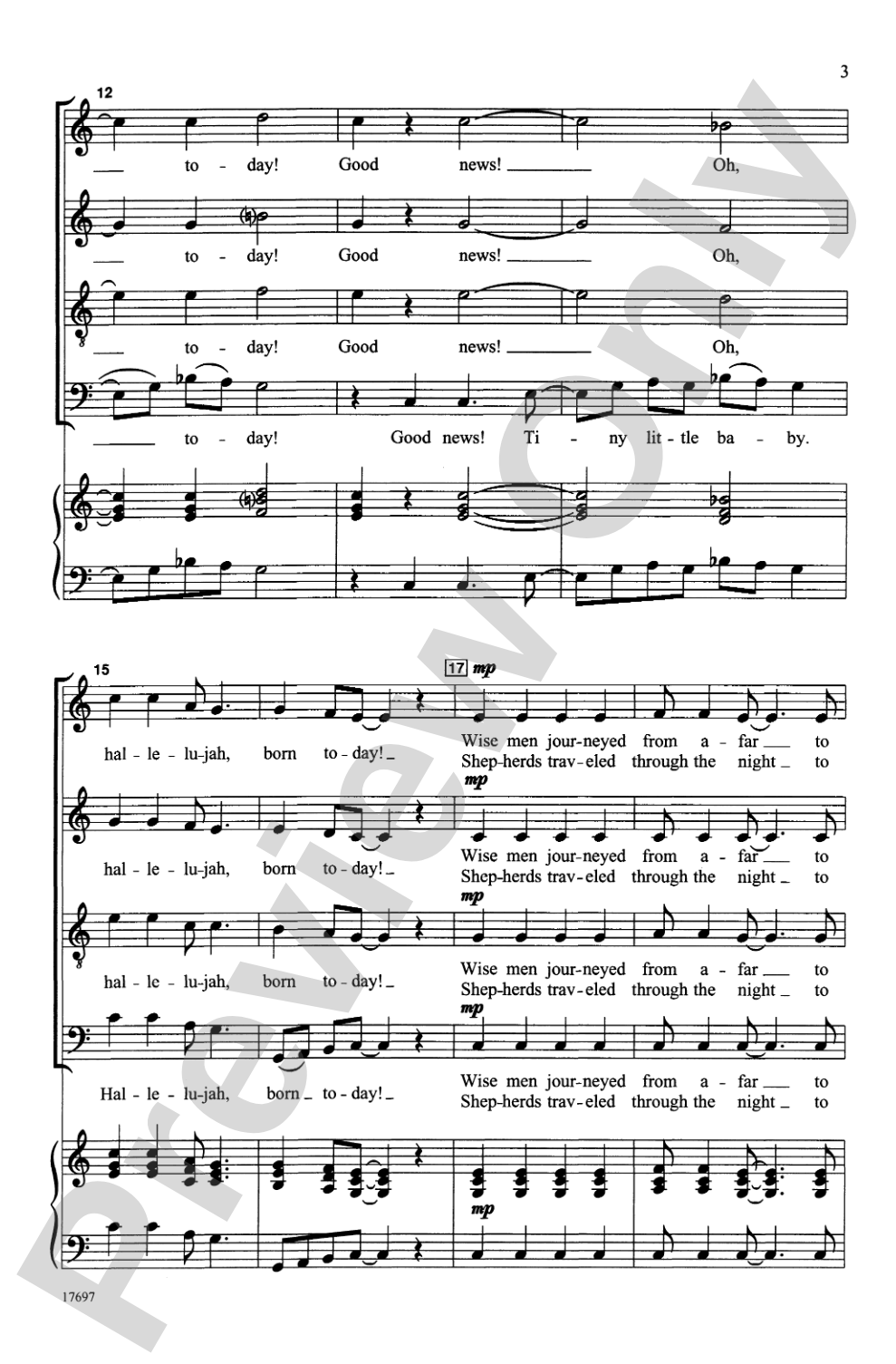
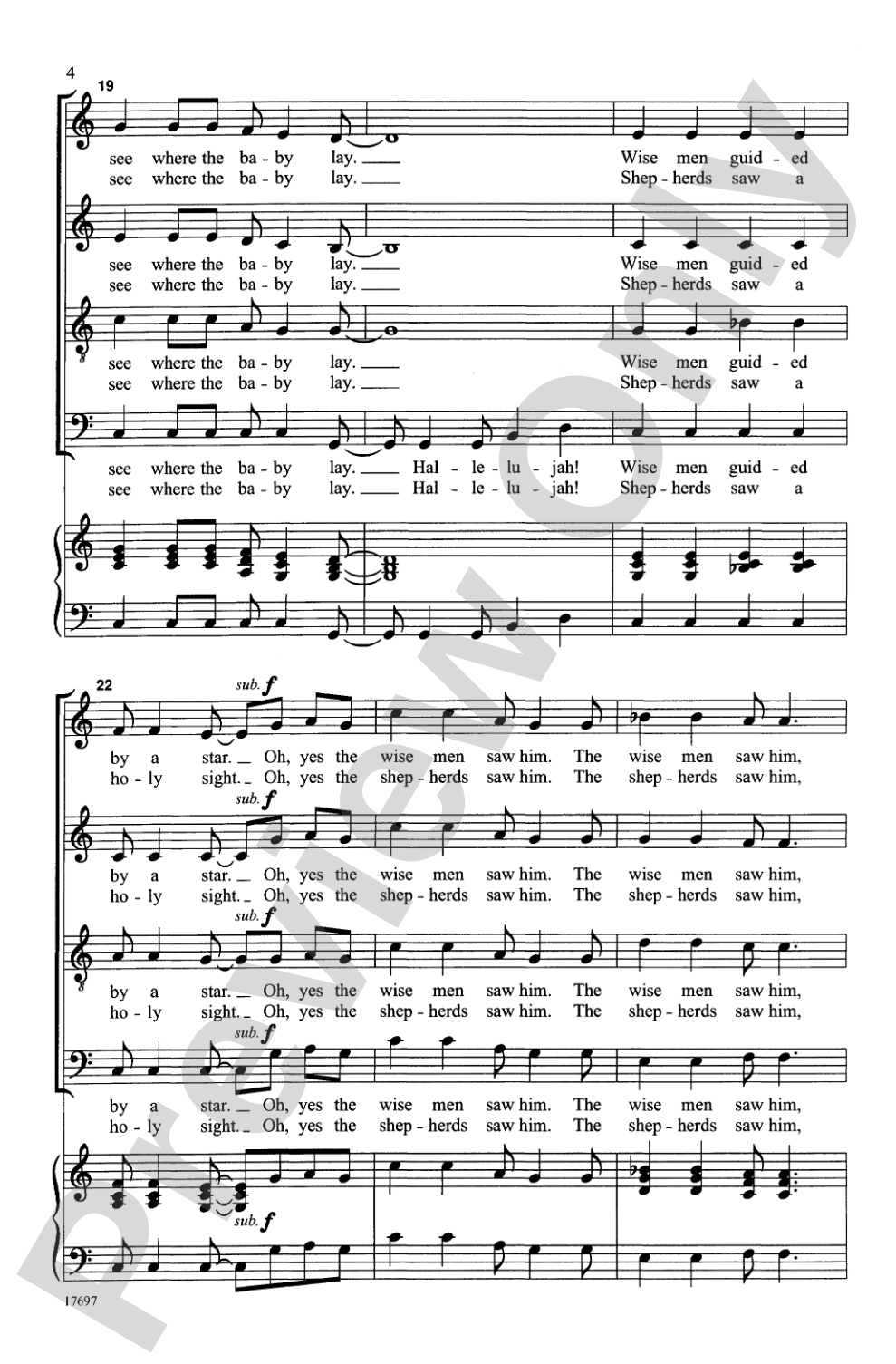

Good News! (A Christmas Spiritual): SATB, a cappella Choral Octavo
Music by Jay Althouse
Item: 00-PO-0004006
$2.25
Minimum order quantity: 20 copies
Pickup currently not available
Description
New for TTBB! One of the best in a long line of exuberant, original, a cappella Christmas spirituals by Jay Althouse. It opens with an energetic melody sung by the low voice with the upper three voices singing in counterpoint above. Rhythmic energy develops the piece and it ends with an electrifyimg eight measure coda that's the pinnacle of excitement. No solos, no tempo changes make for quick learning. In the classic spiritual tradition, yet fresh and contemporary.


Good News! (A Christmas Spiritual): SATB, a cappella Choral Octavo isn't in MakeMusic Cloud just yet...but it could be. Let us know you'd like to see it, and you'll help shape what comes next. In the meantime, start a free trial and dive into thousands of interactive titles your students can play along with today.
Request This Title
Tell us you want it.
Start Your Free Trial
Explore everything that's ready to play right now.
Sample Audio
1
Audio File
--:--
0:00
0:00
Sample Video
No sample videos found.
Additional Details
Series:
Alfred Archive Edition: Alfred Choral Designs
Publisher:
Alfred Music
Page Count:
12
SKU:
00-PO-0004006
More about this title
About the Composer: Jay Althouse

Jay Althouse holds degrees in Music Education and Music from Indiana University of Pennsylvania, where he was later honored as a Distinguished Alumnus. His career spans both publishing and composition: he spent eight years managing rights and licenses for a major educational music publisher and served on the Executive Board of the Music Publishers Association of America. As a composer, he has amassed more than 800 published choral works performed widely across the English-speaking world and is a writer member of ASCAP with a consistent record of Special Awards for his compositions.
Beyond choral composition, Althouse has collaborated with his wife Sally K. Albrecht on children's musicals and co-authored influential pedagogical resources including The Complete Choral Warm-up Book and Accent on Composers. He compiled and arranged vocal solo collections such as Folk Songs for Solo Singers and created classroom materials on music fundamentals and composer study. In 2009, the choral work he co-wrote with Albrecht, I Hear America Singing, was performed by the San Francisco Girls and Boys Choirs at President Barack Obama's Inauguration. He currently serves on the National Advisory Board of the Folk Art Society of America.
Why we love this
Althouse builds momentum with genuine ingenuity here: opening with low voices carrying the melody while upper three voices weave counterpoint creates textural interest that doesn't require soloists or rely on tempo tricks. The rhythmic drive builds naturally through the piece, culminating in an eight-measure coda that feels earned rather than tacked on. For directors seeking a Christmas spiritual that's rooted in tradition but sounds contemporary, this delivers the energy and accessibility that make it stick in singers' and audiences' ears alike.
What to expect
Infectious joy wrapped in the warmth of the spiritual tradition. Low voices anchor the piece with an earthy, grounded melody while upper voices dance above in clever dialogue. The whole structure propels forward with infectious rhythmic energy that feels both celebratory and rooted.
Who it's for
Intermediate to advanced SATB choirs with solid rhythmic literacy and blend. The counterpoint and rhythmic drive require attention to ensemble cohesion, making this a good fit for choirs that have sung together for a season or more.
How to get the most out of it
- Balance the opening carefully so the bass or tenor melody cuts through clearly while the counterpoint above supports rather than overwhelms it.
- Let rhythmic precision do the work in building excitement; the energy comes from locked entrances and clean articulation, not from rushing.
- Shape the eight-measure coda as a single arc rather than eight separate measures; the singers should feel it as one unified swell to the final moment.
How to use it
Program this as a concert opener or placed strategically in a Christmas set to shift the mood and tempo. Its compact length and driving energy make it an ideal counterpart to slower sacred works or as a standalone moment that reminds audiences why spirituals remain central to choral life.
Skills your students will build
- Singing counterpoint while maintaining a clear supporting role beneath the primary melody
- Rhythmic precision and ensemble alignment in syncopated or complex rhythmic passages
- Building phrase energy and momentum through collective commitment rather than tempo changes
- Balance and blend in four-part writing where voices occupy different registral spaces