
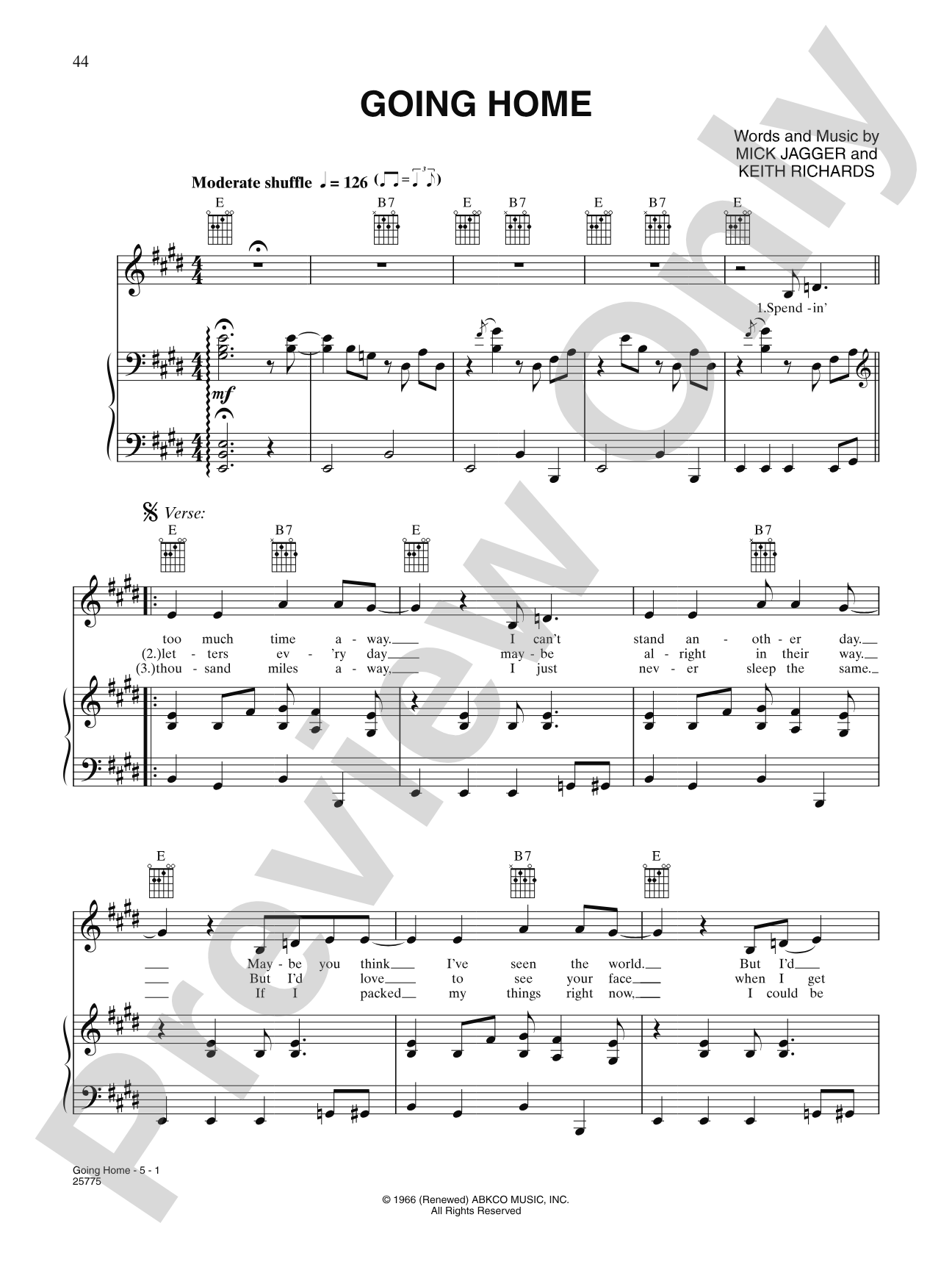

Goin' Home: Piano/Vocal/Chords
The Rolling Stones
Item: 00-PS-0012161
$4.99
Pickup currently not available
Related Items
Doncha Bother Me: Piano/Vocal/Chords |
$4.99
|
View | |
Flight 505: Piano/Vocal/Chords |
$4.99
|
View | |
High and Dry: Piano/Vocal/Chords |
$4.99
|
View | |
I Am Waiting: Piano/Vocal/Chords |
$4.99
|
View | |
It's Not Easy: Piano/Vocal/Chords |
$4.99
|
View | |
Think: Piano/Vocal/Chords |
$4.99
|
View | |
Lady Jane: Authentic Guitar TAB |
$5.99
|
View | |
I Am Waiting: Authentic Guitar TAB |
$5.99
|
View | |
Flight 505: Authentic Guitar TAB |
$5.99
|
View | |
Going Home: Authentic Guitar TAB |
$9.99
|
View | |
The Rolling Stones: Aftermath: Authentic Guitar TAB Book |
$19.95
|
View |
Description
Titles are: Paint It, Black * Stupid Girl * Lady Jane * Under My Thumb * Doncha Bother Me * Think * Flight 505 * High and Dry * It's Not Easy * I Am Waiting * Going Home.


Goin' Home: Piano/Vocal/Chords isn't in MakeMusic Cloud just yet...but it could be. Let us know you'd like to see it, and you'll help shape what comes next. In the meantime, start a free trial and dive into thousands of interactive titles your students can play along with today.
Request This Title
Tell us you want it.
Start Your Free Trial
Explore everything that's ready to play right now.
Sample Audio
No sample audio found.
Sample Video
No sample videos found.
Additional Details
Series:
Alfred's Classic Album Editions
Publisher:
Alfred Music
Page Count:
48
SKU:
00-PS-0012161
More about this title
About the Composer: Mick Jagger
Mick Jagger stands as one of rock music's most influential frontmen and songwriters. As the primary lyricist and vocal force of The Rolling Stones, Jagger crafted some of the most enduring rock songs of the 20th century, often collaborating with Keith Richards to shape the band's distinctive sound across five decades of recording and performance.
For music educators and performers, Jagger's songwriting demonstrates how memorable melodies, sharp lyrical wit, and rhythmic precision can drive engagement across generations of listeners. His compositions balance accessibility with sophistication, making them valuable models for understanding song structure and vocal phrasing in contemporary music.
Why we love this
This collection captures eleven essential Rolling Stones tracks in a format that lets pianists and singers explore the band's evolution from early blues-influenced rock through their most iconic compositions. The piano/vocal/chords layout gives performers multiple entry points into these songs, whether you're accompanying a vocalist, interpreting them as solo piano pieces, or using them as starting points for arrangement.
What to expect
These eleven songs pulse with the raw confidence and sardonic edge that defined The Rolling Stones. Whether it's the slink of 'Under My Thumb,' the soulful yearning of 'Going Home,' or the sharp rhythmic snap of 'Paint It Black,' each track carries a distinct emotional texture that rewards close listening and intentional performance.
Who it's for
This book works for pianists who want to expand beyond classical repertoire into rock and popular music, as well as vocalists who need accompaniment for their own performances or vocal coaching. Intermediate to advanced pianists and singers will find these arrangements accessible while still offering interpretive flexibility.
How to get the most out of it
- Pay close attention to the rhythmic drive underneath the melody. Many of these songs rely on a specific groove rather than strict melodic ornamentation; locking that pocket pays off more than rushing the phrasing.
- Treat the chord voicings as suggestions rather than rules. These songs originated with guitar, and adapting them for your hand size and touch on the keyboard will make them feel natural under your fingers.
- Vary your dynamic approach within verses and choruses rather than treating entire sections as one volume level. The recorded versions often build energy through arrangement layering, which you can replicate with intentional touch control.
How to use it
Program these individually or in clusters throughout a recital season to connect with audiences who might not typically attend classical concerts. A solo pianist might use one or two as contemporary interludes in a mixed program, while a vocalist could feature several in a jazz or contemporary music recital.
Skills your students will build
- Reading chord symbols and slash notation in rock/pop context
- Balancing melodic phrasing with rhythmic groove
- Adapting guitar-originated voicings for piano
- Building dynamic shape across longer song forms
- Sight-reading contemporary lead sheets