
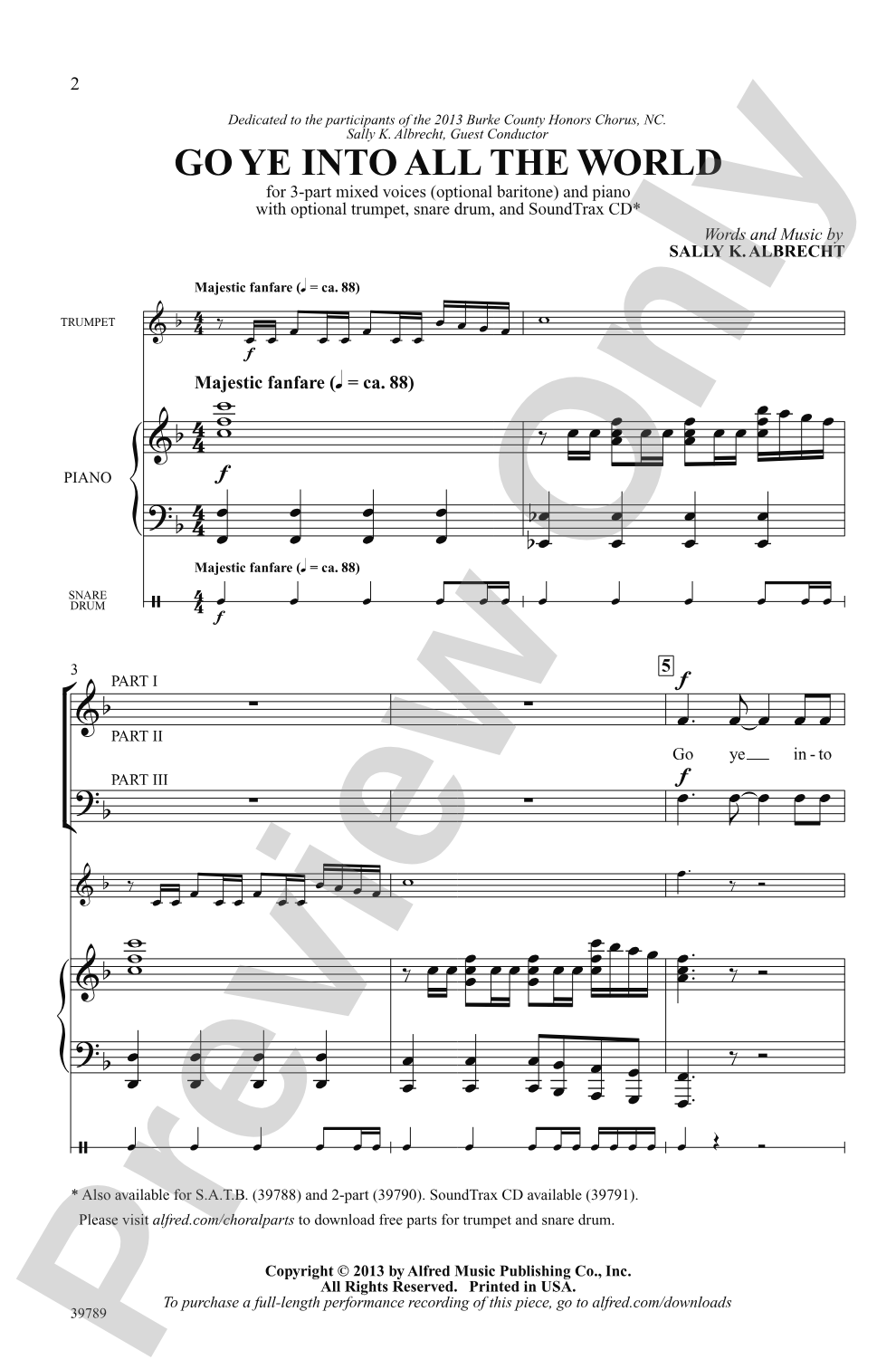

Go Ye Into All the World: 3-Part Mixed Choral Octavo
Words and music by Sally K. Albrecht
Item: 00-PO-0001609
$1.85
Minimum order quantity: 20 copies
Pickup currently not available
Related Items
Go Ye Into All the World: SoundTrax Digital Audio Download |
$27.99
|
View | |
Go Ye Into All the World: SATB Choral Octavo |
$1.85
|
View | |
Go Ye Into All the World: 2-Part Choral Octavo |
$1.85
|
View | |
Go Ye Into All the World: SATB Choral Octavo |
$1.85
|
View | |
Go Ye Into All the World: 3-Part Mixed Choral Octavo |
$1.85
|
View | |
Go Ye Into All the World: 2-Part Choral Octavo |
$1.85
|
View | |
Go Ye Into All the World: Choral Octavo SoundTrax CD |
$27.99
|
View |
Description
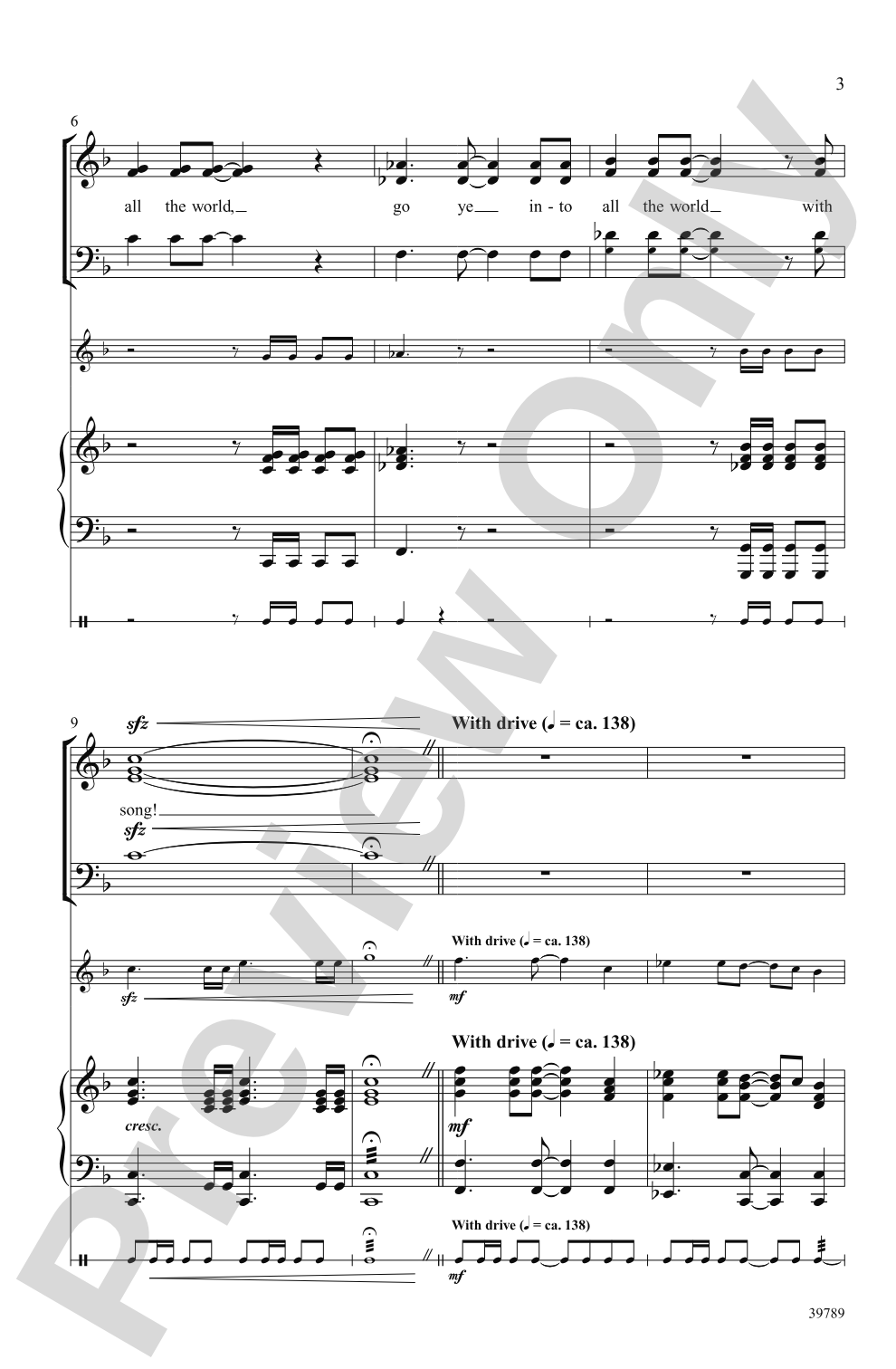
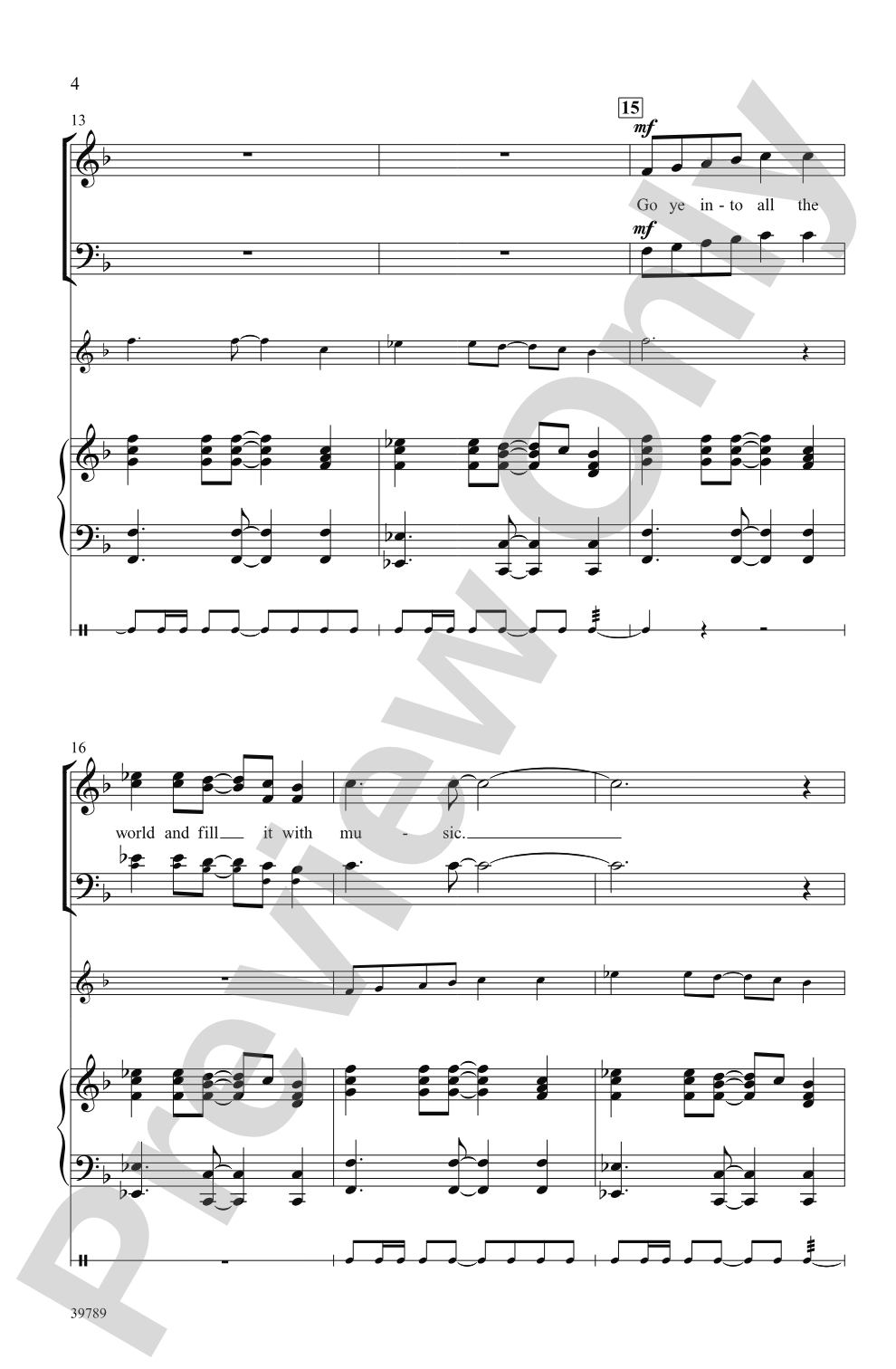
Your choirs will delight in performing this majestic and rhythmic song of joy. Echoes and a contrasting counterpoint "Sing Jubilate Deo" section make it easy to assemble. Download free parts for trumpet and snare drum at alfred.com/choralparts.


Go Ye Into All the World: 3-Part Mixed Choral Octavo isn't in MakeMusic Cloud just yet...but it could be. Let us know you'd like to see it, and you'll help shape what comes next. In the meantime, start a free trial and dive into thousands of interactive titles your students can play along with today.
Request This Title
Tell us you want it.
Start Your Free Trial
Explore everything that's ready to play right now.
Sample Audio
1
Audio File
--:--
0:00
0:00
Sample Video
No sample videos found.
Additional Details
Series:
Alfred Choral Designs
Publisher:
Alfred Music
Page Count:
12
SKU:
00-PO-0001609
More about this title
About the Composer: Sally K. Albrecht

Sally K. Albrecht has shaped American choral music for decades as a composer, conductor, and clinician with a particular gift for integrating movement into choral performance. Since 1987, she has received the ASCAP Special Music Award annually and published over 600 choral works alongside 75 larger songbooks and musicals. Her conducting has graced honor choir festivals at Lincoln Center, Carnegie Hall, and The Kennedy Center, and she spent more than thirty years directing school choral and vocal publications for major educational music publishers, including her tenure at Alfred Music.
Albrecht holds degrees from Rollins College (B.A. in Music and Theater, 1976), the University of Miami (M.A. in Drama, 1977; M.M. in Accompanying, 1979), and has taught at Oakland University, Jersey City State College, and Meredith College. She is a Distinguished Alumna of both the University of Miami Frost School of Music and Rollins College, where she serves as a board member. A native of Cleveland, Ohio, she lives in Wake Forest, North Carolina with her husband, composer and arranger Jay Althouse.
Why we love this
Albrecht writes sacred choral music that energizes without overwhelming young singers. The interplay between echoes and the contrasting counterpoint section ("Sing Jubilate Deo") gives your ensemble natural variety and musical contrast within a single learning piece, while the optional trumpet and snare drum parts invite collaboration across your program and add festive texture without complicating the core vocal writing.
What to expect
Majestic and rhythmically alive, this piece radiates joy and purpose. The echoing textures create space and clarity, allowing each voice part to shine before the celebratory counterpoint section lifts the musical energy and invites the choir to sing with full voice.
Who it's for
Mixed choirs at the 3-part level who are ready for texture and counterpoint but benefit from accessible vocal ranges and clear voice leading. This works well for choirs transitioning from unison or two-part singing to more complex harmony, or for any ensemble seeking uplifting sacred repertoire with built-in performance interest.
How to get the most out of it
- Balance the echo passages so they land clearly but don't overshadow the main melodic line; think of them as musical reinforcement rather than a secondary event.
- Shape the "Sing Jubilate Deo" counterpoint section with gentle dynamic lift to distinguish it from surrounding material and help singers track their own line within the texture.
- If adding the optional trumpet and snare drum, rehearse the rhythm section with your singers first to lock the pulse before layering instrumental color.
- Encourage singers to feel the joy and rhythmic vitality of the text; Albrecht's setting thrives on forward motion and a sense of celebration.
How to use it
Program this as a strong closing piece for a sacred choral concert or spring celebration, where its majestic character and rhythmic momentum can leave audiences uplifted. It also pairs well in a concert section focused on joyful anthems or works exploring themes of commission and call. The optional instrumental parts make it flexible for contexts where you can draw players from your band or orchestra program.
Skills your students will build
- Singing in SAB voicing with clear part independence
- Tracking a line within counterpoint textures
- Echo precision and rhythmic clarity
- Building musical line and phrasing in sacred music
- Ensemble balance when instruments are added