
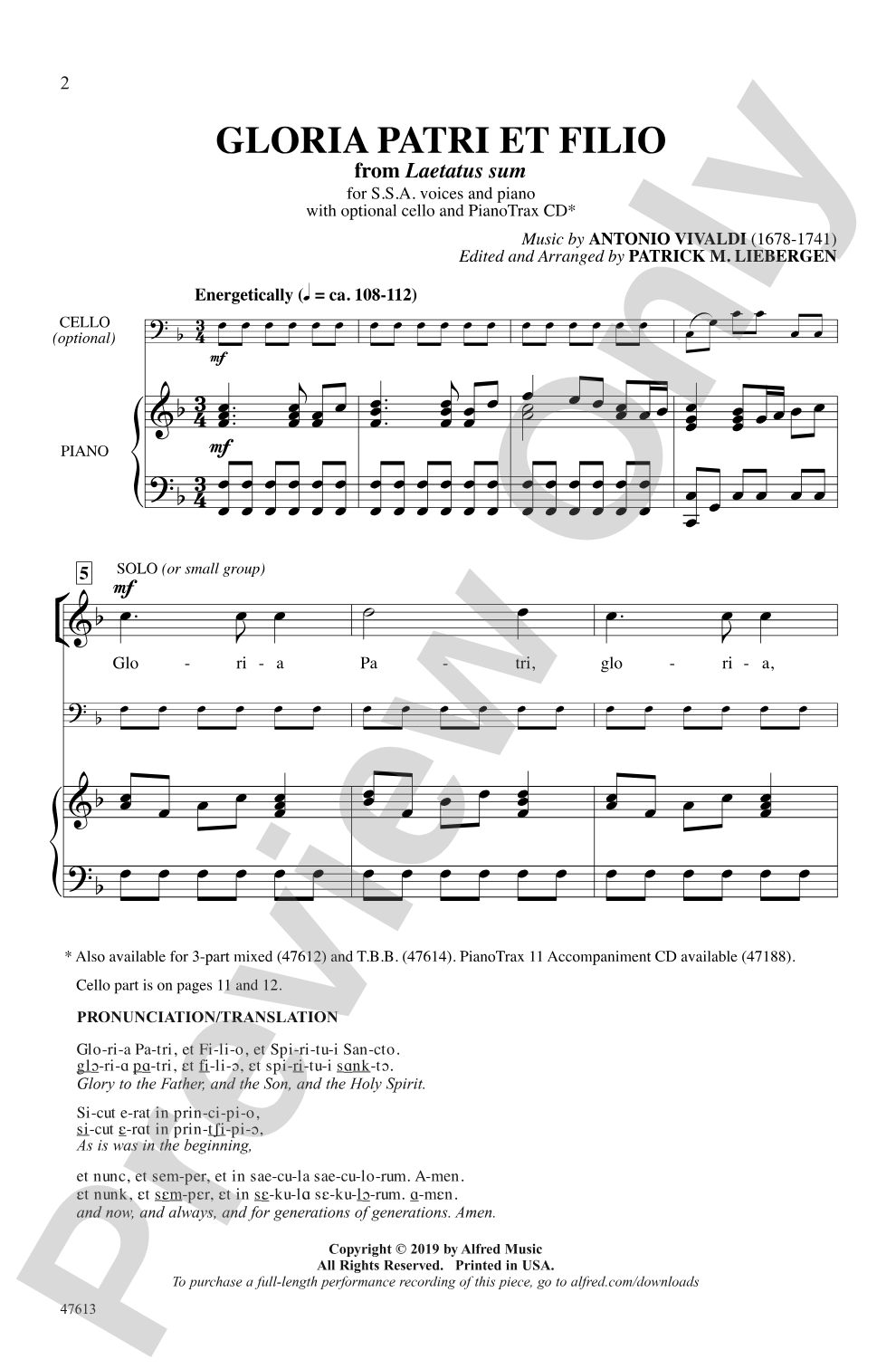
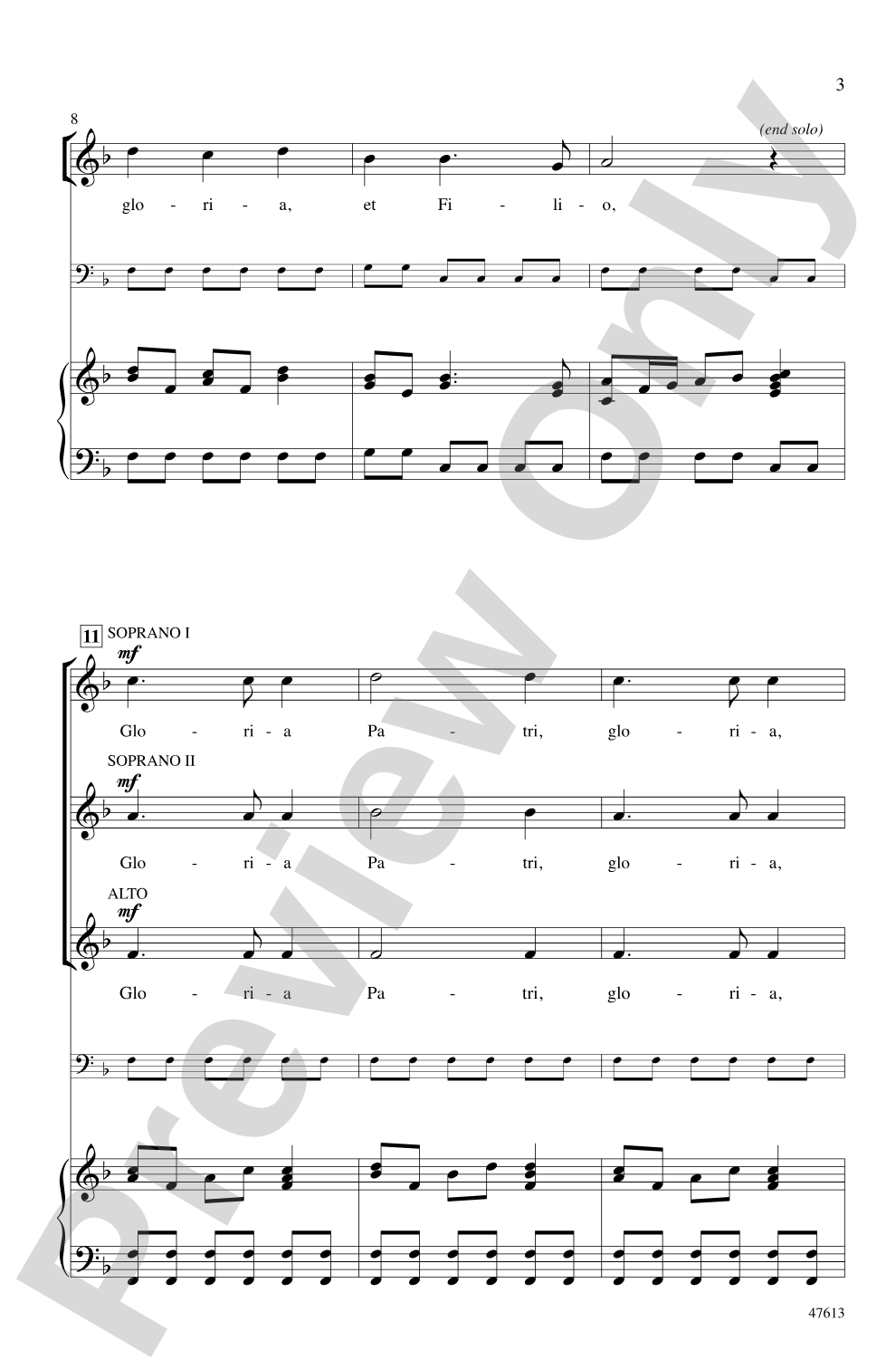
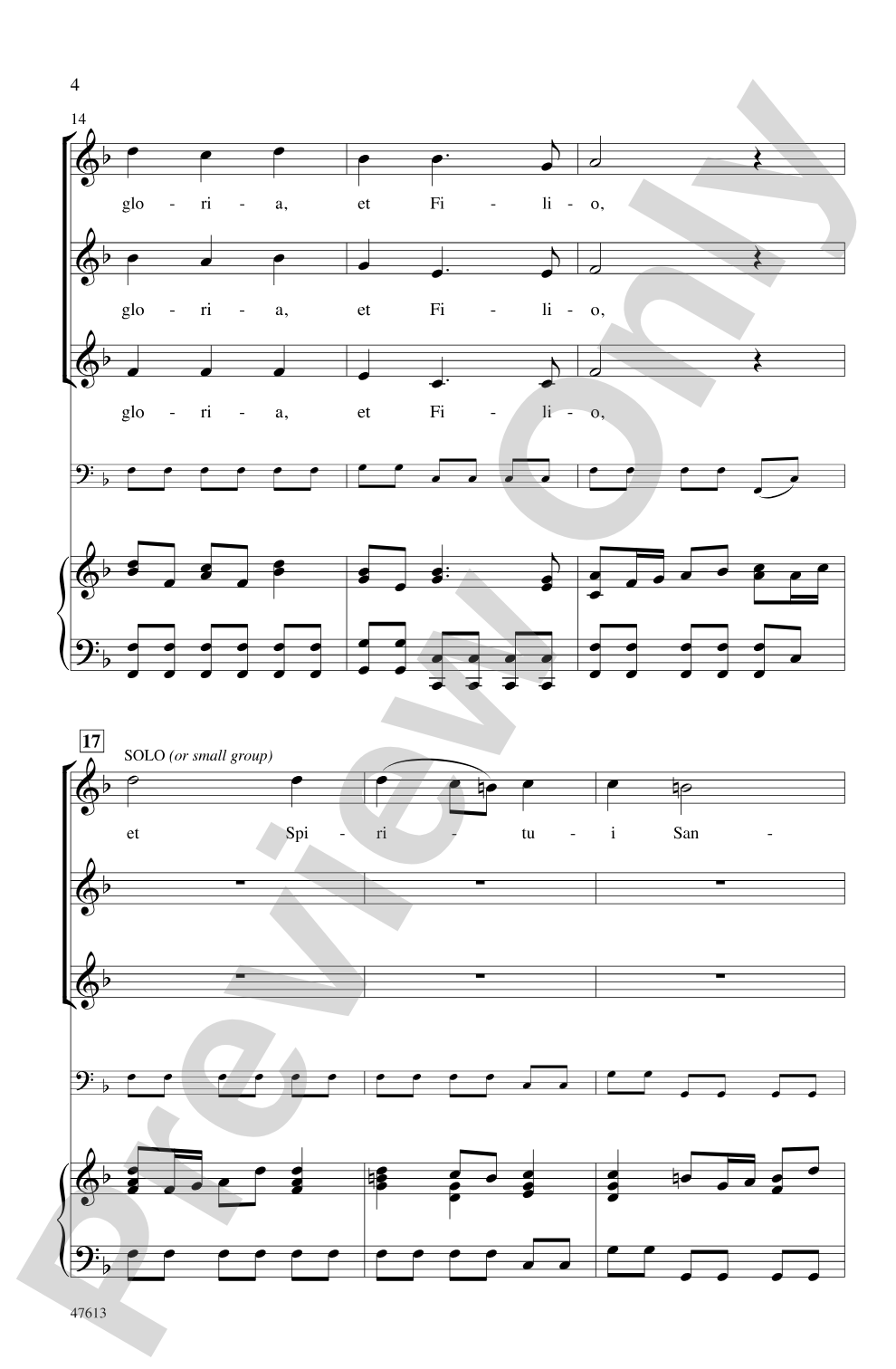

Gloria Patri et Filio: SSA Choral Octavo
Music by Antonio Vivaldi / ed. and arr. Patrick M. Liebergen
Item: 00-PO-0006041
$2.05
Minimum order quantity: 20 copies
Pickup currently not available
Description
From master composer Antonio Vivaldi's Laetatus Sum (a setting of Psalm 121), this edition brings the brief work to today's choirs. Featuring an accessible Latin text and a lively optional cello part, this well-crafted arrangement is an ideal introduction to many of the conventions of Baroque style, including terraced dynamics and the alternation between a small group (or soloist) and the full ensemble.


Gloria Patri et Filio: SSA Choral Octavo isn't in MakeMusic Cloud just yet...but it could be. Let us know you'd like to see it, and you'll help shape what comes next. In the meantime, start a free trial and dive into thousands of interactive titles your students can play along with today.
Request This Title
Tell us you want it.
Start Your Free Trial
Explore everything that's ready to play right now.
Sample Audio
1
Audio File
--:--
0:00
0:00
Sample Video
No sample videos found.
Additional Details
Series:
Alfred Choral Designs
Publisher:
Alfred Music
Page Count:
12
SKU:
00-PO-0006041
More about this title
About the Composer: Antonio Vivaldi
Antonio Vivaldi (1678-1741) was an Italian Baroque composer and virtuoso violinist whose prolific output shaped the conventions of the concerto grosso and established many of the harmonic and structural principles that defined his era. Known as il Prete Rosso (the Red Priest) for his red hair and his position as an ordained clergyman, Vivaldi spent much of his career in Venice, where he composed sacred music for the Ospedale della Pietà, a charitable institution for orphaned and abandoned girls with an renowned music program.
Vivaldi's sacred works reveal the same dramatic flair and instrumental clarity that made his secular compositions influential across Europe. His mastery of voice leading, his bold use of contrast, and his instinct for memorable melodic gesture make his sacred music compelling for modern choirs and essential listening for understanding how Baroque composers balanced devotional text with musical sophistication.
Why we love this
Liebergen's arrangement introduces singers to Baroque architecture without requiring advanced vocal technique. The piece demonstrates terraced dynamics and solo-versus-ensemble writing in a direct, immediately singable form, giving students concrete experience with period conventions they'll encounter in larger sacred works.
What to expect
Bright and buoyant, with a sense of liturgical celebration anchored in clear harmonic progressions. The piece moves with purposeful energy, its alternation between intimate solo writing and full ensemble moments creating an intimate conversation before opening into collective joy.
Who it's for
This arrangement suits developing treble choirs and those new to early music repertoire. Singers gain immediate access to Vivaldi's craft through an edition that respects Baroque style while remaining accessible to high school or adult amateur choirs.
How to get the most out of it
- Shape the terraced dynamics by preparing the transition between solo passages and full choir moments in rehearsal as distinct textural shifts, not gradual crescendos.
- Emphasize crisp articulation on text syllables to bring out the rhythmic liveliness of Vivaldi's melodic lines.
- If using the optional cello part, balance it as a foundational continuo voice rather than as a solo instrument; it supports harmonic clarity and period style.
- Maintain consistent vowel sounds across the SSA voicing, particularly on sustained notes, to achieve the unified resonance characteristic of Baroque sacred music.
How to use it
Pair this with other Baroque sacred works to build a concert section on devotional music, or use it as a concert finale where its modest scale and bright character provide an uplifting close. It also works well in liturgical settings or as a contest piece for treble ensembles seeking approachable early music with genuine musical substance.
Skills your students will build
- Understanding terraced dynamics and textural contrast in Baroque vocal music
- Singing Latin text with period-appropriate articulation and phrasing
- Responding to solo-versus-ensemble writing and transitions between smaller and larger voicing
- Recognizing harmonic language and voice leading conventions of the Baroque era