

Gloria In Excelsis Deo: 2-Part Choral Octavo
By Franz Joseph Haydn / arr. Russell Robinson
Item: 00-PO-0005302
$2.25
Minimum order quantity: 20 copies
Pickup currently not available
Description
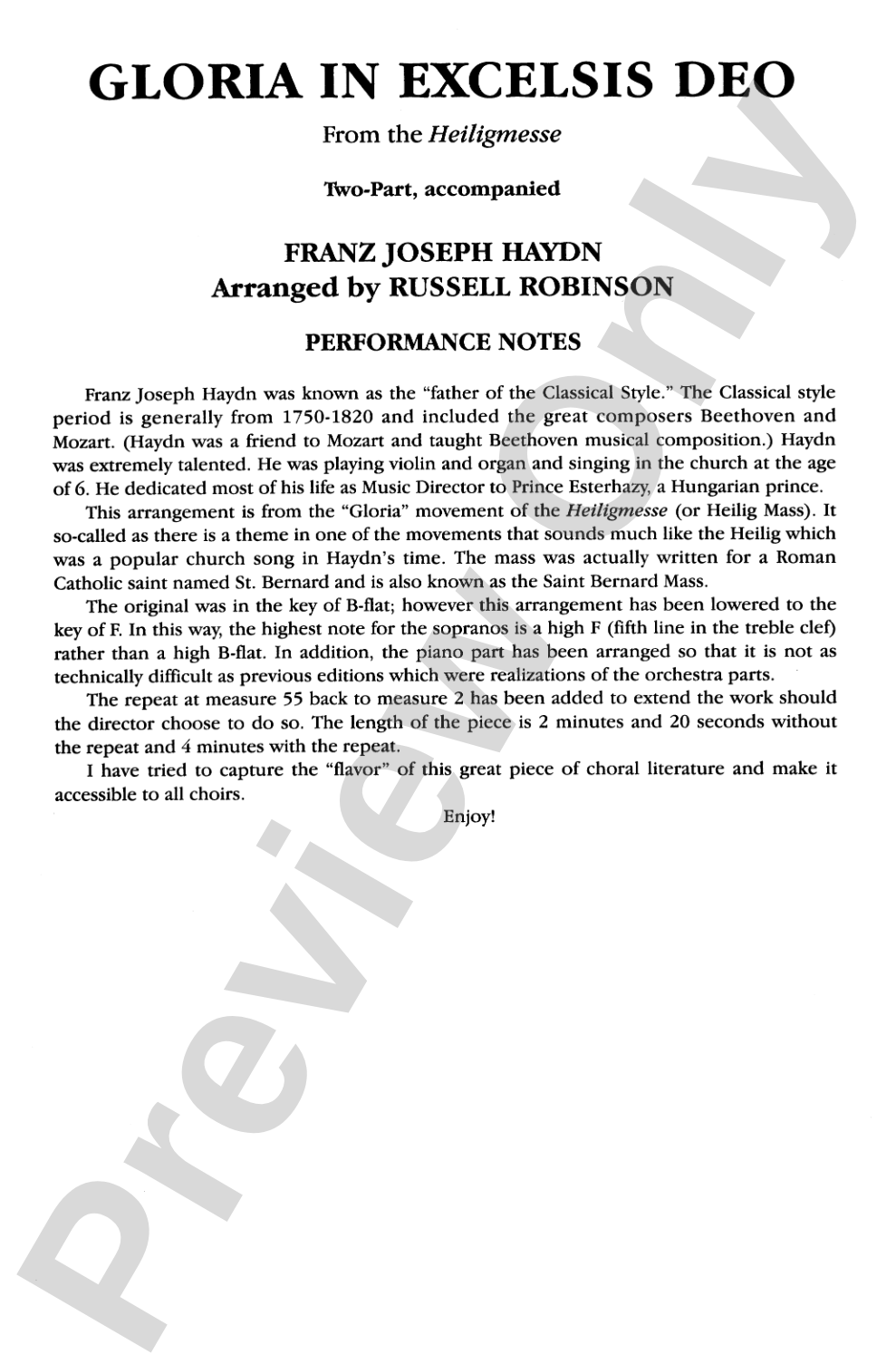
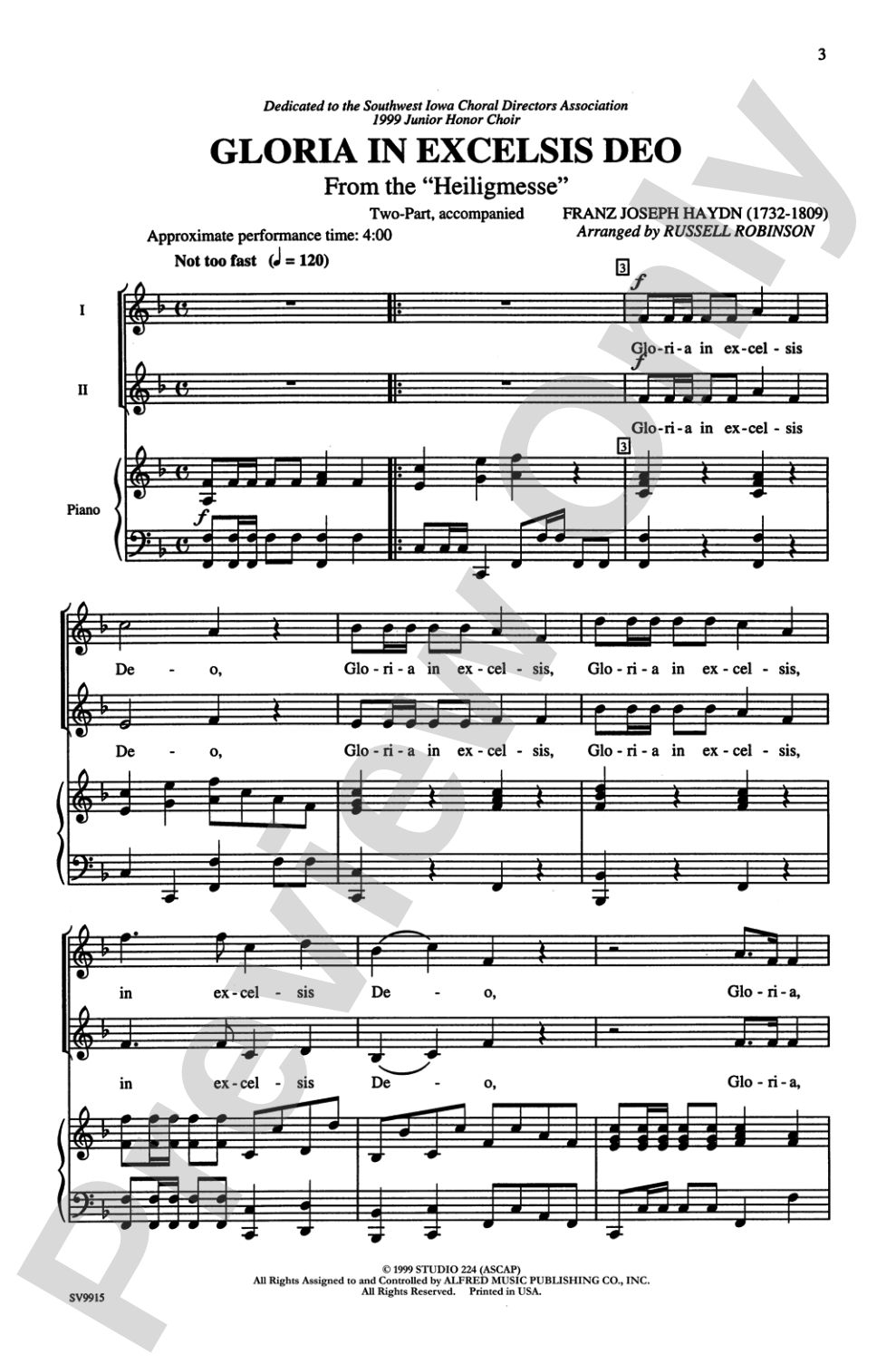
In our new Developing SATB Repertoire series, Russell Robinson has arranged an exciting edition of the famous Haydn "Gloria" from Heiligmesse. Introduce your developing choirs to great choral repertoire with this four-part masterpiece.


Gloria In Excelsis Deo: 2-Part Choral Octavo isn't in MakeMusic Cloud just yet...but it could be. Let us know you'd like to see it, and you'll help shape what comes next. In the meantime, start a free trial and dive into thousands of interactive titles your students can play along with today.
Request This Title
Tell us you want it.
Start Your Free Trial
Explore everything that's ready to play right now.
Sample Audio
No sample audio found.
Sample Video
No sample videos found.
Additional Details
Series:
Alfred Archive Edition: Belwin Festival Series
Publisher:
Alfred Music
Page Count:
8
SKU:
00-PO-0005302
More about this title
About the Composer: Franz Joseph Haydn
Franz Joseph Haydn (1732-1809) was an Austrian composer whose prolific output shaped the Classical era. His sacred vocal works, including the six late masses, combine architectural clarity with genuine spiritual depth. Haydn's gift for memorable melody and his mastery of four-part writing made his choral works essential to the repertoire for developing ensembles.
Why we love this
Robinson's two-part arrangement preserves the integrity of Haydn's original Gloria melody while making this masterwork accessible to developing choirs. The eight-page format fits seamlessly into a rehearsal schedule, and the sacred text combined with Haydn's Classical elegance gives students genuine repertoire rather than a simplified exercise.
What to expect
Bright and ceremonial, with the forward motion of Classical style. The melody sits comfortably in the middle register, allowing singers to focus on ensemble cohesion and expressive line rather than struggling with extremes. There is genuine musical substance here; this feels like real music, not a stepping stone.
Who it's for
Developing choirs working toward contest or festival performance will find this arrangement substantially rewarding without overextending their range or technical ability. It works well for middle school or early high school ensembles that are ready to engage with actual masterworks rather than adaptations designed purely for ease.
How to get the most out of it
- Emphasize the long lines in the melody. Haydn's phrases are architectural; find where each one breathes rather than breaking at every punctuation mark.
- Balance the harmonic progression carefully in the middle voices. Even in two-part writing, the inner architecture supports the melody.
- Approach the text with clarity and energy. "Gloria in excelsis Deo" should feel like a proclamation, not a recitation.
- Use the recorded accompaniment to establish tempo and harmonic context before rehearsing without it.
How to use it
This pair well with other sacred repertoire from the Classical and early Romantic periods in a concert celebrating choral masterworks. The eight-page length makes it suitable for a spring festival where directors are programming multiple groups, or as a substantial centerpiece in a concert focused on shorter choral works.
Skills your students will build
- Reading four-part harmonic progressions in two-part notation
- Sustaining longer melodic phrases over harmonic movement
- Ensemble intonation in a cappella or lightly accompanied settings
- Clear diction in Latin sacred text
- Understanding Classical melodic structure and phrasing