

Gloria In Excelsis Deo: SAB Choral Octavo
By Franz Joseph Haydn / arr. Russell Robinson
Item: 00-PO-0003077
$2.25
Minimum order quantity: 20 copies
Pickup currently not available
Description
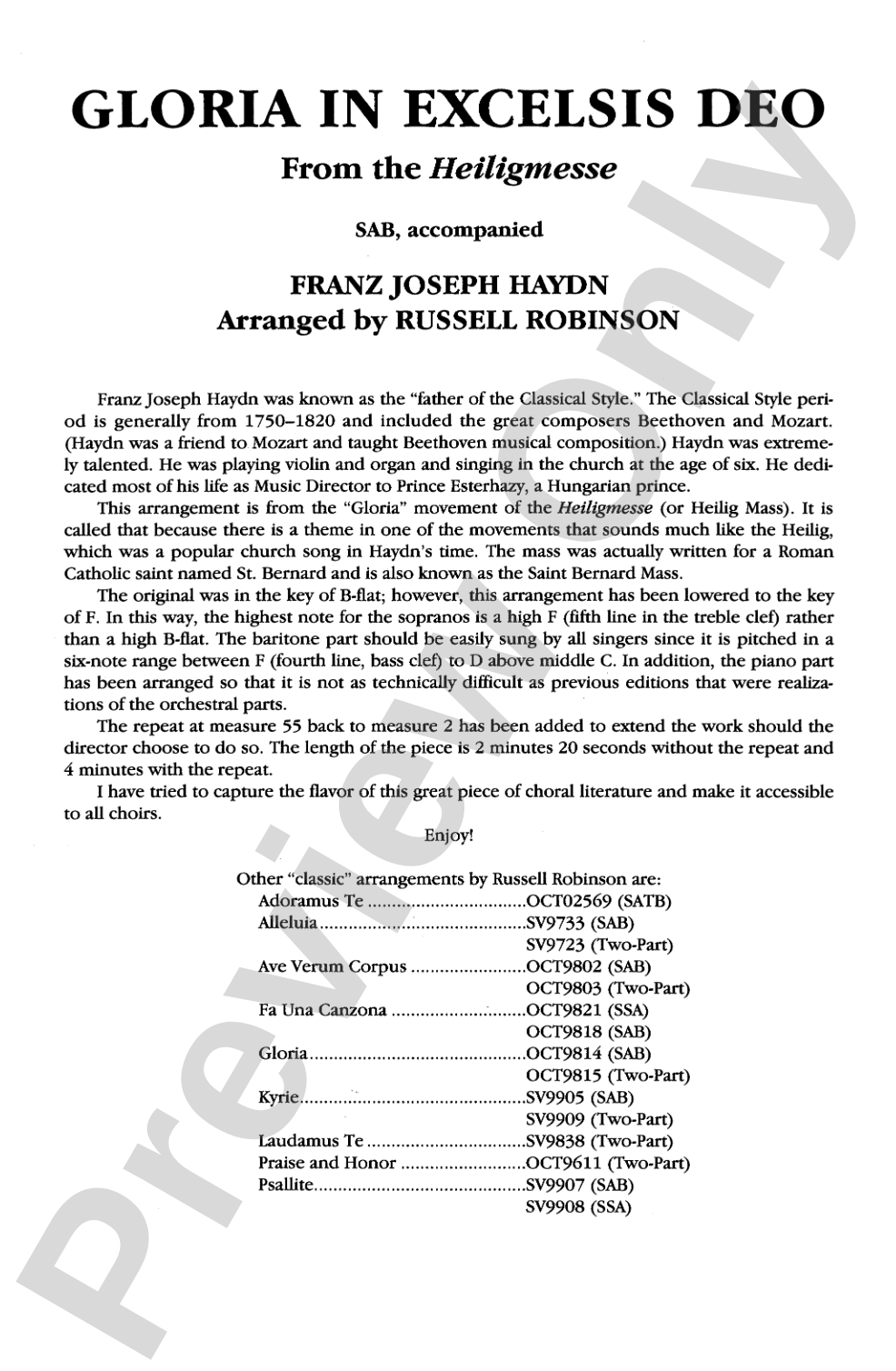
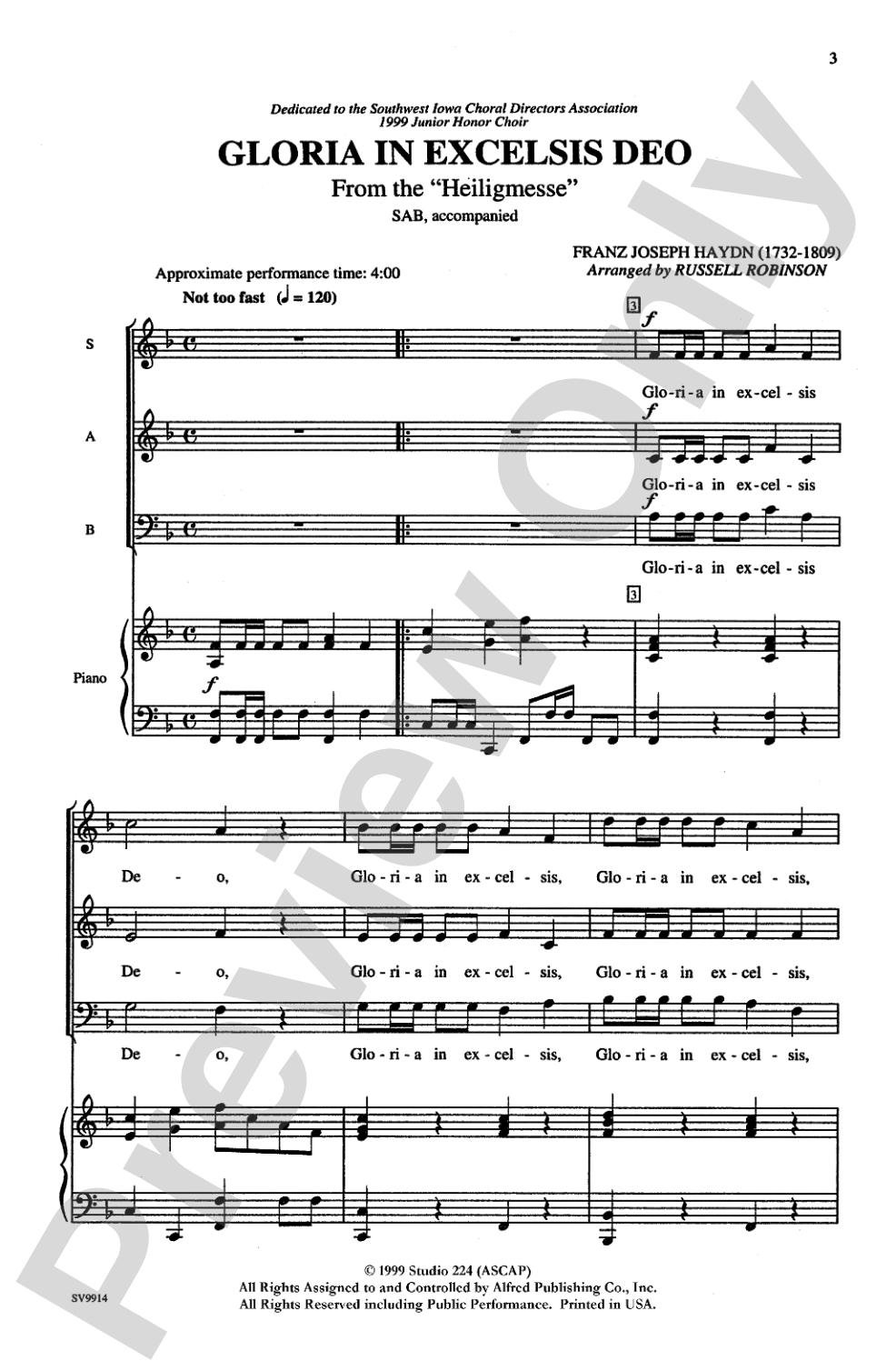
In our new Developing SATB Repertoire series, Russell Robinson has arranged an exciting edition of the famous Haydn "Gloria" from Heiligmesse. Introduce your developing choirs to great choral repertoire with this four-part masterpiece.


Gloria In Excelsis Deo: SAB Choral Octavo isn't in MakeMusic Cloud just yet...but it could be. Let us know you'd like to see it, and you'll help shape what comes next. In the meantime, start a free trial and dive into thousands of interactive titles your students can play along with today.
Request This Title
Tell us you want it.
Start Your Free Trial
Explore everything that's ready to play right now.
Sample Audio
No sample audio found.
Sample Video
No sample videos found.
Additional Details
Series:
Alfred Archive Edition: Studio PR Catalog
Publisher:
Alfred Music
Page Count:
12
SKU:
00-PO-0003077
More about this title
About the Composer: Franz Joseph Haydn
Franz Joseph Haydn (1732-1809) shaped the Classical symphony and string quartet into their modern forms, and his sacred works remain cornerstones of the choral repertoire. Prolific across every genre, Haydn spent nearly three decades as Kapellmeister at the Esterházy court, where he composed masses, motets, and larger sacred works that balanced structural clarity with genuine spiritual warmth.
His Heiligmesse ("Holy Mass") exemplifies his gift for writing music that is both intellectually satisfying and deeply singable. The "Gloria" section in particular showcases Haydn's ability to set liturgical text with energy and dignity, making his sacred music as accessible to developing choirs as it is rewarding for experienced ensembles.
Why we love this
This arrangement opens Haydn's mastery to choirs still building their confidence with four-part writing. Robinson's adaptation honors the original's Classical architecture and celebratory character while making it genuinely singable for SAB voicing, so your students encounter a real masterwork, not a simplified approximation.
What to expect
Jubilant and assured, with the bright ceremonial energy of a Classical-era celebration. The writing sits comfortably in the voice but never loses its sense of occasion; singing it feels like stepping into genuine liturgical tradition rather than performing a children's arrangement.
Who it's for
Developing mixed choirs ready to engage with recognized repertoire from music history rather than simple strophic pieces. This works equally well for middle school ensembles with solid fundamentals and high school choirs seeking accessible but substantial sacred music for festivals or concert settings.
How to get the most out of it
- Shape the text declamation carefully in the fast passages; clarity of diction matters more than pushing the tempo, especially when all three parts move together.
- Balance the parts so the sopranos don't dominate the harmonic foundation. SAB voicing asks altos to carry significant weight, so encourage them to sing with confidence and projection.
- Listen for the interplay between voice parts rather than treating each line as independent. Haydn's voice-leading rewards ensemble cohesion.
- Mark the fermatas and phrase endpoints clearly in rehearsal. Classical-era phrasing often feels more deliberate than modern singers expect, and this clarity elevates the whole arrangement.
How to use it
Program this on a sacred or seasonal concert alongside simpler contemporary arrangements to show your singers the span of what choral music can be. Its manageable length and festival designation make it ideal for spring competition prep or holiday programs seeking a masterwork that doesn't demand advanced technique.
Skills your students will build
- Reading three-part mixed voicing with upper and lower voices maintaining independent lines
- Executing Classical-era phrasing and text declamation in a foreign language
- Balancing parts so middle voices carry harmonic weight in SAB texture
- Recognizing and performing standard liturgical text in a major choral work
- Sustaining ensemble blend across changing harmonic movement