

Gloria In Excelsis Deo: SATB Choral Octavo
By Franz Joseph Haydn / arr. Russell Robinson
Level: Moderate
Item: 00-PO-0005173
$2.25
Minimum order quantity: 20 copies
Pickup currently not available
Description
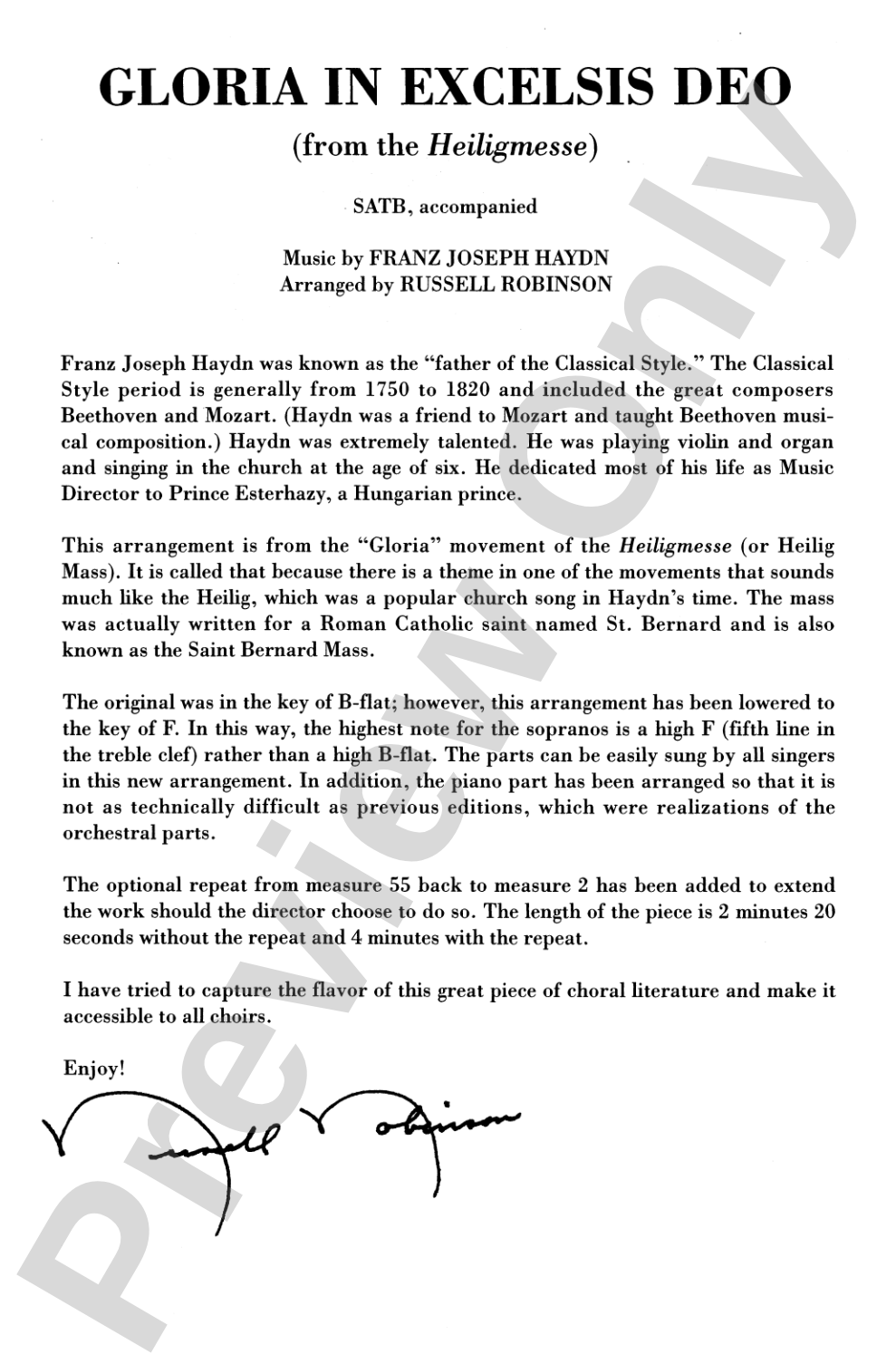
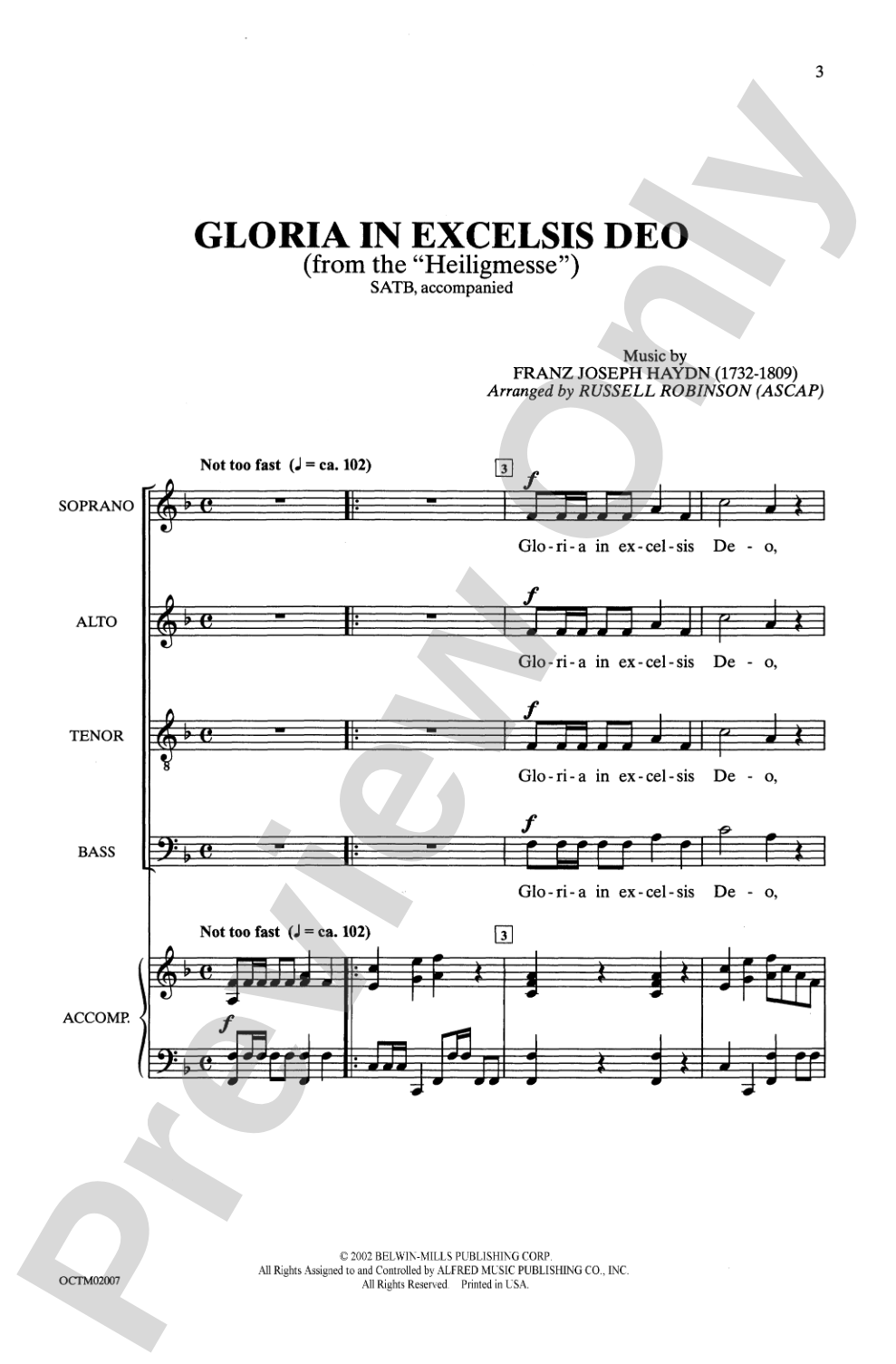
In our new Developing SATB Repertoire series, Russell Robinson has arranged an exciting edition of the famous Haydn "Gloria" from Heiligmesse. Introduce your developing choirs to great choral repertoire with this four-part masterpiece.


Gloria In Excelsis Deo: SATB Choral Octavo isn't in MakeMusic Cloud just yet...but it could be. Let us know you'd like to see it, and you'll help shape what comes next. In the meantime, start a free trial and dive into thousands of interactive titles your students can play along with today.
Request This Title
Tell us you want it.
Start Your Free Trial
Explore everything that's ready to play right now.
Sample Audio
1
Audio File
--:--
0:00
0:00
Sample Video
No sample videos found.
Additional Details
Series:
Alfred Archive Edition: Belwin Sacred Choral Series
Publisher:
Alfred Music
Page Count:
12
SKU:
00-PO-0005173
More about this title
About the Composer: Franz Joseph Haydn
Franz Joseph Haydn (1732-1809) shaped the Classical symphony and string quartet while serving as Kapellmeister for the Esterházy family in Austria. His prolific output spans symphonies, quartets, sonatas, and sacred vocal works that balance formal sophistication with clarity and wit. Haydn's sacred music, including his late masses, demonstrates how intellectual rigor and genuine spiritual expression coexist in the Classical style.
For choral directors, Haydn's works remain foundational repertoire. His melodic gift and transparent orchestration make his pieces accessible to developing singers, while his harmonic language and structural command reward careful rehearsal. The "Heiligmesse" from which this Gloria derives exemplifies Haydn's ability to write music that serves both liturgical function and concert performance.
Why we love this
Russell Robinson's arrangement opens the door to genuine Classical masterwork material for choirs still building four-part security. The Haydn original carries historical weight and musical substance, yet this edition preserves the brilliance of the source without overwhelming developing singers. Programming a Gloria of this caliber signals to your singers and audience that your ensemble engages with repertoire that matters.
What to expect
Luminous and declarative. The Gloria opens with a confident proclamation that recalls both church and concert hall, then unfolds with the clarity that defines Haydn's style. The interplay between voices creates moments of gentle counterpoint and sudden unison emphasis, giving singers the sense of musical conversation rather than mechanical part-singing.
Who it's for
Intermediate-level SATB choirs ready to tackle meaningful repertoire with four authentic voice parts. This arrangement works for developing high school choirs, community choirs strengthening their foundation, and directors seeking contest or festival material that combines accessibility with artistic substance.
How to get the most out of it
- Balance the soprano line without letting it float free from the harmonic support of the lower three parts; Haydn's counterpoint depends on hearing all voices as equal contributors.
- Shape the text naturally through the phrase rather than holding back for drama; Classical style favors forward momentum and natural speech inflection.
- Pay attention to Haydn's dynamic markings as structural signposts; sudden shifts in volume clarify form and keep the familiar text fresh.
- Tune the major chords with care, particularly at cadences where classical proportions reward slight widening of thirds in upper voices.
How to use it
Feature this as a concert centerpiece for a sacred or classical-themed program; its 12 pages and moderate difficulty make it substantial without dominating an evening. Consider pairing it with other Classical-era sacred works to create thematic coherence, or use it as a showcase piece for a competition or festival where judges value both accessibility and repertoire depth.
Skills your students will build
- Reading and executing four-part SATB texture with independent voice lines
- Understanding Classical harmonic progression and authentic cadences
- Singing period-appropriate text expression in English translation
- Balancing individual voice security with blended ensemble sound
- Interpreting dynamic contrast and structural phrasing in formal Classical music