
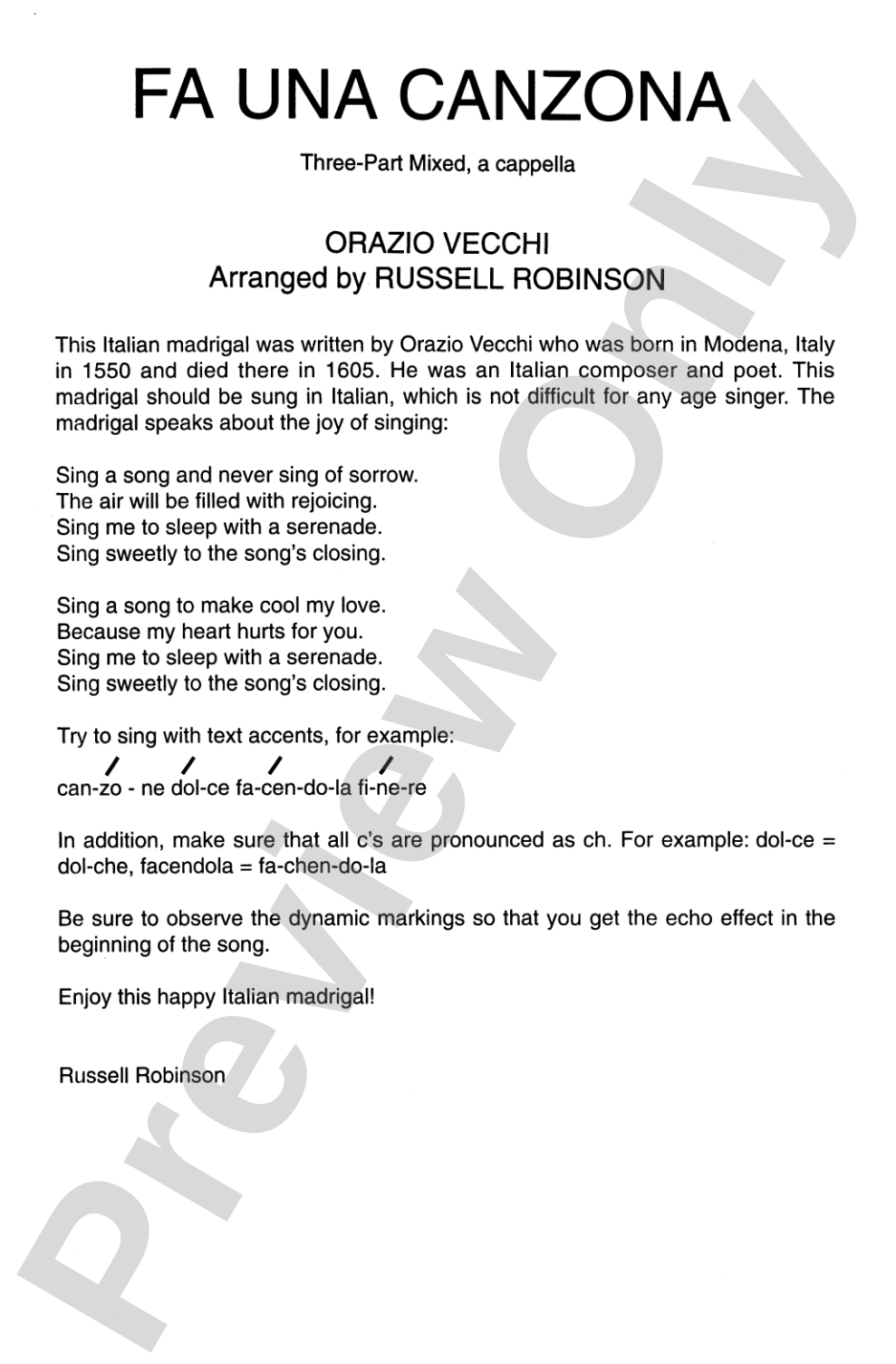

Fa Una Canzona (Sing Now a Song): 3-Part Mixed, a cappella Choral Octavo
(Sing Now Song)
By Orazio Vecchi / arr. Russell Robinson
Item: 00-PO-0003045

$1.95
Minimum order quantity: 20 copies
Pickup currently not available
Related Items
Fa Una Canzona (Sing Now a Song): SATB, a cappella Choral Octavo |
$2.25
|
View | |
Fa Una Canzona (Sing Now a Song): SSA, a cappella Choral Octavo |
$2.25
|
View | |
Fa Una Canzona: SATB, a cappella Choral Octavo |
$2.25
|
View | |
Fa Una Canzona: SSA, a cappella Choral Octavo |
$2.25
|
View | |
Fa Una Canzona: 3-Part Mixed, a cappella Choral Octavo |
$1.95
|
View |
Description
The most famous of all fifteenth century Italian madrigals is brought to life in this new Russell Robinson edition from our Developing SATB Repertoire series. Both English and Italian texts are included.


Don't just read it, hear it, play along with it, and watch your students grow with it. In MakeMusic Cloud, Fa Una Canzona (Sing Now a Song): 3-Part Mixed, a cappella Choral Octavo comes alive with professional accompaniment, adjustable tempo, and built-in practice tools that turn solo practice into real progress.
Open in the Player
Jump straight in and assign it today.
Start Your Free Trial
Open this title and explore the full library in minutes.
Sample Audio
1
Audio File
--:--
0:00
0:00
Sample Video
No sample videos found.
Additional Details
Series:
Alfred Archive Edition: Belwin Festival Series
Publisher:
Alfred Music
Page Count:
4
SKU:
00-PO-0003045
More about this title
About the Composer: Orazio Vecchi
Orazio Vecchi (1550-1604) was an Italian composer and maestro di cappella whose madrigals defined the secular vocal music of the late Renaissance. Working in Modena and other northern Italian cities, he became known for crafting works that balanced textual clarity with expressive harmonic language, making him a bridge between the strict polyphonic traditions and the emerging expressive ideals of early Baroque music.
Why we love this
Russell Robinson's arrangement opens this celebrated madrigal to three-part choirs without sacrificing its harmonic richness or historical character. The piece works beautifully for developing ensembles because it teaches Renaissance counterpoint through singable, rewarding lines while remaining short enough to learn and polish in a few rehearsals.
What to expect
The music sparkles with the playful, conversational quality that defines Italian madrigals; voices dance in and out, creating moments of harmonic warmth followed by lighter textures. There is both directness and elegance here, a sense of musical storytelling that feels intimate even in a choral setting.
Who it's for
This arrangement serves developing mixed choirs looking to build confidence with Renaissance repertoire without the complexity of full SATB writing. High school and community choirs will find it accessible yet substantial enough to perform at contests or festivals.
How to get the most out of it
- Shape each phrase as a complete thought rather than counting syllables; the Italian text naturally guides phrasing if you follow the sung vowels.
- Balance the three parts so no single voice dominates; in madrigals, the dialogue between voices matters as much as any individual line.
- Take time with text underlay between the English and Italian versions during rehearsal to ensure singers understand where each text begins and how the word painting supports the music.
How to use it
Program this as an elegant contrast to contemporary works or to anchor a Renaissance-focused concert set. Its brevity and cappella format make it ideal for festival competitions or as an opening piece that establishes musical sophistication early in a program.
Skills your students will build
- Reading and performing Renaissance polyphonic texture
- Managing two text languages in a single score
- Balancing independent melodic lines while maintaining ensemble cohesion
- Phrasing according to text and harmonic rhythm rather than measure lines