
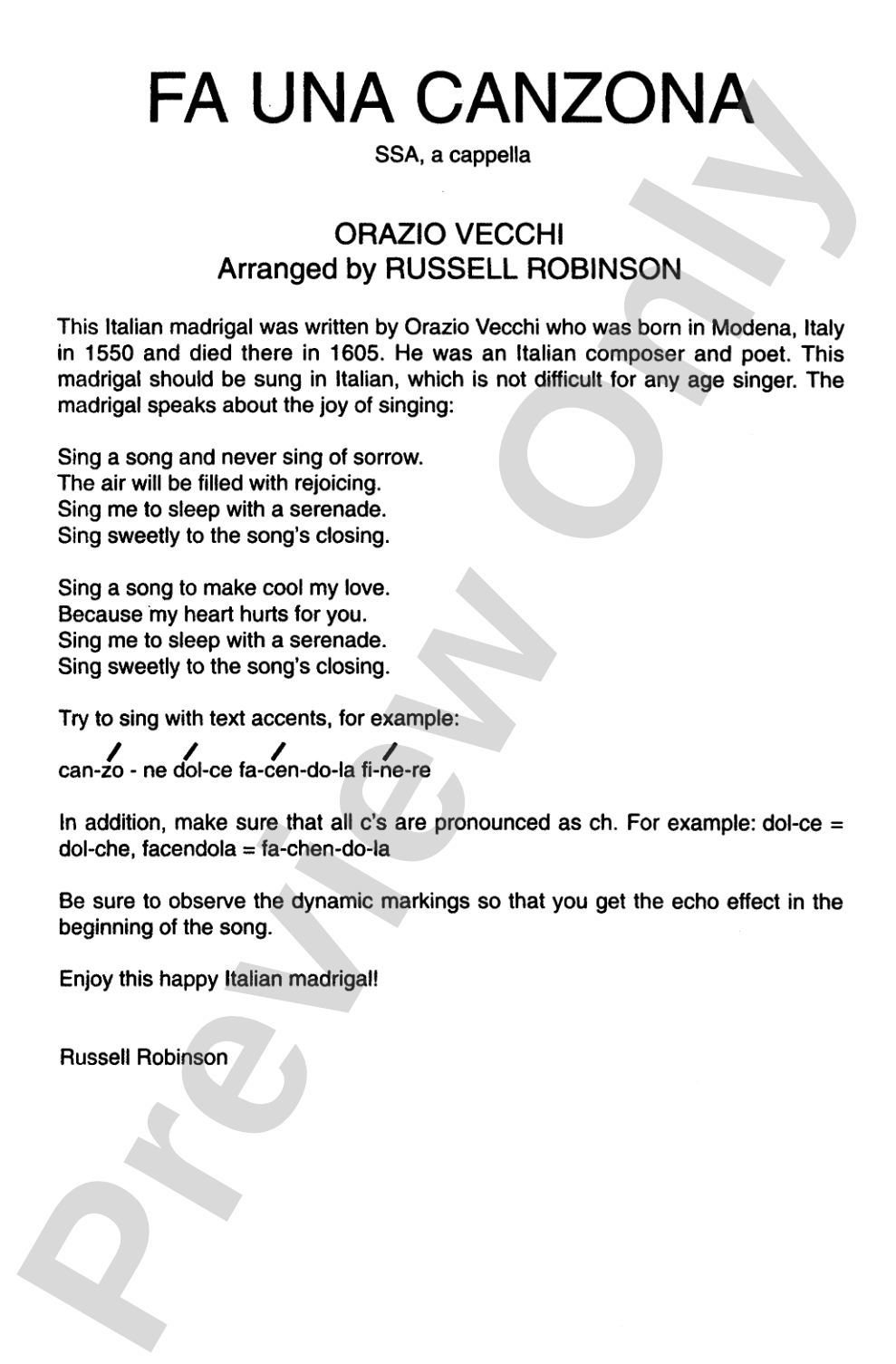

Fa Una Canzona (Sing Now a Song): SSA, a cappella Choral Octavo
(Sing Now Song)
By Orazio Vecchi / arr. Russell Robinson
Item: 00-PO-0002705

$2.25
Minimum order quantity: 20 copies
Pickup currently not available
Related Items
Fa Una Canzona (Sing Now a Song): SATB, a cappella Choral Octavo |
$2.25
|
View | |
Fa Una Canzona (Sing Now a Song): 3-Part Mixed, a cappella Choral Octavo |
$1.95
|
View | |
Fa Una Canzona: SATB, a cappella Choral Octavo |
$2.25
|
View | |
Fa Una Canzona: SSA, a cappella Choral Octavo |
$2.25
|
View | |
Fa Una Canzona: 3-Part Mixed, a cappella Choral Octavo |
$1.95
|
View |
Description
The most famous of all fifteenth century Italian madrigals is brought to life in this new Russell Robinson edition from our Developing SATB Repertoire series. Both English and Italian texts are included.


Don't just read it, hear it, play along with it, and watch your students grow with it. In MakeMusic Cloud, Fa Una Canzona (Sing Now a Song): SSA, a cappella Choral Octavo comes alive with professional accompaniment, adjustable tempo, and built-in practice tools that turn solo practice into real progress.
Open in the Player
Jump straight in and assign it today.
Start Your Free Trial
Open this title and explore the full library in minutes.
Sample Audio
1
Audio File
--:--
0:00
0:00
Sample Video
No sample videos found.
Additional Details
Series:
Alfred Archive Edition: Belwin Festival Series
Publisher:
Alfred Music
Page Count:
4
SKU:
00-PO-0002705
More about this title
About the Composer: Orazio Vecchi
Orazio Vecchi (1550-1605) was an Italian composer and maestro di cappella whose madrigals and secular vocal works defined the sophistication of late Renaissance music. His ability to craft elegant vocal lines and emotional depth within the constraints of the madrigal form made him one of the most performed composers of his era, and his works remain central to understanding Renaissance vocal music.
Vecchi's compositional legacy rests on his gift for setting text with both musical and dramatic clarity. His madrigals balance accessibility with artistry, making them equally valuable for study and performance in educational settings.
Why we love this
This arrangement captures one of the Renaissance's most enduring melodies while making it genuinely singable for developing choirs. Robinson's edition respects the historical context of the madrigal while providing clear, modern notation and both Italian and English texts, letting singers connect with the poetry that originally drove this music.
What to expect
Elegant and unhurried, with the warm sonority of three voices blending in close harmony. There's a lyrical quality to the melodic line that feels both timeless and intimate, drawing the listener into the gentle celebration at the song's heart.
Who it's for
High school, early college, and community choirs with solid part-singing skills and comfort with Renaissance harmonic language will find this piece both accessible and rewarding. The SSA voicing works well for treble-focused ensembles while remaining standard enough to fit into festival and competition programming.
How to get the most out of it
- Approach the a cappella texture as an opportunity to shape phrase breathing together. Without instrumental support, intentional breath placement becomes part of your interpretive voice.
- Balance the three voice parts so the uppermost line carries the melody's contour without drowning out the harmonic foundation below it.
- Work the text as separate entities. Rehearse the Italian version and English version independently until each word naturally aligns with its musical line, then transition between languages cleanly.
- Listen for moments where the vocal lines move in similar motion versus contrary motion. These shifts in texture are what give a Renaissance madrigal its shape and momentum.
How to use it
Program this as a centerpiece for a Renaissance or secular vocal concert, or pair it with other madrigals for a thematic exploration of fifteenth and sixteenth century vocal writing. It also works beautifully in a contest or festival setting where its musical sophistication and historical significance stand out.
Skills your students will build
- Renaissance harmonic language and voice leading
- Intonation in close harmonic textures without instrumental support
- Bilingual text underlay and interpretation (Italian and English)
- Balancing independent melodic lines within small ensemble voicing
- Understanding madrigal form and secular vocal traditions