

Fa Una Canzona (Sing Now a Song): SATB, a cappella Choral Octavo
(Sing Now Song)
By Orazio Vecchi / arr. Russell Robinson
Level: Moderately Easy
Item: 00-PO-0002710
$2.25
Minimum order quantity: 20 copies
Pickup currently not available
Related Items
Fa Una Canzona (Sing Now a Song): SSA, a cappella Choral Octavo |
$2.25
|
View | |
Fa Una Canzona (Sing Now a Song): 3-Part Mixed, a cappella Choral Octavo |
$1.95
|
View | |
Fa Una Canzona: SATB, a cappella Choral Octavo |
$2.25
|
View | |
Fa Una Canzona: SSA, a cappella Choral Octavo |
$2.25
|
View | |
Fa Una Canzona: 3-Part Mixed, a cappella Choral Octavo |
$1.95
|
View |
Description
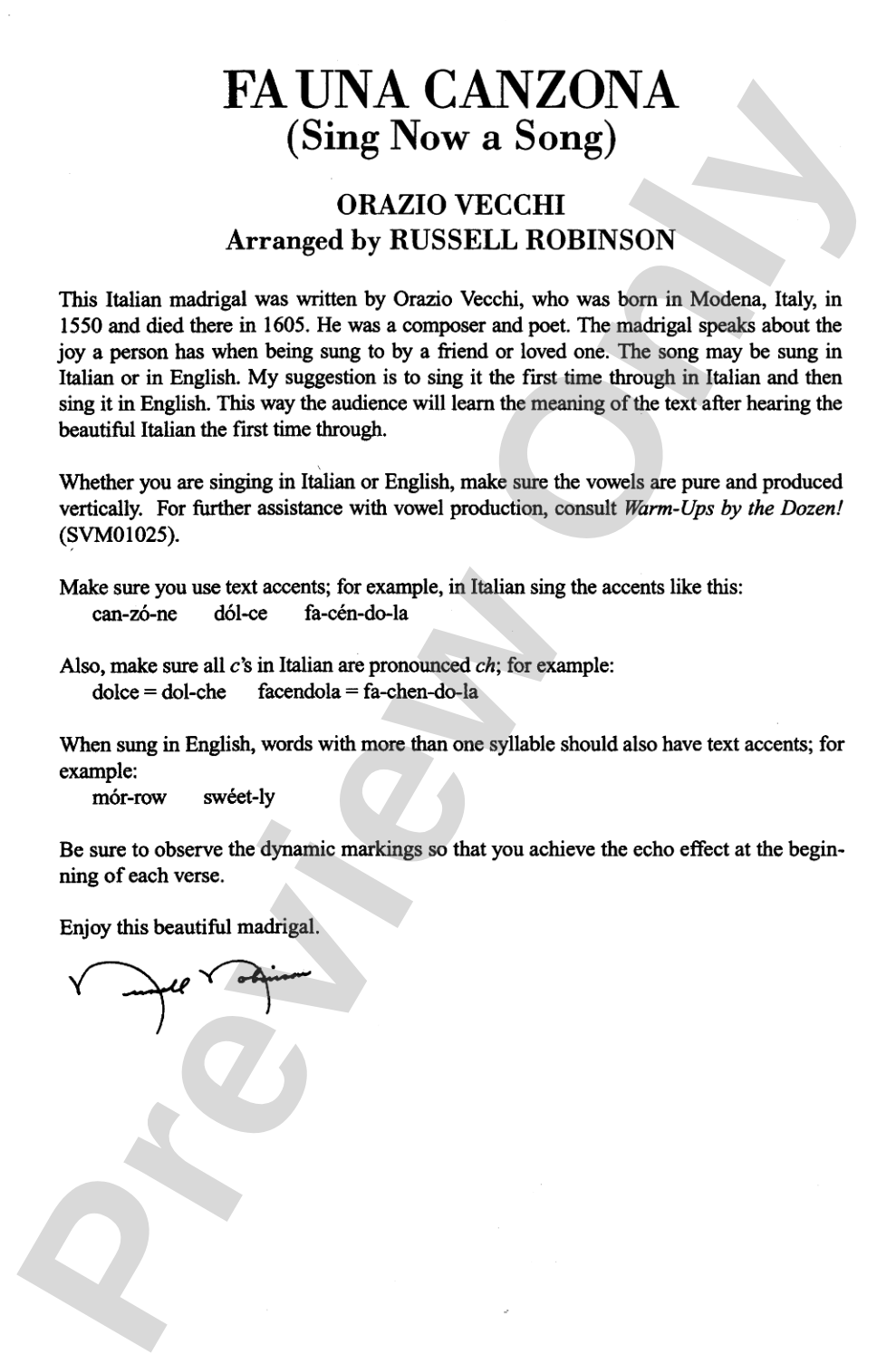
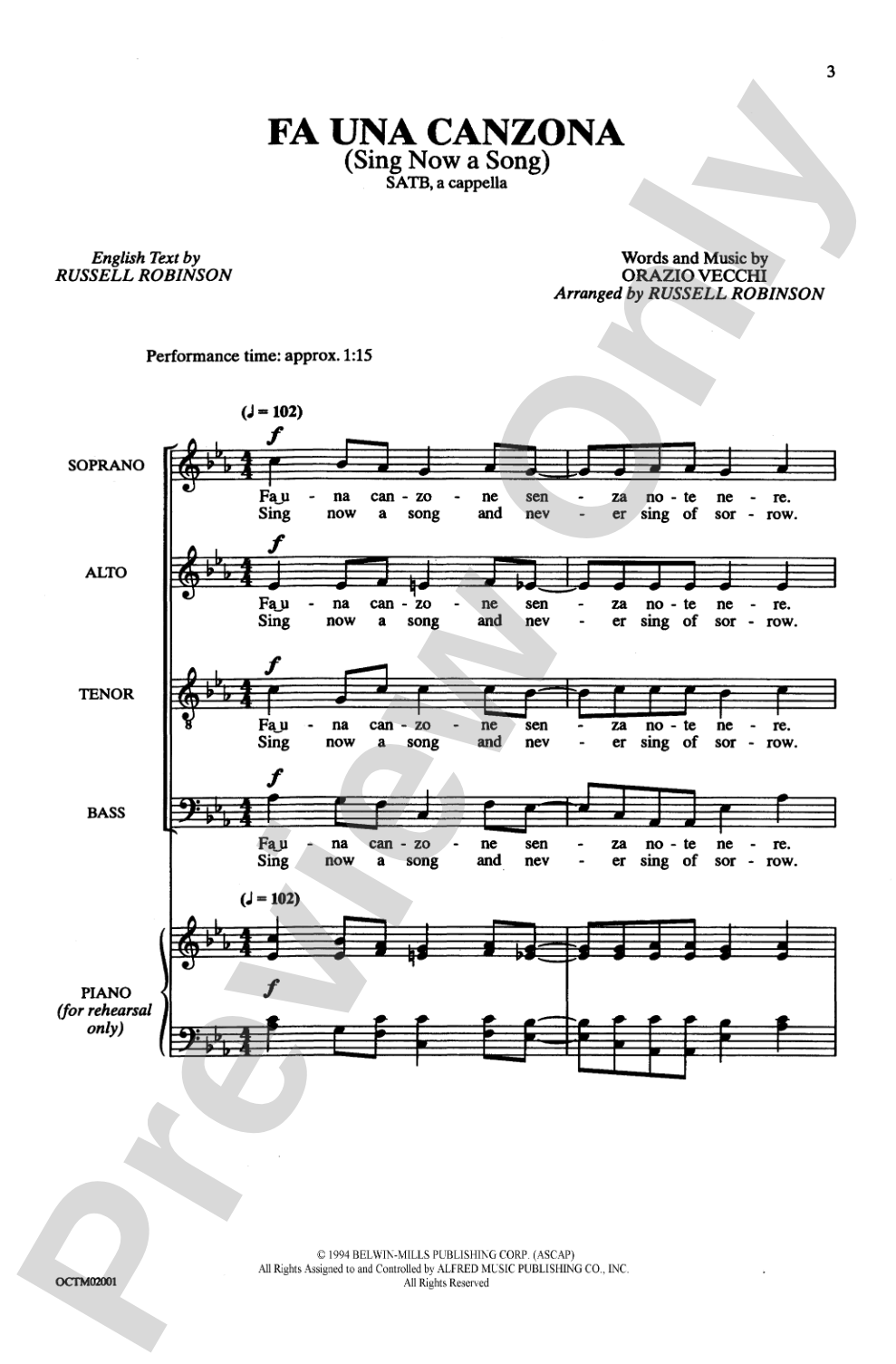
The most famous of all fifteenth century Italian madrigals is brought to life in this new Russell Robinson edition from our Developing SATB Repertoire series. Both English and Italian texts are included.


Fa Una Canzona (Sing Now a Song): SATB, a cappella Choral Octavo isn't in MakeMusic Cloud just yet...but it could be. Let us know you'd like to see it, and you'll help shape what comes next. In the meantime, start a free trial and dive into thousands of interactive titles your students can play along with today.
Request This Title
Tell us you want it.
Start Your Free Trial
Explore everything that's ready to play right now.
Sample Audio
1
Audio File
--:--
0:00
0:00
Sample Video
No sample videos found.
Additional Details
Series:
Alfred Archive Edition: Belwin Mills Catalog
Publisher:
Alfred Music
Page Count:
12
SKU:
00-PO-0002710
More about this title
About the Composer: Orazio Vecchi
Orazio Vecchi (1550-1605) was a master of the Italian madrigal and one of the most prolific composers of the late Renaissance. Working primarily in Modena, he combined sophisticated counterpoint with direct emotional expression, earning him recognition as one of the era's finest madrigal composers. His output includes over 200 madrigals, many of which became models for composers across Europe.
Vecchi's gift for writing memorable melodic lines and achieving clarity within polyphonic texture made his madrigals accessible without sacrificing artistic depth. His works remain essential to understanding how the Renaissance madrigal evolved from purely vocal experimentation into a fully realized artistic form.
Why we love this
This is genuine Renaissance repertoire at a level where young singers can actually achieve musical success. Robinson's edition respects the original while providing the textual clarity and voicing transparency that Grade 2 SATB choirs need. You'll find your singers engaging with authentic counterpoint and genuine madrigal style rather than simplified imitations.
What to expect
The music breathes with the gentle conversation of Renaissance Italy. Lines weave together with elegant simplicity, creating moments of surprising harmonic richness that emerge from pure vocal counterpoint. Singing this madrigal feels like joining an intimate musical gathering where everyone's voice matters.
Who it's for
Grade 2 SATB choirs ready to explore authentic Renaissance repertoire without getting lost in technical complexity. This works equally well for concert choirs, contest/festival preparation, and singers who want to experience madrigal singing as an ensemble art form rather than as soloists.
How to get the most out of it
- Shape each phrase with the text as your guide. The Italian underlay reveals the natural arc of the music; let it direct your phrasing and dynamic contours.
- Balance the voice parts so the soprano line sings clearly without the altos and tenors disappearing. Renaissance polyphony lives when every strand of color is audible.
- Encourage singers to listen horizontally within their own line first, then vertically to the other parts. This builds independence and true ensemble awareness.
- Consider performing both the Italian and English versions across different concerts. Each text brings its own character and can deepen singers' connection to the music.
How to use it
Pair this with other madrigals or Renaissance choral works to build a thematic concert, or use it as a centerpiece for a "Madrigal Dinner" style event. Its moderate difficulty and bilingual text make it ideal for educational programming or as a bridge piece between lighter contemporary repertoire and more demanding classical works.
Skills your students will build
- Renaissance harmonic language and cadential patterns
- Independent vocal line reading within four-part polyphony
- Text expression in two languages (Italian and English)
- Balancing blend and clarity in a cappella singing
- Madrigal style and historical performance awareness